






SleekPixel for home stagers: before/after Instagram cards
Days on market, sold-over-asking percentage, room type, palette, listing agent credit. The data you already record for each staging project becomes a 1080 by 1080 Instagram card with before and after photos and the trust signals agents look for.
♾️ Lifetime License available
From project record to social proof in one save
Home stagers run on referrals from listing agents. The pitch is always the same: 'Stage the property, sell it faster, sell it for more.' The best proof of that pitch is the last project you finished, which had a real sold price and a real days-on-market count. The worst thing a stager can do is post that proof inconsistently or weeks after the fact when the agent has moved on.
SleekPixel reads the project post stored in WordPress. before_image and after_image attachments composite into a 1080 by 1080 card. days_on_market, sold_delta_percent, listing_agent, and room_type render as overlay callouts. The studio handle, project number, and city anchor the footer. The card publishes the day the sale closes, while the agent's brokerage is still talking about the win.
The result is a stream of social proof timed to the moments that matter. Agents see the before, the after, the days on market, and the sold delta in a single thumb-stop on their feed. The stager's pipeline fills with referrals because the proof is constant, on time, and visually consistent.
Workflow
From staged to posted in four steps
Define the staging project post type
Design the 1080 by 1080 card
Connect the closing data fields
{days_on_market} and {sold_delta_percent} into the overlays. Listing agent maps to a footer credit and a caption tag.
Publish on closing day
Output
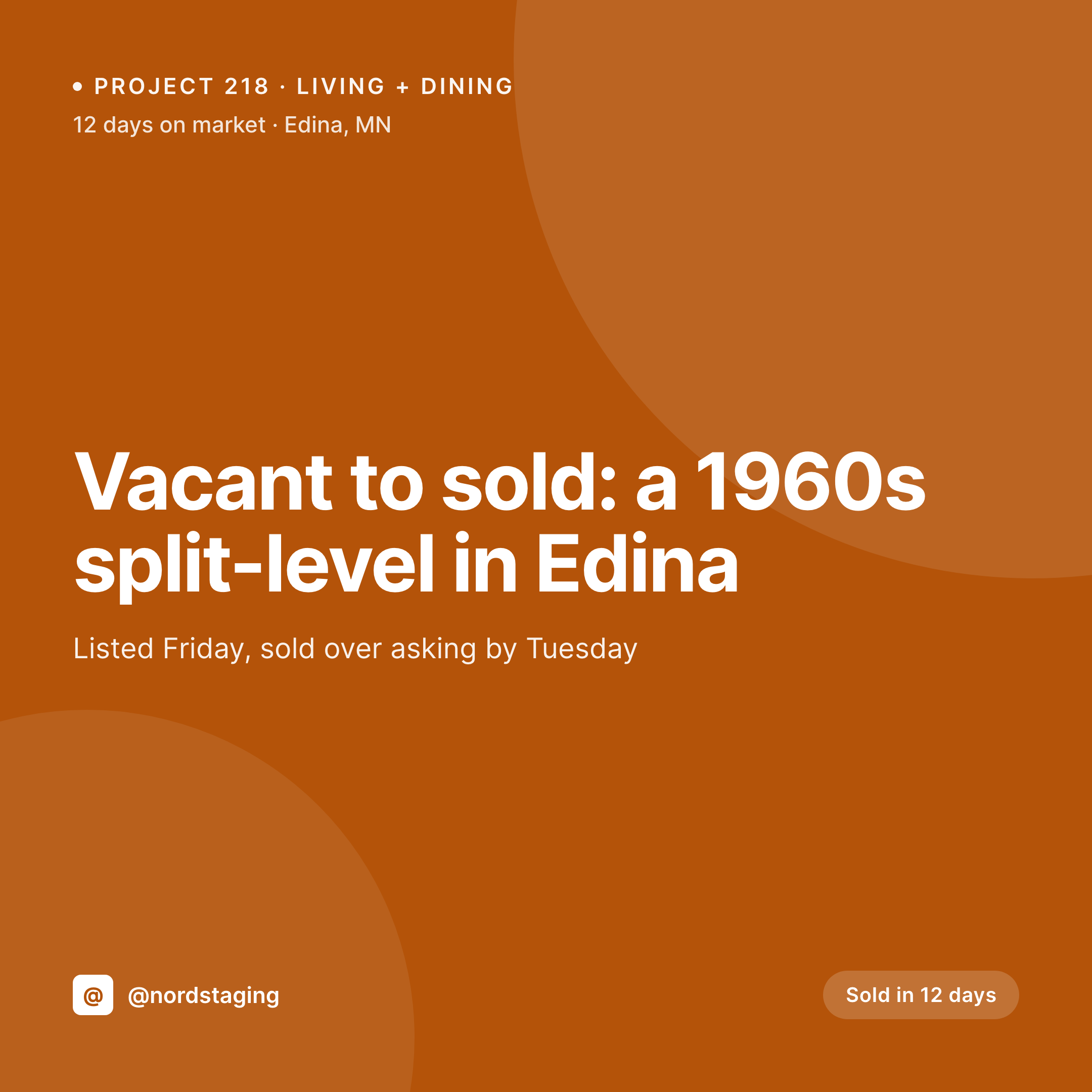
Sample Edina split-level staging card
Instagram-feed sized 1080x1080 card from one staging project post, showing before and after, days on market, sold delta, and the listing agent credit.

Comparison
Manual staging posts vs SleekPixel for home stagers
Stager's Canva template
- Each closing means another Canva session to assemble a post by hand
- Days-on-market and sold delta retyped from MLS notes, with typos
- Before/after layouts drift between projects, breaking studio identity
- Listing agent's name forgotten on half the posts, damaging the referral
- Posts go up two weeks late, after the agent has moved to the next listing
SleekPixel
- Before and after photos composite automatically from project post fields
- Days on market, sold delta, and listing agent render as overlay callouts
- Studio handle, project number, and city anchor the footer for brand recognition
- Instagram-native 1080 by 1080 dimensions enforced at render time
- Bulk regenerate brings the entire archive up to current brand standards
Features
What SleekPixel gives you for home stager
Days-on-market badge
The days_on_market field renders as a top-right badge with green for under-14 sales. Agents see the result before they read the caption, which is exactly how Instagram is consumed.
Sold-over-asking callout
sold_delta_percent renders as a percentage callout on the after photo. The before photo carries the list price for context. Together they tell the whole story in two numbers.
Listing agent credit
listing_agent and brokerage render in the footer band. The agent gets tagged in the post caption automatically, which compounds the referral loop without manual effort.
Use cases
Where this fits a home staging business
Solo stagers
One stager with a warehouse and a moving crew cannot also be a social media manager. Template-driven cards turn each closing into a post automatically.
Stager and agent partnerships
Repeat agent partnerships deepen when the agent gets tagged in a polished post every closing. The referral relationship becomes a content engine.
Multi-warehouse staging companies
Larger staging firms with city teams render each closing under the local handle while keeping a national brand identity, all from the same template.
The bigger picture
Why staging proof is a perishable asset
Stagers compete for the next listing on the strength of the last sale. The window in which that proof lands is short. Within two weeks of the sold closing, the agent has moved to the next property, the seller has moved out, and the comp data has aged into a background number.
Posting a before-and-after that week is the difference between the agent recommending the stager on their next pitch and the agent moving on. The pattern that wins is consistent posting timed to closings, with the days-on-market and sold-delta surfaced in the image itself. Most stagers know this and try to maintain the pattern by hand.
Three weeks into a busy spring market, the design backlog has eaten the consistency. Posts go up late or not at all. The proof loop breaks.
Template-driven cards solve the operational problem. The project post already exists, the fields are already populated, the closing is the trigger that fires the render. The stager spends thirty seconds approving the card instead of two hours building it.
The referral loop stays intact through the busy season, which is the season where most of the year's revenue lives.
Questions
Common questions about SleekPixel for home stager
Not directly. MLS integration depends on the local board's policies. You enter the days on market, list price, and sold price on the project post once the sale closes. SleekPixel reads from those fields, not from the MLS feed itself.
The before_image field stores the pre-staging photo. Some stagers store two: a seller's listing photo and a staged listing photo. A comparison_type field can pick which pair drives the composite.
Yes. Add a photographer field. The footer band has room for both credits, and the caption template can tag both Instagram handles automatically.
The sold-delta callout hides itself when the value is zero or negative. The card focuses on days-on-market or list-versus-sold dollar amount instead, depending on the template fallback rule.
Yes. Rental staging needs different signals: occupancy rate, nightly rate, booking lead time. Build a parallel template that pulls from rental-specific fields like occupancy_lift_percent and the same engine renders the cards.
The card renders on save. Posting timing is up to you. A scheduling tool like Later or Buffer can pull the rendered image from the project post URL and queue it for the day the closing makes public.
Yes. A separate template variant focuses on warehouse inventory rather than staged-in-place. A field like card_variant with values 'closing', 'inventory', 'process' routes to the right template per project.
Yes. The card re-renders on any field update. If the sold delta corrects after closing, save the project post and the new card replaces the old in the post sidebar, ready to repost.
Pricing
More than 1000+
happy customers
Explore our flexible licensing options tailored to your needs. Upgrade your license anytime to access more features, or opt for a lifetime license for ongoing value, including lifetime updates and lifetime support. Our hassle-free upgrade process ensures that our platform can grow with you, starting from whichever plan you choose.
Lifetime ♾️
Most popular
EUR
once
- Unlimited websites
- Lifetime updates
- Lifetime support
...or get the Bundle Deal
and save €250 🎁
The Bundle (unlimited sites)
Pay once, own it forever
Elevate your WordPress site with our exclusive plugin bundle that includes all of our premium plugins in one package. Enjoy lifetime updates and lifetime support. Save significantly compared to buying plugins individually.
What’s included
-
SleekAI
-
SleekByte
-
SleekMotion
-
SleekPixel
-
SleekRank
-
SleekView
€749
Continue to checkoutBrowse more
- Mastodon link previews
- Lemon Squeezy product covers
- YouTube Music cover art
- Twitch profile banner
- Amazon Storefront banners
- Threads post images
- Pinterest pins
- Dribbble shot covers
- podcast cover art
- Discord stage banner
- Bluesky link cards
- TikTok profile banners
- Twitch starting soon screen
- VSCO cover
- Substack post headers