






SleekPixel for LiteSpeed Cache crawler tune-ups
LiteSpeed Cache (LSCWP) pairs with LiteSpeed servers and QUIC.cloud for page caching, image optimization, and crawler-warmed cache. The tune-up posts get a SleekPixel card with the cache-hit shape, the crawler state, and a brand mark, drawn from safe configuration options.
♾️ Lifetime License available
LSCWP tune-ups deserve crawler-shaped share cards
LiteSpeed Cache stores configuration in options keyed under litespeed.conf., with values for cache mode, browser cache TTL, ESI rules, image optimization, the QUIC.cloud bridge, and the crawler schedule. Operational data lives in custom tables: wp_litespeed_crawler tracks the crawler queue and per-URL warm state, wp_litespeed_img_optm tracks the image optimization queue. The configuration is safe to expose at a summary level. The crawler queue and image-optim tables are operational and never belong on a public share.
LSCWP tune-up posts document the cache-hit shape after a tune sprint. A 96 percent cache-hit rate, a fully warmed crawler queue, and a QUIC.cloud bridge active are concrete signals that the tune worked. The audience for these posts is performance engineers and site owners on LiteSpeed hosting. A generic homepage banner makes the tune-up look like a marketing post. A real crawler-and-cache card communicates the LiteSpeed work directly in the preview.
SleekPixel binds to a tune-recap post type with fields for cache-hit rate, crawler state, period, and summary. A whitelisted subset of the litespeed.conf options renders as small posture badges: QUIC.cloud bridged, image optim active, ESI in use. The render produces a 1200x630 PNG that surfaces the cache shape and the bridge posture.
Workflow
From LSCWP data to crawler-shaped card
Set up the tune-recap post type
Whitelist safe LSCWP options
Bind template fields
Publish or update the post
Output
Sample LSCWP tune-up card
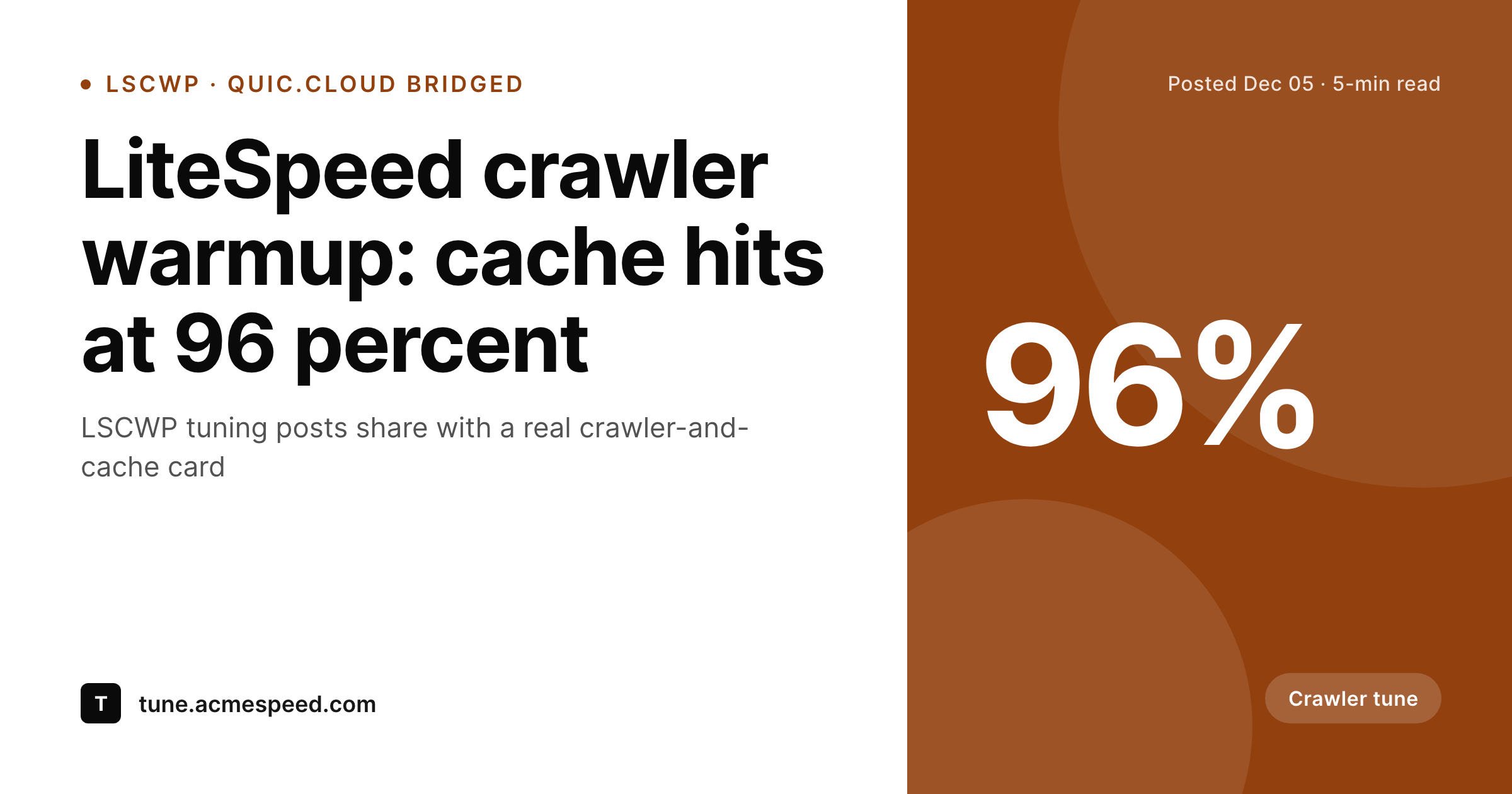
A 1200x630 OG card from a LiteSpeed Cache recap: cache-hit rate, crawler-state badge, QUIC.cloud bridge label, brand mark, and a tune-period meta line.
Comparison
Default theme OG vs SleekPixel for LiteSpeed Cache
Default theme OG image
- LSCWP tune-up posts share with the same banner as any marketing post
- Cache-hit rate and crawler state never appear in the social preview
- QUIC.cloud bridge posture stays invisible to anyone forwarding the link
- Manual exports of crawler graphics stop happening after the first quarter
- Performance engineers see no concrete signal in the share preview
SleekPixel
-
Reads whitelisted state from the
litespeed.conf.options at render time -
Operational tables in
wp_litespeed_crawlerstay outside the template - Cache-hit rate rendered at a rounded percentage on the share card
- Crawler-state badge for warmed, warming, and idle states
- Per-tune-up variants for initial config, sprint tune, and audit recap posts
Features
What SleekPixel gives you for LiteSpeed Cache
Cache-hit-rate card
The rounded cache-hit rate is the focal point on the LSCWP tune-up card. Big numerals on the left, the crawler-state badge on the right, the brand mark at the bottom. The cache posture is legible from the preview before the click.
QUIC.cloud bridge badge
When the QUIC.cloud bridge is active, a small badge renders on the card to communicate the edge-side posture. The badge respects the actual configuration and stops rendering when the bridge is disabled on subsequent saves.
Crawler-state visuals
Warmed, warming, and idle states each render with a distinct accent so a reader scanning a feed can tell at a glance which state the post represents. The crawler queue itself stays operational and outside the template.
Use cases
Where LSCWP sites benefit from cache shares
Agency LiteSpeed-host recaps
Agencies running LiteSpeed-hosted client sites publish per-client tune-up recaps. The card surfaces the cache shape and the QUIC.cloud posture for procurement-grade evidence.
Internal performance audits
Periodic internal audits of the LSCWP setup publish recap posts with the cache-hit shape and the crawler state. The card surfaces the audit shape for leadership forwards.
Optimization tutorial posts
How-to posts on configuring LSCWP get a tutorial card with the recommended posture as a sample. The visual signals the technical nature of the guide before the click.
The bigger picture
Why LSCWP tune-ups need cache-shaped shares
LiteSpeed-hosted sites get most of their performance from the LiteSpeed server stack and the LSCWP plugin. Tune-up posts document the work and the resulting cache shape, and the share preview is what lands in Slack and email when the link gets forwarded. A generic homepage banner reads as a marketing post.
A real cache card with the hit rate, the crawler state, and the QUIC.cloud bridge posture reads as concrete performance evidence. The audience cares about the specifics. Performance engineers responding to a forwarded link want to see the cache shape in the preview itself, not after the click.
The compounding effect shows up in the back catalog. A year of tune-up recaps, each with a consistent cache card, becomes evidence for procurement and prospective clients evaluating LiteSpeed-hosted setups. The visual consistency across the catalog signals operational maturity.
LSCWP provides the configuration through safe options. SleekPixel takes those options, binds them through a whitelist, and renders the cards that turn the underlying LSCWP work into visible cache evidence across every tune.
Questions
Common questions about SleekPixel for LiteSpeed Cache
No. The crawler queue lives in wp_litespeed_crawler and is operational. SleekPixel only reads whitelisted summary state from the litespeed.conf. options. The crawler queue and per-URL warm state stay outside any template binding.
Counts at a rounded magnitude are technically available through a custom binding, but most teams prefer to keep the image-optim queue off public share cards. The 'image optim active' badge is the safe alternative and communicates the posture without leaking volume.
Partially. LSCWP can run on non-LiteSpeed hosting with reduced functionality (no full-page server cache, no ESI). The configuration options still expose the WordPress-side toggles, which is what the card reads. The cache-hit rate value typically reflects the QUIC.cloud bridge in that setup.
Image optim runs through QUIC.cloud when the bridge is active. The 'image optim active' and 'QUIC.cloud bridged' badges communicate the posture. The actual image optim runs in the background outside of any share-render path.
Yes. Initial setup, sprint tune, audit recap, and emergency optimization each use a tune-type-specific template variant. The selection is bound to the tune-type field on the post, so editors pick the kind and the right design renders.
No. The cache purge runs on post save through LSCWP's hooks. SleekPixel runs on the same save event but writes to uploads, not to the cache directory. The two operations are independent and do not interfere with each other.
Yes, as a small meta line tied to a whitelisted value. The server version is exposed in the configuration summary on the WordPress side and renders alongside the other meta on the card. Editors do not need to type the version manually.
Yes. The ESI active flag is exposed through the whitelist and renders as a small 'ESI' badge on the card. ESI-active sites get a posture indicator that signals the more advanced cache configuration to performance-aware readers.
Pricing
More than 1000+
happy customers
Explore our flexible licensing options tailored to your needs. Upgrade your license anytime to access more features, or opt for a lifetime license for ongoing value, including lifetime updates and lifetime support. Our hassle-free upgrade process ensures that our platform can grow with you, starting from whichever plan you choose.
Lifetime ♾️
Most popular
EUR
once
- Unlimited websites
- Lifetime updates
- Lifetime support
...or get the Bundle Deal
and save €250 🎁
The Bundle (unlimited sites)
Pay once, own it forever
Elevate your WordPress site with our exclusive plugin bundle that includes all of our premium plugins in one package. Enjoy lifetime updates and lifetime support. Save significantly compared to buying plugins individually.
What’s included
-
SleekAI
-
SleekByte
-
SleekMotion
-
SleekPixel
-
SleekRank
-
SleekView
€749
Continue to checkoutBrowse more
- Mailchimp email banner
- Instagram stories
- X list banners
- Telegram bot avatar
- Buy Me a Coffee banners
- Threads profile banners
- Threads story-style images
- Kick channel banners
- Beacons.ai banner
- Instagram Reels covers
- SoundCloud track art
- Apple Podcasts covers
- Stan Store cover
- X community banners
- Ko-fi shop images