






SleekPixel for LuckyWP Table of Contents sites
LuckyWP Table of Contents parses headings into a nested tree and stores it in wp_postmeta under the lwptoc_items key. SleekPixel reads the tree depth, counts top-level chapters and nested subsections, and renders a card that signals reference scope on the share preview.
♾️ Lifetime License available
Reference-grade posts deserve a reference-grade card
LuckyWP Table of Contents is the heavier alternative to Easy Table of Contents, used by sites that publish reference-grade long form content with deep nested structure. The plugin parses headings on save, builds a nested tree of chapters and subsections, and writes the tree into wp_postmeta under the lwptoc_items key. The frontend renders the TOC via the lwptoc shortcode or an auto-insertion filter.
The piece that defaults break is the share image. A reference guide with eight chapters and twenty subsections shares with the same OG image as a regular blog post. SleekPixel reads the nested lwptoc_items tree, counts the top-level chapters and the nested subsections at one level deep, and renders a card naming both. The badge stamps the chapter count, a smaller slot names the subsection depth, and the accent stripe signals a reference guide.
The benefit is for both sides of the share. Readers searching for a reference can pick the right post from a preview, without clicking and reading the first paragraph to figure out scope. Editorial teams that mix quick takes and reference guides get a share that matches the actual scope of each post.
Workflow
From nested TOC tree to share card
Install alongside LuckyWP
Pick a reference template
Map TOC fields to slots
lwptoc_items, the nested subsection count one level deep, and the primary category for the accent tone.
Save a reference post
save_post, LuckyWP parses the heading tree and writes lwptoc_items. SleekPixel reads the tree inside the same request and renders the reference card with the new chapter and depth counts.
Output
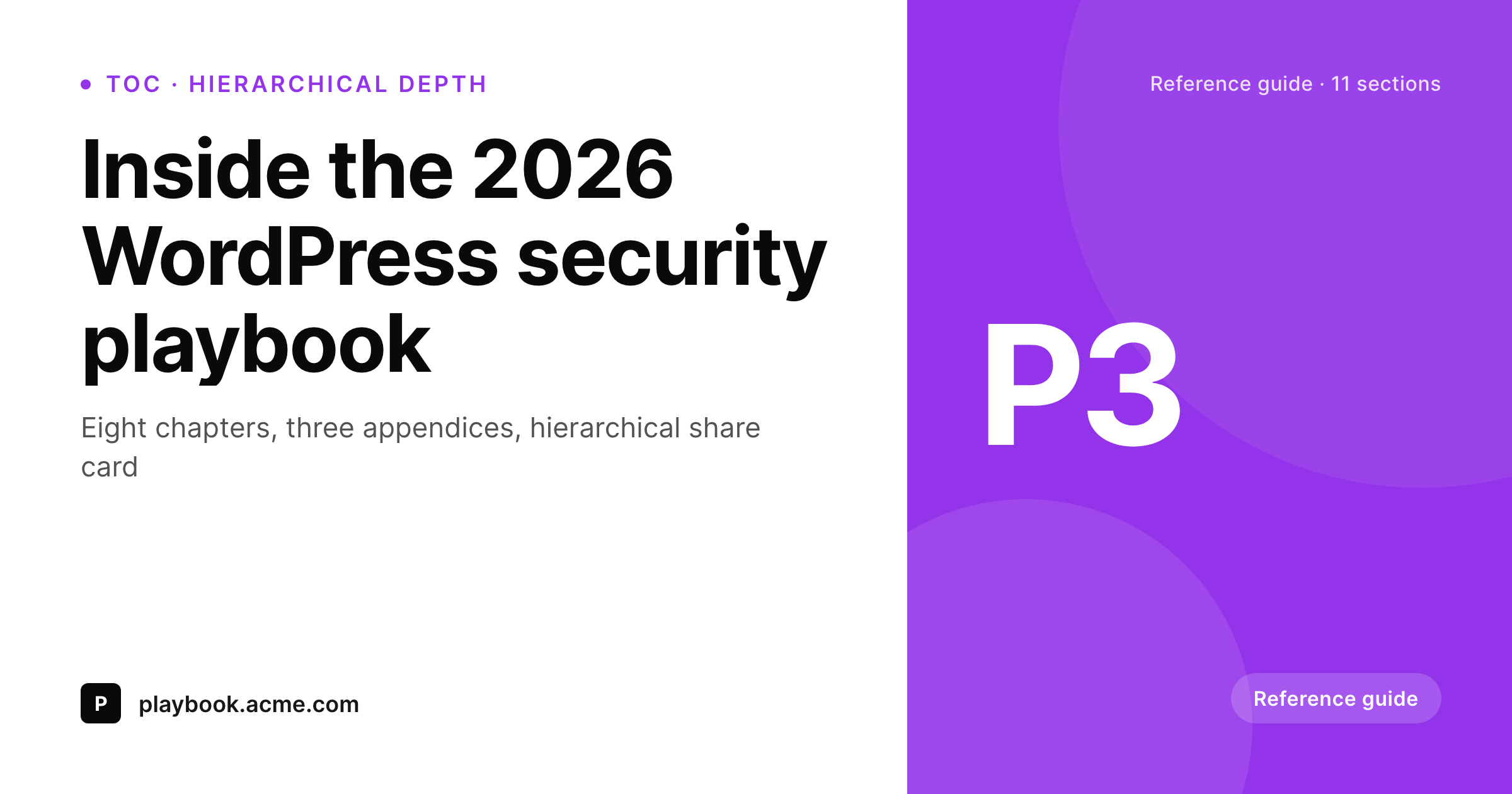
Sample reference-guide share card
Rendered from a real LuckyWP TOC tree. The chapter count and subsection depth both come from lwptoc_items, the reference accent from the post category.
Comparison
Default reference share vs SleekPixel for LuckyWP TOC
Default theme OG image
- LuckyWP Table of Contents has no built-in share image generator
- Nested TOC tree lives in postmeta, never on the share preview
- Reference guides and quick takes share with the same default OG image
- Readers cannot tell scope from the share, click and bounce on long posts
-
No hook from
lwptoc_itemsinto a per-post share card
SleekPixel
-
Reads
wp_postmetafor the nestedlwptoc_itemstree structure - Counts top-level chapters and one-level-deep subsections separately
- Renders a chapter count badge and a subsection depth secondary slot
- Pulls accent tone from the post's primary category for reference vs blog
-
Re-renders on
save_postso the depth tracks live edits
Features
What SleekPixel gives you for LuckyWP Table of Contents
Chapter count badge
The template uses the count of top-level entries in the LuckyWP TOC tree as a chapter badge on the card. An eight-chapter reference shows as eight chapters, a three-chapter post shows as three on every share.
Subsection depth slot
A secondary slot names the count of one-level-deep subsections under the chapters. Together with the chapter count, the slot gives readers a sense of both breadth and depth before they click through to read the post.
Reference category accent
Posts in reference categories get a deeper accent stripe than posts in regular blog categories. SleekPixel pulls the category from wp_term_relationships and switches the template accent based on the type.
Use cases
Where reference-heavy sites get the most lift
Technical playbooks
Engineering and security playbooks with deep nested structure get a share card that names the chapter and subsection counts, signaling reference scope.
Whitepaper archives
Sites that publish whitepapers as WordPress posts get a card that names the structure, making the share preview look like a paper rather than a blog.
Internal knowledge bases
Knowledge base articles with multi-level headings get a share preview that names the depth, helping internal teams pick the right article from chat.
The bigger picture
Why nested structure should drive the share preview
Sites that pick LuckyWP Table of Contents over Easy Table of Contents do it because they care about heading hierarchy. The plugin preserves the full nested structure of a post's headings, which matters for reference guides, technical playbooks and knowledge bases where the difference between a chapter and a subsection is the difference between a section and a sub-step. The piece that defaults break is the share.
A reference guide with eight chapters and twenty subsections shares with the same OG image as a quick take, and readers on Slack or LinkedIn see no signal that the share leads to a multi-chapter reference. LuckyWP already collected the structure in lwptoc_items. SleekPixel turns that structure into a design signal.
The chapter count becomes a badge, the subsection depth becomes a secondary slot, and the accent stripe signals reference scope. Readers searching for a reference pick the right post from the share, editorial teams get a higher quality of engagement on the work they put into deep posts, and the reference guide finally has a share preview that matches the work the post represents.
Questions
Common questions about SleekPixel for LuckyWP Table of Contents
No. SleekPixel reads lwptoc_items postmeta, which LuckyWP writes regardless of whether the TOC is auto-inserted or rendered via the lwptoc shortcode. Both modes produce the same parsed structure that the render uses.
Yes. The depth count can be set to one, two or three levels in the template settings. Most reference sites use two levels because three levels deep tends to be too granular for a share preview, but the option is available for sites with deeply nested whitepapers.
Yes. Every save_post triggers a fresh parse by LuckyWP and a fresh render by SleekPixel. Reordering chapters or moving subsections produces a new card on the next save, so the share preview always reflects the current structure.
Yes. SleekPixel reads from postmeta, which LuckyWP populates regardless of whether the rendered TOC appears via shortcode or auto-insertion. The render path is independent of the display path.
Yes. SleekPixel templates can be scoped by category, post type or custom field. A reference category gets the reference template, a blog category gets the regular template, and both can read from the same lwptoc_items meta if needed.
The parse still runs on save, and lwptoc_items is still written to postmeta. SleekPixel uses the postmeta value regardless of the frontend visibility setting, so a TOC that is parsed but not displayed still drives the share card.
Optionally. The template can hide the chapter badge below a configurable threshold, say three chapters, so short posts that happen to have a few headings do not render a card that overpromises depth they do not have.
SleekPixel reads the postmeta key for whichever TOC plugin is active. Running both EZ-TOC and LuckyWP on the same site is unusual, but SleekPixel can be pointed at either key per template, so the integrations can coexist on different post types.
Pricing
More than 1000+
happy customers
Explore our flexible licensing options tailored to your needs. Upgrade your license anytime to access more features, or opt for a lifetime license for ongoing value, including lifetime updates and lifetime support. Our hassle-free upgrade process ensures that our platform can grow with you, starting from whichever plan you choose.
Lifetime ♾️
Most popular
EUR
once
- Unlimited websites
- Lifetime updates
- Lifetime support
...or get the Bundle Deal
and save €250 🎁
The Bundle (unlimited sites)
Pay once, own it forever
Elevate your WordPress site with our exclusive plugin bundle that includes all of our premium plugins in one package. Enjoy lifetime updates and lifetime support. Save significantly compared to buying plugins individually.
What’s included
-
SleekAI
-
SleekByte
-
SleekMotion
-
SleekPixel
-
SleekRank
-
SleekView
€749
Continue to checkoutBrowse more
- office hours card
- workshop replay card
- holiday greeting cards
- hackathon cards
- partnership card
- LinkedIn update cards
- buy one get one cards
- founder letter card
- tool of the day cards
- shell tip card
- press release cards
- explainer essay card
- lifetime deal card
- infographic card snippets
- award announcement images
- Stan Store cover
- Vimeo thumbnails
- Telegram channel banner
- LinkedIn newsletter headers
- Kick channel banners
- Kick stream thumbnails
- Facebook group banners
- Telegram channel cover images
- Beacons.ai banner
- Instagram ad images
- Snapchat ad images
- Klaviyo email headers
- Substack post headers
- Threads profile banner
- Discord server icon