






SleekPixel for Two Factor configuration writeups
Two Factor is the WordPress core-team 2FA plugin maintained by 10up. The engineering writeups that document the setup, provider choices, and rollout choices get a SleekPixel card with provider badges and a clean brand line, drawn from safe summary fields.
♾️ Lifetime License available
Engineering writeups deserve real share previews
The Two Factor plugin stores provider state in usermeta keys: _two_factor_enabled_providers for the list of enabled providers per user, _two_factor_provider for the primary, plus per-provider keys like _two_factor_totp_key for TOTP secrets. Recovery codes and the TOTP key are sensitive and never belong on a public share. The list of providers available across the install, set as a global option, is safe to expose at a summary level.
Engineering teams that write up the Two Factor setup want the post to share with a real card. The post body documents which providers are enabled, what the default is, what the fallback flow looks like. The audience is other engineering teams researching the same setup, plus internal stakeholders who want to understand the auth posture. A generic homepage banner makes the post look like a marketing update. A provider-badge card communicates the technical content of the post in the share preview itself.
SleekPixel binds to a setup-post type with fields for primary provider, fallback provider, scope, and a short summary. A whitelisted subset of the Two Factor global options renders the available-provider list as small badges. The per-user usermeta stays operational and never touches the template. The render lands a 1200x630 PNG that signals the engineering nature of the post.
Workflow
From Two Factor config to engineering card
Create the setup-post type
Whitelist safe global options
Bind template fields
Publish or update the post
Output
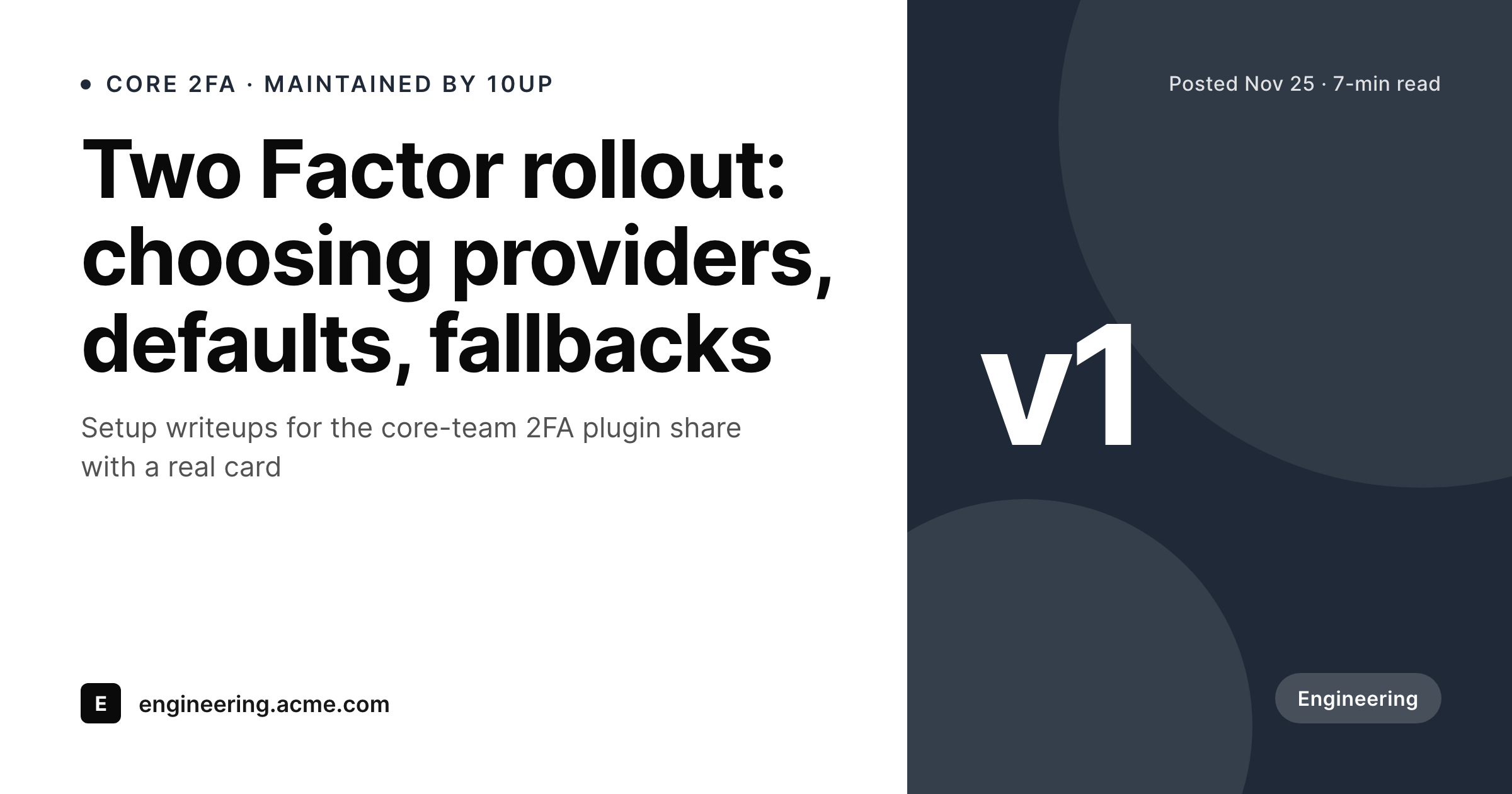
Sample Two Factor setup card
A 1200x630 OG card from a Two Factor setup post: primary provider, fallback provider, scope label, brand mark. Drawn from safe fields only.
Comparison
Default theme OG vs SleekPixel for Two Factor
Default theme OG image
- Two Factor setup writeups share with the same banner as any other blog post
- Provider names and fallback choices never appear on the social preview
- Engineering audiences see no technical signal before clicking the link
- Manual exports of setup diagrams stop happening after the first writeup
- Brand refresh sweeps leave the engineering back catalog inconsistent
SleekPixel
- Reads available provider list from safe global options on the Two Factor side
-
Per-user
_two_factor_totp_keyand recovery codes never touched - Provider badges for TOTP, email, U2F, FIDO2, and backup codes
- Scope label drawn from the role configuration on the global setting
- Per-writeup variants for migration, initial setup, and reconfiguration posts
Features
What SleekPixel gives you for Two Factor
Engineering-style cards
The Two Factor setup card uses a denser, code-aware layout. Provider badges sit alongside the brand line, the headline carries the post title, and the meta line includes a publish date and a short scope label.
Provider-aware badges
Each enabled provider renders as a small badge: TOTP, email codes, U2F, FIDO2, backup codes. The badges respect the actual global configuration and update on the next post save if providers change.
Scope-label rendering
The scope label communicates which roles or user groups are covered by the configured 2FA. Editors do not need to type the scope into the post body because the value comes from the safe global configuration.
Use cases
Where Two Factor writeups benefit most readers
Internal engineering docs
Engineering teams write up the 2FA setup for internal documentation. The share preview reads as a technical document, which is the right framing for internal Slack and Notion forwards.
Open-source contribution posts
Contributors writing about the Two Factor plugin externally get a card that signals the technical content. Posts perform better on Hacker News and Twitter when the share matches the audience.
Migration writeups
Teams migrating from a commercial 2FA tool to the core plugin publish migration notes. The card carries before-and-after provider badges that communicate the migration shape at a glance.
The bigger picture
Why engineering writeups need engineering-shaped shares
Engineering writeups have a narrow audience that responds to specific cues. Provider names, scope labels, and the technical framing of the post are the cues that signal 'this is a real engineering document' to other engineers scanning a feed. A generic homepage banner is the wrong cue.
Provider badges and a clean scope label are the right cue. The difference shows up in click-through, in inbound discussion, and in the quality of the conversation the post generates. Engineers who click on a technically-framed preview arrive with the right expectations and engage on the technical content.
Engineers who click on a generic preview either do not click, or click and leave when the content does not match the framing. The compounding effect is reputation. A back catalog of consistently engineering-framed writeups builds a reader base that returns for the next post.
A back catalog of inconsistent or generic shares trains the audience to skip the feed. SleekPixel takes the safe Two Factor summary fields, binds them through a whitelist, and renders the cards that turn the underlying configuration work into shareable technical evidence.
Questions
Common questions about SleekPixel for Two Factor
No. The _two_factor_totp_key usermeta key is sensitive and never touched by the render. SleekPixel only reads safe global options like the available-provider list. Per-user data stays inside WordPress and outside any template binding.
No. Recovery codes are sensitive per-user data and stay operational. The template can render a 'backup codes enabled' badge from a safe global flag, but the codes themselves are never accessible to the binding. The whitelist enforces this at the plugin level.
No. Per-user enrollment data is operational. The card shows the global configuration: which providers are available, which is the default, what the scope is. Individual users are not represented on the share card at all.
Yes. Initial setup, migration, and reconfiguration each use a distinct template variant. The 'writeup kind' field on the post selects the variant, so editors pick the kind and the right design renders automatically.
WebAuthn and FIDO2 are providers in the Two Factor plugin's provider list. If they are enabled in the global configuration, they render as badges through the same whitelist. No special handling is needed because the badge logic is uniform across all providers.
Yes. Third-party plugins that register custom providers appear in the provider list the same way as the built-in providers. The badge renders if the provider is enabled, with a fallback icon when the custom provider does not declare its own.
Yes. A custom field on the setup post holds the contributor mention, and the template renders it as a small attribution line below the brand mark. The field is editorial and independent of any Two Factor data binding.
No. Two Factor runs on login and on user profile pages. SleekPixel runs only on post save and on a background render queue. The two systems work on different events and do not share any execution paths.
Pricing
More than 1000+
happy customers
Explore our flexible licensing options tailored to your needs. Upgrade your license anytime to access more features, or opt for a lifetime license for ongoing value, including lifetime updates and lifetime support. Our hassle-free upgrade process ensures that our platform can grow with you, starting from whichever plan you choose.
Lifetime ♾️
Most popular
EUR
once
- Unlimited websites
- Lifetime updates
- Lifetime support
...or get the Bundle Deal
and save €250 🎁
The Bundle (unlimited sites)
Pay once, own it forever
Elevate your WordPress site with our exclusive plugin bundle that includes all of our premium plugins in one package. Enjoy lifetime updates and lifetime support. Save significantly compared to buying plugins individually.
What’s included
-
SleekAI
-
SleekByte
-
SleekMotion
-
SleekPixel
-
SleekRank
-
SleekView
€749
Continue to checkoutBrowse more
- LinkedIn carousel slides
- Open Graph images
- Facebook ad images
- VSCO cover
- Discord server banners
- Snapchat snap images
- Gumroad product covers
- Telegram channel banner
- Xiaohongshu cover images
- TikTok Now image
- Tidal cover art
- Twitch camera frame
- LinkedIn ad images
- TikTok ad images
- Twitch offline banners