






SleekPixel for WP Migrate database sync runs
WP Migrate (Delicious Brains / WP Engine) keeps each push and pull as a named profile. SleekPixel reads wpmdb_settings and the per-run history, then renders an OG card showing the profile name, direction, replacement count, and run duration for any sync URL shared in chat or runbooks.
♾️ Lifetime License available
Sync-report URLs that name the profile and direction
WP Migrate stores its sync configuration in the wpmdb_settings option with named profiles for each migration scenario: push-prod-to-staging, pull-prod-to-local, sync-uploads-only. Each profile carries its search-replace rules, the included tables, the include-media flag, and the destination endpoint. Run history (with timestamps, table counts, and replacement counts) lives in additional options the plugin writes after each completed run.
Engineering teams share sync URLs constantly: the runbook entry for the production-pull, the Slack reference for a teammate who needs the same dataset locally, the CI-triggered sync that needs a visible status. The default link preview is the engineering site's homepage card, which carries no information about which profile ran, which direction, or whether the run actually succeeded at all.
SleekPixel reads the WP Migrate profile and the most recent run history entry, then composes a card with the profile name, direction (push or pull), source and destination, table count, replacement count, and duration. Failed runs render with an amber template; in-flight runs show progress pulled from the live transient.
Workflow
From sync profile to share card
Apply to sync reports
Bind profile and history
wpmdb_settings keys (profile name, direction, source, destination, rule count) and to the per-run history (tables, replacements, duration, success flag) from the options table.
Hook sync completion
wpmdb_migration_complete and the failure equivalent. Cards regenerate the moment a run finishes, including runs triggered by WP-CLI or by remote API for CI/CD pipelines and automation.
Share URLs in channels
Output
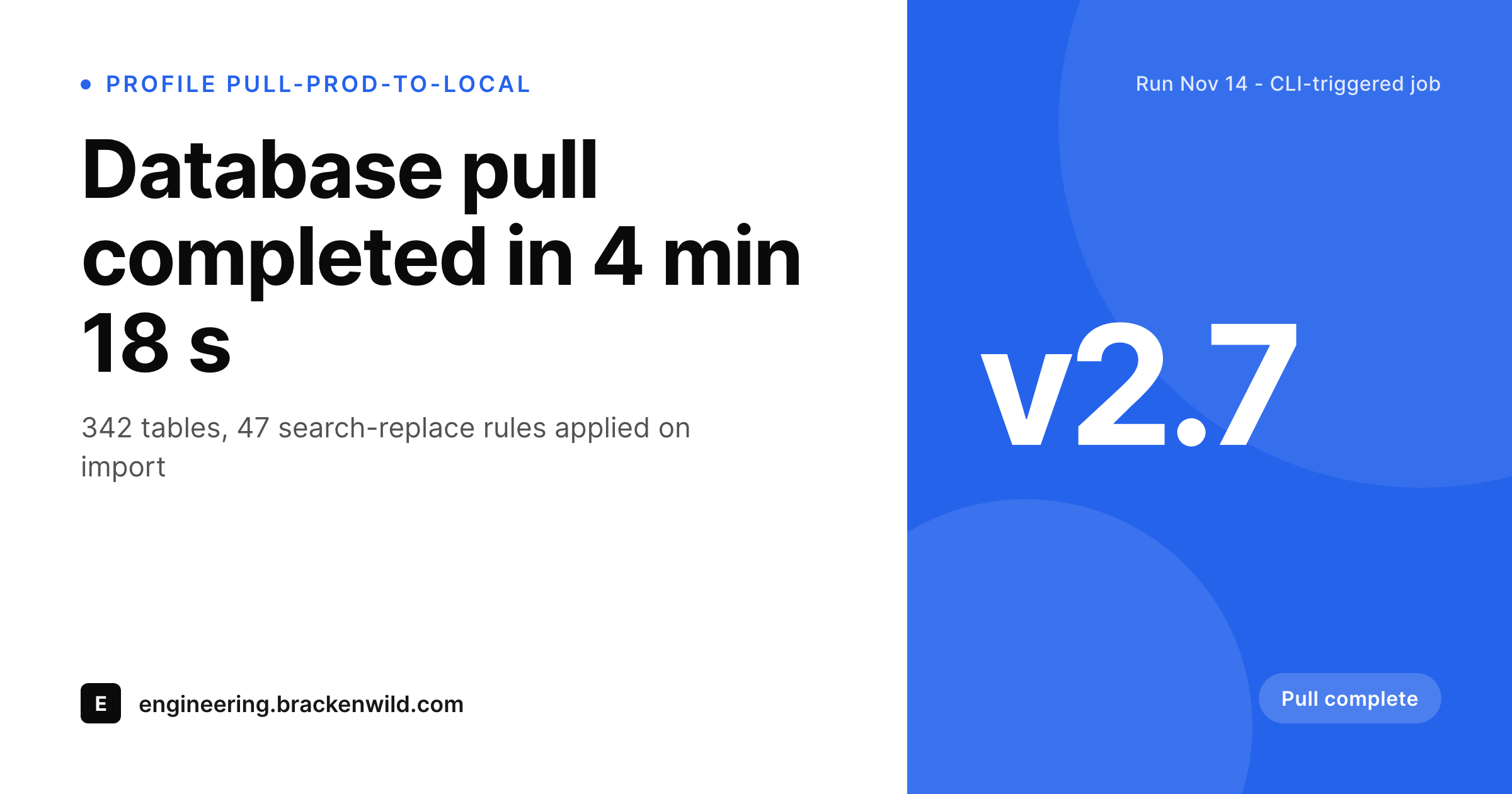
Sample WP Migrate sync run card
Rendered from the real wpmdb_settings profile and the latest run history showing a CLI-triggered pull with 47 search-replace rules across 342 tables.
Comparison
Default sync OG vs SleekPixel for WP Migrate
Same engineering site logo
- Every WP Migrate sync URL previews with the engineering site's homepage image
- Profile names from wpmdb_settings never reach the share preview area
- Direction (push or pull) stays invisible at share time in every channel
- Replacement and table counts hide behind the click-through gate always
- Failed sync runs look identical to successful ones in shared links daily
SleekPixel
-
Reads
wpmdb_settingsfor profile names, directions, and rule sets - Profile name and direction (Push or Pull) form the card headline area
- Search-replace rule count and table total composited as paired metrics
- Source and destination endpoint references on a secondary card line
- Failure state flips the card to amber with the failure step visible always
Features
What SleekPixel gives you for WP Migrate
Profile name and direction
The named profile from wpmdb_settings renders as the headline along with a Push or Pull badge. Engineering teams reading chat see exactly which migration the URL points at, without having to open the dashboard to cross-reference profile IDs against the team docs.
Replacement and table totals
The card surfaces the number of search-replace rules applied (typical signal of how complex the migration is) and the total tables included. Bigger numbers signal heavier runs that may need a maintenance window, smaller ones signal routine syncs to manage.
Source and destination endpoints
The card includes the source and destination URL references from the profile (typically prod, staging, and local hostnames). This makes it impossible to confuse a pull from staging with a pull from production at preview time before triggering the run.
Use cases
Where WP Migrate cards reduce ambiguity
Engineering sync runbooks
Runbook entries link to specific profile URLs with the card already showing direction and source. Engineers picking up an unfamiliar codebase identify the right sync workflow without reading three paragraphs of context.
CI/CD pipeline syncs
CI jobs that trigger WP Migrate via WP-CLI post the sync URL into a deploy channel with the run state already on the preview. Failed runs surface immediately without anyone parsing the log output.
Compliance audit trail
Quarterly compliance reviews require evidence of data movement. Sync URLs pasted into audit docs render with profile, direction, and date, providing the visible audit trail review boards expect to see.
The bigger picture
Why WP Migrate cards belong in engineering
Database sync mistakes are some of the most expensive engineering errors. A pull when you meant a push, a sync to prod instead of staging, the wrong profile picked up at 2 AM from a tired runbook. WP Migrate is a careful tool that names every profile and tracks every run.
The data exists to prevent confusion, but the data lives in the dashboard while the conversations happen in chat. Engineers paste sync URLs into Slack with no preview signal beyond a generic site logo. The push-to-prod profile and the pull-to-local profile look identical in chat until someone clicks.
With SleekPixel, the profile name and direction are right there on the preview. Source and destination endpoints are visible. Rule and table counts give a sense of weight.
Failed runs flip to amber. The engineer reaching for a runbook entry at 2 AM sees what they are about to trigger before they click it. Compliance auditors get a visible trail without parsing logs.
Questions
Common questions about SleekPixel for WP Migrate
Yes. Both versions write to wpmdb_settings with the same profile structure. Pro features like media-file sync, theme/plugin sync, and cloud-storage destinations add fields that SleekPixel can optionally render on the card.
Yes. Direction is a top-level field on every profile. SleekPixel renders Push or Pull as a prominent badge in the corner of the card, with an arrow icon that points from source to destination so the direction is obvious even without reading.
Yes. WP Migrate writes to the same run-history options whether the migration was triggered from the dashboard or via wp migratedb on the command line. CI systems that automate syncs through CLI get the same per-run cards as manual dashboard runs.
Yes. Each profile can drive its own template variant. Production pulls might render with a red accent and a Warning Production data label, while staging-to-local syncs render with a routine teal. Both come from the same run-history feed with different template branches.
No. Card regeneration runs after wpmdb_migration_complete fires and takes maybe a second of work via Action Scheduler. The actual database export, transfer, and search-replace operations are completely untouched by SleekPixel during the run.
Yes. Media-only syncs write their own run-history entries with a media-file count. SleekPixel can render a media-specific card variant with the file count and total size instead of table count and rule count, so the metrics match what the run actually did.
By default no, since rules often include sensitive hostnames. The template can include a sanitised summary (e.g. 14 hostname rules, 3 path rules) that gives a sense of scope without leaking the actual replacement values into a public preview unintentionally.
Yes. Cloud-based syncs through WP Engine record their endpoints and run history just like local syncs do. SleekPixel reads from the same option structure regardless of whether the sync ran fully on-site or through a hosted intermediary in the cloud.
Pricing
More than 1000+
happy customers
Explore our flexible licensing options tailored to your needs. Upgrade your license anytime to access more features, or opt for a lifetime license for ongoing value, including lifetime updates and lifetime support. Our hassle-free upgrade process ensures that our platform can grow with you, starting from whichever plan you choose.
Lifetime ♾️
Most popular
EUR
once
- Unlimited websites
- Lifetime updates
- Lifetime support
...or get the Bundle Deal
and save €250 🎁
The Bundle (unlimited sites)
Pay once, own it forever
Elevate your WordPress site with our exclusive plugin bundle that includes all of our premium plugins in one package. Enjoy lifetime updates and lifetime support. Save significantly compared to buying plugins individually.
What’s included
-
SleekAI
-
SleekByte
-
SleekMotion
-
SleekPixel
-
SleekRank
-
SleekView
€749
Continue to checkoutBrowse more
- TikTok cover images
- LinkedIn article covers
- Telegram channel images
- Threads post images
- Facebook ad images
- Facebook cover photos
- Warpcast frame images
- Twitch alert
- Signal sticker pack
- Twitch overlay
- Klaviyo email headers
- Tidal cover art
- Dribbble shot covers
- Farcaster cast images
- Gumroad product covers