






SleekPixel for longform article cards
Longform articles need an OG image that communicates depth in the feed and in Slack unfurls. SleekPixel reads the headline, read time, word count, and section list from your WordPress post meta and renders a 1200x630 OG card that signals long-form work at every link preview.
♾️ Lifetime License available
OG cards for long-form articles that earn the click
Longform articles are different from essays. An essay is one continuous argument; a longform article is a structured piece with sections, subheadings, and often technical depth. The OG image for a longform article should signal that structure so the reader knows what they are getting before they click. Most blogs use a generic featured image that gives the reader no information about the article's depth, structure, or technical level.
SleekPixel handles the longform card by reading structured fields. Map article_headline, read_time, word_count, and section_count to the template. The headline takes the title slot, the read time and word count render on the meta line, and the section count appears on the mark area. Together, the elements communicate that this is a structured piece with substantial depth, not a quick post.
The OG image 1200 by 630 is the default size because longform articles depend on link previews more than essays do. The same template emits a 1200 by 675 Twitter card for the share post and a 1200 by 1200 LinkedIn card for professional reposts. All three sizes render from one definition so the article reads consistently across every channel where it surfaces.
Workflow
How SleekPixel handles longform articles
Map the article fields
article_headline, read_time, word_count, and section_count as the template inputs. Read time can be computed from word count, and section count can be counted from the h2 headings in the post body via a small WordPress filter.
Draft the article
Publish and render
Share and link
Output
Sample longform article OG card
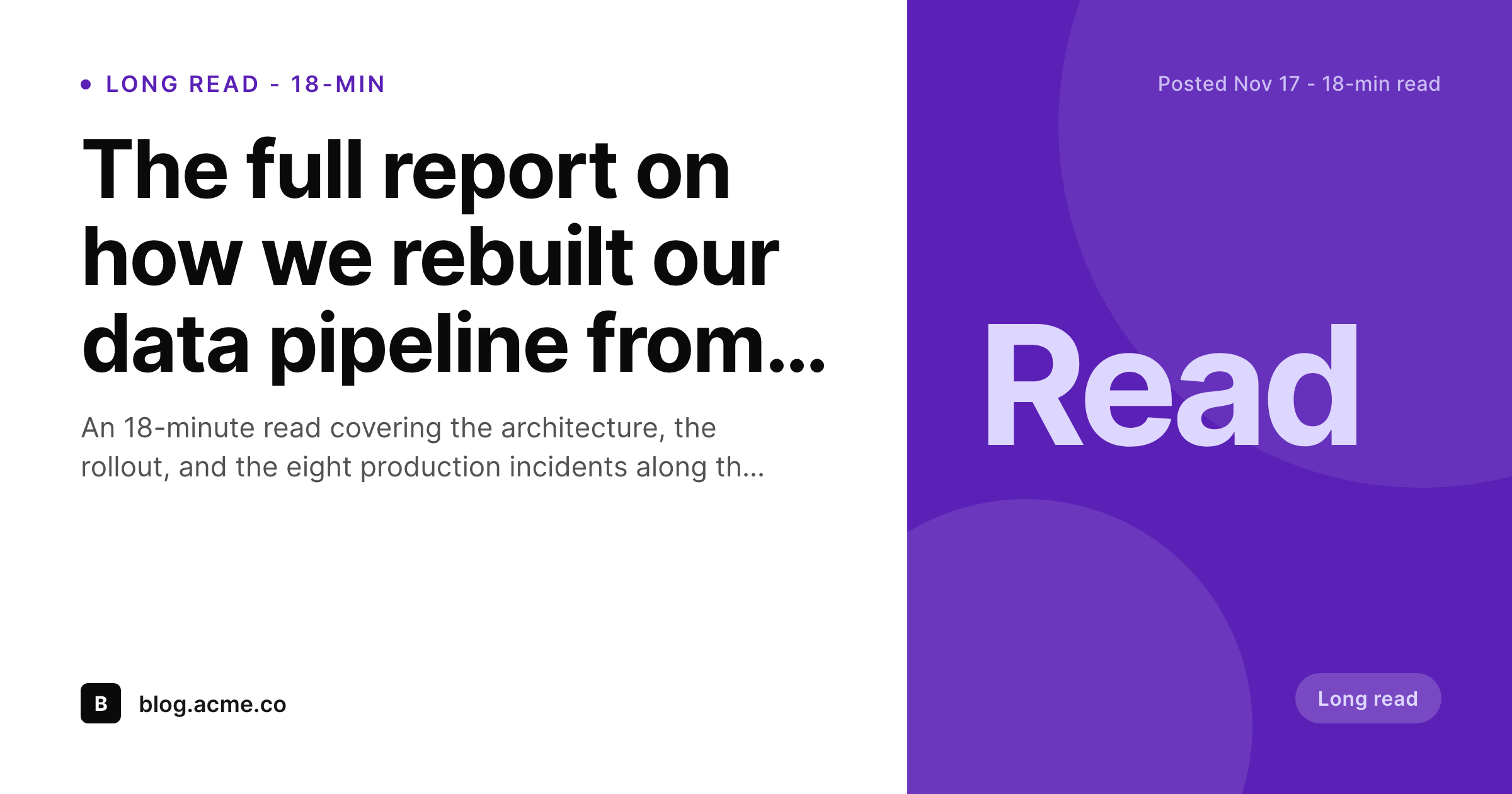
An OG image for a longform article on data pipeline rebuilds. The headline takes the title slot, the read time and word count render on the meta line, and the section count sits on the mark.
Comparison
Default theme OG image vs SleekPixel for longform article
Default theme OG image
- Default themes show a featured image that does not signal article depth or structure
- Read time and section count live in body text and never reach the OG preview in feeds
- Word count is missing from the card so depth signals are lost on the share
- Each longform article needs a custom design pass because no template handles structure
- Slack unfurls and email previews all look generic instead of editorially serious
SleekPixel
-
Reads
article_headline,read_time, andsection_countfrom meta - Renders the read time prominently on the meta line for clear commitment signaling
- Emits OG 1200x630, Twitter 1200x675, and LinkedIn 1200x1200 from one template
- Updates the card automatically when article details change on save in WordPress
- Caches the PNG so feed unfurlers and Slack unfurls serve the same file across shares
Features
What SleekPixel gives you for longform article card
Headline on the title slot
The headline anchors the card. The template reserves the title slot and handles two-line wrapping for longer headlines automatically. Short headlines use a larger font size so the title takes primary visual weight at every render across the various output sizes the template produces.
Read time on the meta line
Read time is the primary commitment signal for longform readers. The meta line renders 18-min read or 12-min read so anyone seeing the unfurl knows the time investment immediately. That filter improves the click-through rate of readers who specifically want long-form work.
Section count on the mark
Longform articles have structure, and the section count communicates that structure. The mark area renders the section count so readers see at a glance that the article is organized into 8 or 12 sections, which signals depth and makes the piece feel less intimidating.
Use cases
Teams that publish longform articles from WordPress
Engineering deep dives
Engineering blogs publish longform deep dives on architecture rebuilds, migrations, and infrastructure projects. The template signals depth so the OG image communicates editorial seriousness when the article is shared in Slack channels and engineering newsletters.
Research and analysis pieces
Research-driven content pieces with original data benefit from the depth signal. The OG image carries the read time and section count, which helps the piece compete with shorter analysis from other publications in the same feed and link-preview spaces.
Tutorial and guide content
Long-form tutorials and guides use the same template because the read time and section count matter to readers deciding whether to bookmark for later. The template makes guide content stand out in the feed where shorter tutorial posts dominate the typical sharing pattern.
The bigger picture
Why longform articles need depth signaling on the OG card
Longform articles depend on link previews more than shorter content does, because the reader's decision to click depends on understanding what they are committing to. A reader sees a link in Slack, in a newsletter, or in a Twitter feed and has two seconds to decide whether to invest 18 minutes reading. The OG image is the only signal that makes that decision easier or harder.
A generic featured image gives the reader nothing, so they fall back on the headline alone and often skip past on the assumption that the article is shorter and less serious than it actually is. Click-through rate suffers, which is unfortunate because longform articles are usually the most valuable content a blog produces. SleekPixel solves the depth-signal problem with a template that renders read time, section count, and word count onto the OG card directly.
The reader sees an 18-min read with 12 sections and 3,400 words and understands immediately that this is a serious piece. That clarity converts the reader who has the time and is in the right mindset. It also filters out the reader who is not in that mindset, which is a feature rather than a problem because that reader was going to bounce anyway.
Across a year of monthly longform articles, the OG cards build a recognizable editorial brand in feed and link-preview spaces, and the archive reads as a serious body of work rather than scattered long posts that happen to be longer than usual.
Questions
Common questions about SleekPixel for longform article card
Yes. The template includes a default formula at roughly 250 words per minute. A WordPress filter computes word count on save and derives read time from it, writing both to meta. You can override the read time manually if you prefer to set it explicitly for specific articles.
Yes. A WordPress filter counts h2 headings in the post body on save and writes the count to the section_count meta. The filter runs during save_post so the count stays current with the body. You can override the count manually for articles with non-standard heading structure.
Yes. The template renders all three sizes from one definition, but you can configure different content per size if needed. For example, you might show fewer details on the smaller Twitter card and more details on the larger LinkedIn card while keeping the OG image as the default reference.
Yes. The article meta does not include the code itself, so the card stays clean regardless of how code-heavy the article is. The depth signal comes from read time, word count, and section count, which all reflect the article's overall structure rather than its specific content.
Yes. Longform article cards use a sans-serif font on the headline by default to distinguish them from essay cards which use serif. The visual contrast helps readers tell at a glance whether a piece is an essay (continuous argument) or a structured article (sections, technical depth).
Section count is a structural signal, not a uniform measure. Readers understand that some sections are longer than others. The signal still works because the total read time captures the overall length and the section count captures the structure, and together they paint an accurate picture.
Yes. Use a part_number meta field for multi-part series. The badge can render Part 2 of 5 so readers see that the article is part of a larger work. Each part keeps its own read time and section count, and the series can be browsed from a shared parent post on the index page.
Yes. The first render after publish stores the PNG and serves it on subsequent requests. Editing the article meta invalidates the cache and triggers a regeneration so the file always reflects the current read time, word count, and section count as stored on the post.
Pricing
More than 1000+
happy customers
Explore our flexible licensing options tailored to your needs. Upgrade your license anytime to access more features, or opt for a lifetime license for ongoing value, including lifetime updates and lifetime support. Our hassle-free upgrade process ensures that our platform can grow with you, starting from whichever plan you choose.
Lifetime ♾️
Most popular
EUR
once
- Unlimited websites
- Lifetime updates
- Lifetime support
...or get the Bundle Deal
and save €250 🎁
The Bundle (unlimited sites)
Pay once, own it forever
Elevate your WordPress site with our exclusive plugin bundle that includes all of our premium plugins in one package. Enjoy lifetime updates and lifetime support. Save significantly compared to buying plugins individually.
What’s included
-
SleekAI
-
SleekByte
-
SleekMotion
-
SleekPixel
-
SleekRank
-
SleekView
€749
Continue to checkoutBrowse more
- Kindle book cover
- Facebook Shop product images
- Instagram bio link banners
- X community banners
- Spotify podcast covers
- Twitch starting soon screen
- podcast cover art
- Discord server banners
- GitHub social preview images
- Pinterest video pin covers
- Dailymotion thumbnails
- TikTok ad images
- Mailchimp email banner
- X social cards
- Instagram stories