






SleekPixel for MailPoet
SleekPixel reads the post or archive issue and renders a custom OG image from its title, issue number, and custom fields. Newsletter archive pages and signup forms get share previews that match the issue.
♾️ Lifetime License available
MailPoet archive pages are blog posts that deserve real share cards
MailPoet runs the entire newsletter pipeline inside WordPress: list management, sending, automation, and an in-site archive of every issue. The archive pages and signup pages live as regular WordPress posts and pages, which means their social-share preview is whatever your theme defaults to. The newsletter that someone wants to share, with last week's issue title and headline, falls back to a generic site logo when posted on social.
SleekPixel handles the metadata layer MailPoet does not try to touch. You build one template in the WordPress admin with dynamic fields like {post_title}, {issue_number}, {list_name}, and any custom field on the post. Every save regenerates the OG image. Whether the post is a public archive of a sent newsletter or a signup page for a new list, the share card ships with the URL.
SleekPixel does not modify MailPoet itself, it works at the post level. MailPoet keeps doing what it does: list management, automation, sending, archive rendering, signup form handling. SleekPixel handles the metadata around the post so an archive issue or signup page looks like part of the brand wherever the URL gets shared.
Workflow
From archive page to share-ready in one save
Design the template
Connect to post type
Save the page
Share anywhere
Output
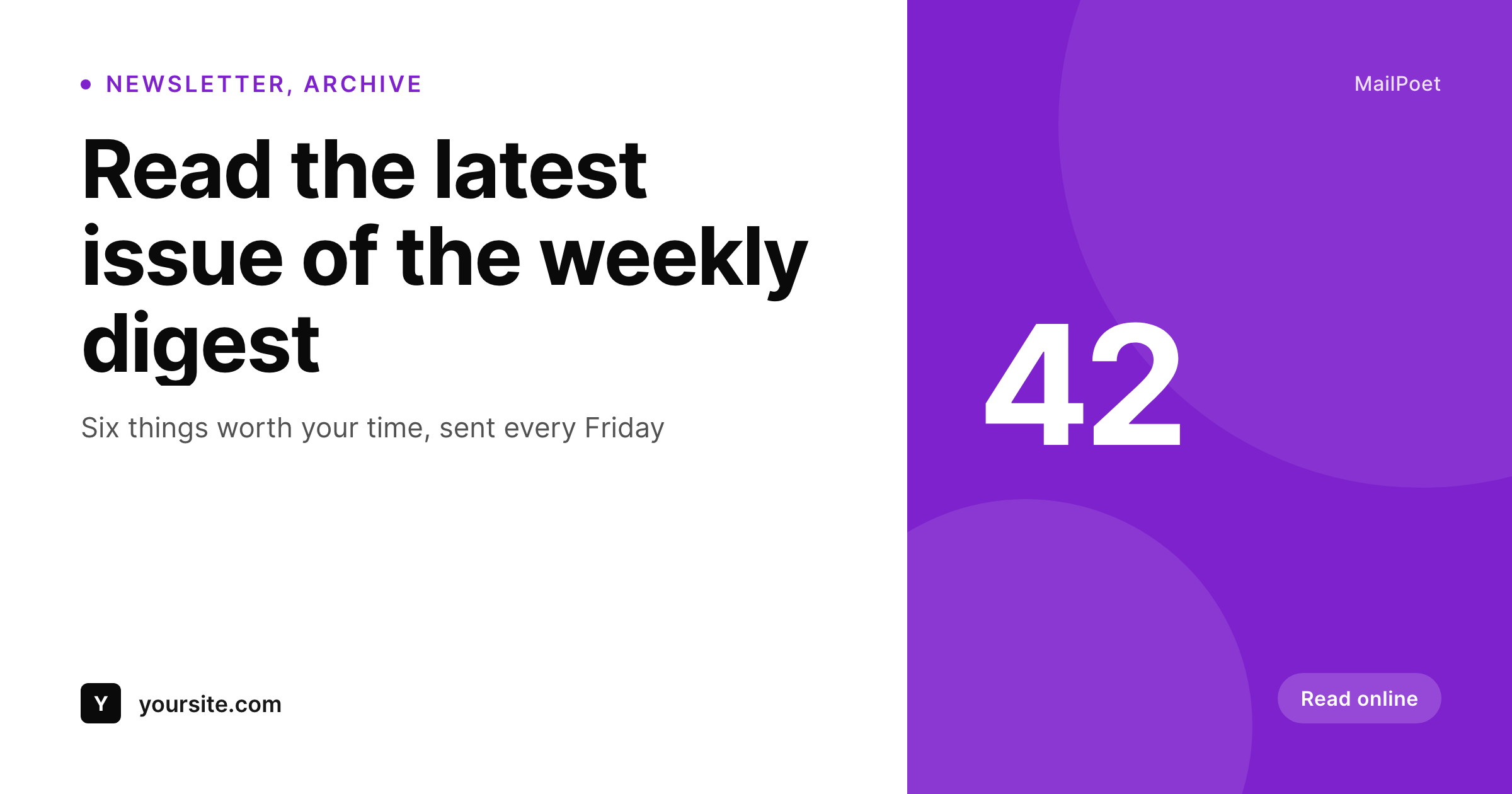
Sample social card for a MailPoet archive issue
This card was rendered from the archive post's title, issue number, and accent color. Same template, every issue.
Comparison
Generic site logo vs SleekPixel
Default site logo on every archive and signup page
- Every archive issue and signup page shares with the same site logo
- Last week's issue and this week's issue look identical when shared
- No issue number or topic appears in the share preview
- Updating the issue title doesn't update any social card
- No automation, card creation falls to a designer or never happens
SleekPixel
- Auto-generated OG image per post on save, every time
- Pulls from any field on the post (issue number, list name, headline)
- Works on archive issues, signup pages, and lead-magnet posts
- Edit the template once and every past archive page regenerates
- Does not touch MailPoet itself, sending and lists stay as configured
Features
What SleekPixel gives you for MailPoet
Template-driven
Design the archive and signup card layout once with dynamic fields. Every MailPoet-related post inherits it on save.
OG + Twitter meta
SleekPixel writes og:image, twitter:image, and twitter:image:alt on each post, no theme code to touch.
Regenerate on demand
Updated the template? Bulk-regenerate every past archive issue and signup page from the admin in one pass.
Use cases
Where this fits best
Newsletter archive issues
Each public archive issue gets a card with the issue title and number, not a site-wide logo.
Signup and welcome pages
Signup pages get share cards with the list name and value prop pulled from custom fields.
Re-engagement and back-issue links
Old archive links shared in tweets and back-catalog pages keep an issue-specific card so each one stands on its own.
The bigger picture
Why archive and signup share cards matter
Newsletter archives are a quiet but durable SEO and brand asset. Each issue's archive URL gets indexed, linked, and re-shared months after the email itself was sent. The thumbnail attached to that URL in a tweet, a Slack channel, or a back-catalog roundup is what readers see before clicking.
A generic site-logo preview on every issue makes last week's piece look identical to one from a year ago, which buries the value of the archive. A per-issue card that pulls the issue title and number directly from the post keeps each piece distinct in shares and search. MailPoet handles list management and sending.
SleekPixel handles the metadata around the archive so the back catalog reads as a real publication.
Questions
Common questions about SleekPixel for MailPoet
No. SleekPixel works at the post level by writing the og:image meta tag for the post that hosts the archive issue or signup form. MailPoet continues to handle sending, lists, and automations exactly as configured.
MailPoet supports public archives, and the archive views are WordPress URLs. SleekPixel reads the post or page that hosts the archive page and writes the og:image based on its fields. If your archive setup uses a non-standard CPT, point SleekPixel at that CPT.
Only if you store that number as a custom field on the post and reference it in the template. SleekPixel does not query MailPoet's tables at render time.
Yes. SleekPixel supports per-category, per-tag, and per-CPT templates. Tag archive pages by list and route each tag to its own template.
The template renders without it. Set defaults per field or design the layout so missing fields collapse gracefully.
Yes, on the next save the image regenerates with the new title. Or trigger a bulk regenerate from the admin.
No. The image is rendered once at save time and stored as a static PNG. Visitors load a regular image URL, no rendering happens at view time.
Generated images stay in the uploads folder. The og:image meta tag stops being written, so new shares fall back to whatever your theme outputs.
Pricing
More than 1000+
happy customers
Explore our flexible licensing options tailored to your needs. Upgrade your license anytime to access more features, or opt for a lifetime license for ongoing value, including lifetime updates and lifetime support. Our hassle-free upgrade process ensures that our platform can grow with you, starting from whichever plan you choose.
Lifetime ♾️
Most popular
EUR
once
- Unlimited websites
- Lifetime updates
- Lifetime support
...or get the Bundle Deal
and save €250 🎁
💎 Want everything forever? The All Access Pass is going away on 01.08.2026.
The Bundle (unlimited sites)
Pay once, own it forever
Elevate your WordPress site with our exclusive plugin bundle that includes all of our premium plugins in one package. Enjoy lifetime updates and lifetime support. Save significantly compared to buying plugins individually.
What’s included
-
SleekAI
-
SleekByte
-
SleekMotion
-
SleekPixel
-
SleekRank
-
SleekView
€749
Continue to checkoutBrowse more
- Bluesky link cards
- Facebook group banners
- Twitter header banners
- KDP hardcover cover
- Audible audiobook cover
- Bluesky feed banner
- Instagram feed posts
- Buy Me a Coffee banners
- Twitch schedule banners
- Threads post images
- Snapchat ad images
- Fansly banner
- Dribbble shot covers
- Apple Music cover art
- TikTok profile banners