






SleekPixel for UpdraftPlus backup runs
UpdraftPlus tracks every backup job with a unique ID, sizes per component, and a remote destination. SleekPixel reads updraft_last_backup and per-job transients, then renders an OG card on each completion so backup URLs shared in chat and email already show what was backed up and where it landed.
♾️ Lifetime License available
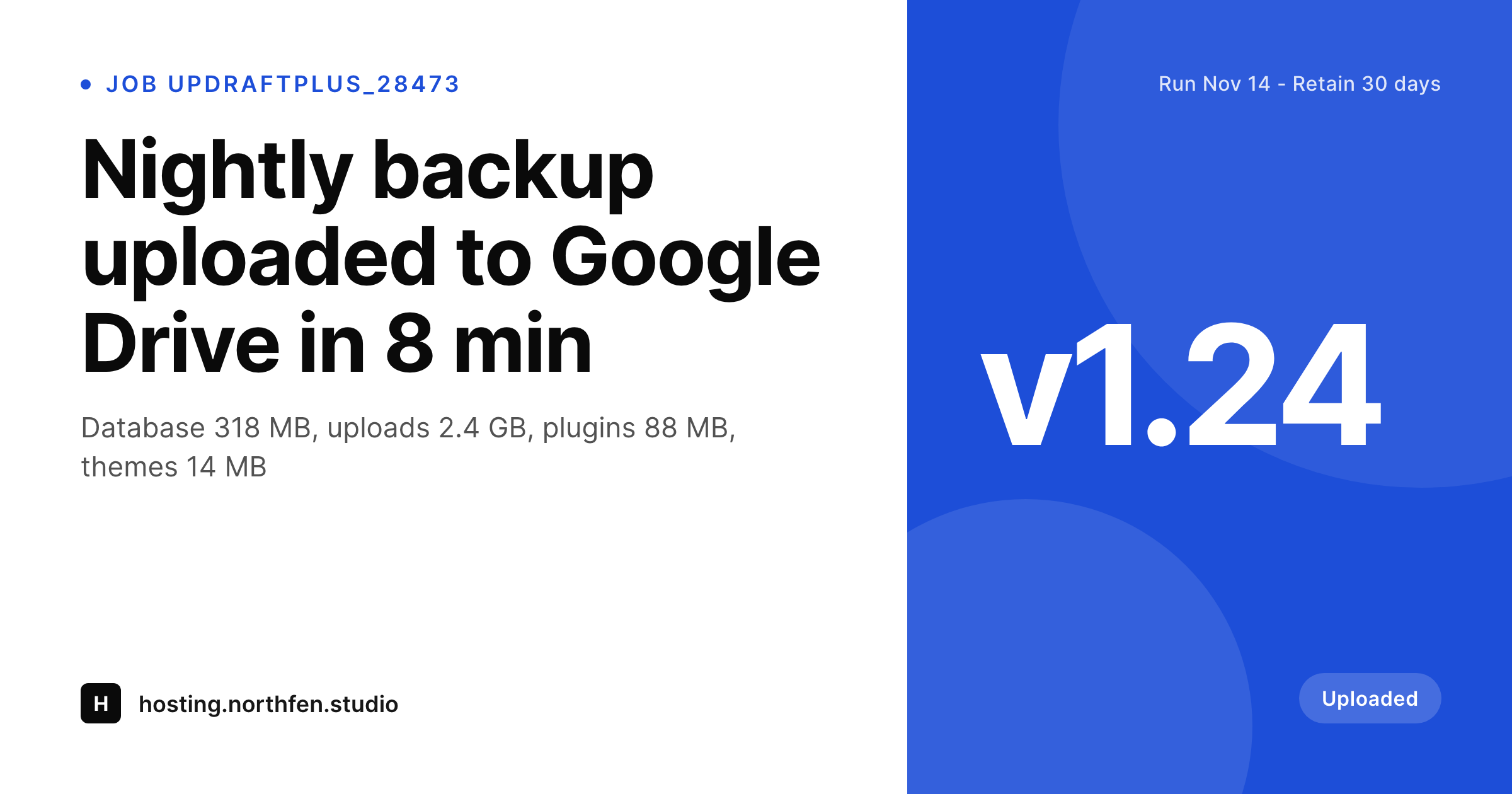
Backup URLs with the job details on the preview
UpdraftPlus writes its backup run history to wp_options, with the latest run stored in updraft_last_backup and historical runs in updraft_backup_history. Each entry carries a job ID, a timestamp, the sizes of the database and file components, the destinations the archive was uploaded to (Google Drive, Dropbox, S3, etc.), and a success flag. Real-time progress lives in transients keyed by job ID.
When teams share a backup-report URL or a job-detail link, the default link preview is the site's homepage card. There is no visible information about which job ran, how big the backup was, where it went, or whether the run actually succeeded. Migration handoffs and ops investigations all start with a click-through just to identify the right archive before any action can be taken.
SleekPixel reads the job entry from updraft_last_backup or updraft_backup_history for the URL being scraped, then renders a card with the job ID, sizes by component, destination, retention setting, and duration. Failed jobs render with an amber template so a broken backup never previews as healthy in a team channel.
Workflow
From last backup to share card
Apply template to reports
Bind history fields
updraft_last_backup or the matching entry in updraft_backup_history for older runs.
Hook backup completion
updraftplus_backup_complete and the failure equivalent. Cards regenerate the moment a job finishes, so the next scrape of the URL picks up the new image automatically without manual steps.
Share URLs in handoffs
Output
Sample UpdraftPlus backup card
Rendered from a real updraft_last_backup entry showing job ID, component sizes, and remote destinations on a nightly run uploaded to Google Drive.
Comparison
Default site OG vs SleekPixel for UpdraftPlus
Same site logo on every URL
- Every backup-report URL previews with the default site homepage card
- Job IDs from UpdraftPlus history never reach the share preview area
- Successful and failed runs look identical when forwarded in chat
- Component sizes (DB, uploads, plugins) stay invisible at preview time
- Destinations like Google Drive or S3 carry no visual signal in shares
SleekPixel
-
Reads
updraft_last_backupandupdraft_backup_historyoptions - Job ID and completion timestamp combine to form the card headline
- Sizes per component (DB, uploads, plugins, themes) render as a small chart
- Destination badges for Google Drive, Dropbox, S3, OneDrive, FTP, and local
- Failure state flips the card to amber with the failure reason text visible
Features
What SleekPixel gives you for UpdraftPlus
Job ID and timestamp on the card
Every UpdraftPlus run has a unique job ID. SleekPixel surfaces that ID along with the completion timestamp as the card headline, so support teams pasting a backup URL can identify exactly which run the conversation is about without opening the page.
Component-size breakdown
UpdraftPlus tracks sizes separately for database, uploads, plugins, themes, and other. SleekPixel composites the four largest components as paired numbers with a total above, so the card communicates the shape of the backup not just its overall weight or size.
Destination icons and retention
The destinations the archive was uploaded to (Google Drive, Dropbox, OneDrive, S3, FTP, local) render as small icons. The retention setting (Keep 30 days, Keep 6 copies) renders as a sublabel, making it obvious how long this backup will survive in remote storage.
Use cases
Where UpdraftPlus cards earn their place
Archive identification
Migration handoffs paste a backup URL that already shows job ID, sizes, and destination. The receiving engineer fetches the correct archive without cross-checking the UpdraftPlus history page first.
Client backup digests
Daily or weekly backup digests forwarded to clients arrive with size, destination, and retention on the preview. Clients see evidence the backup ran without needing to log into the dashboard.
Failed-run triage
When a backup fails, the shared URL renders the failure state and reason on the preview. On-call engineers triage from the chat preview, often resolving credential or quota issues before the next run window.
The bigger picture
Why UpdraftPlus cards remove restore friction
Backups exist to be restored, and restores happen under pressure. Anything that slows the team down at restore time is a problem multiplied by stress. UpdraftPlus already keeps the data that would help: job IDs, component sizes, destinations, success flags, and retention rules.
The dashboard surfaces all of it. What the dashboard cannot do is travel with a URL into Slack, into an email, into a ticket. That is exactly what a share card does.
With SleekPixel, the moment a backup completion URL hits a chat channel, the preview shows the job ID and the destination. A migration handoff pastes a link and the receiving engineer fetches from the right S3 bucket on the first try. A failed run pasted into a war room shows the failure state in red on the preview, so the on-call engineer triages from the channel without opening the report.
The retention setting renders as a sublabel.
Questions
Common questions about SleekPixel for UpdraftPlus
Yes. Both versions write to the same option keys (updraft_last_backup, updraft_backup_history) with the same field structure. Premium features like incremental backups and multisite handling add fields the template can optionally render.
Partially. UpdraftPlus stores progress in transients keyed by job ID. SleekPixel can render an In progress variant of the card with the current step (Backing up uploads, Uploading to S3), but the social scraper cache means the visible preview lags behind the live state.
Once a backup ages out of the history, the entry disappears from updraft_backup_history. The URL falls back to a generic site card. Old share previews continue showing the historical card until scrapers re-fetch, at which point they pick up the fallback.
Yes. UpdraftCentral controls backups remotely but the local UpdraftPlus history is still the source of truth on each site. Cards render from the local history regardless of whether the backup was triggered locally, on a schedule, or via UpdraftCentral.
Yes. The job entry includes a flag for the trigger source. Scheduled backups can render with the schedule name (Nightly, Weekly), manual backups with the user who triggered it, and incremental backups with a chain reference to the previous full backup.
Yes. Premium can upload one backup to multiple destinations. SleekPixel renders all configured destinations as icons (Google Drive plus Dropbox plus S3, for instance), so the card communicates the full redundancy picture not just the first destination.
No. Card regeneration runs after the updraftplus_backup_complete hook fires and takes maybe a second of background work via Action Scheduler. The backup itself, including database export and remote upload, is completely untouched by SleekPixel.
Yes. If UpdraftPlus Premium encrypted the archive, the job entry records that. SleekPixel can render a small lock icon and an Encrypted label, signalling to the recipient that the archive cannot be restored without the corresponding key.
Pricing
More than 1000+
happy customers
Explore our flexible licensing options tailored to your needs. Upgrade your license anytime to access more features, or opt for a lifetime license for ongoing value, including lifetime updates and lifetime support. Our hassle-free upgrade process ensures that our platform can grow with you, starting from whichever plan you choose.
Lifetime ♾️
Most popular
EUR
once
- Unlimited websites
- Lifetime updates
- Lifetime support
...or get the Bundle Deal
and save €250 🎁
The Bundle (unlimited sites)
Pay once, own it forever
Elevate your WordPress site with our exclusive plugin bundle that includes all of our premium plugins in one package. Enjoy lifetime updates and lifetime support. Save significantly compared to buying plugins individually.
What’s included
-
SleekAI
-
SleekByte
-
SleekMotion
-
SleekPixel
-
SleekRank
-
SleekView
€749
Continue to checkoutBrowse more
- LinkedIn post images
- Twitch offline banners
- Rumble thumbnails
- Mastodon profile banners
- Pinterest shop banners
- YouTube Shorts covers
- TikTok shop images
- Telegram channel banner
- Twitch stream overlay images
- TikTok ad images
- Etsy listing images
- Douyin cover
- YouTube Shorts thumbnails
- Pinterest product pin covers
- Instagram grid tiles