






SleekPixel for essay cards
Long-form essays earn engagement when the share card signals depth. SleekPixel reads the headline, word count, and read time from your WordPress post meta and renders a Twitter card so readers know what kind of commitment they're clicking into before they tap through to the post.
♾️ Lifetime License available
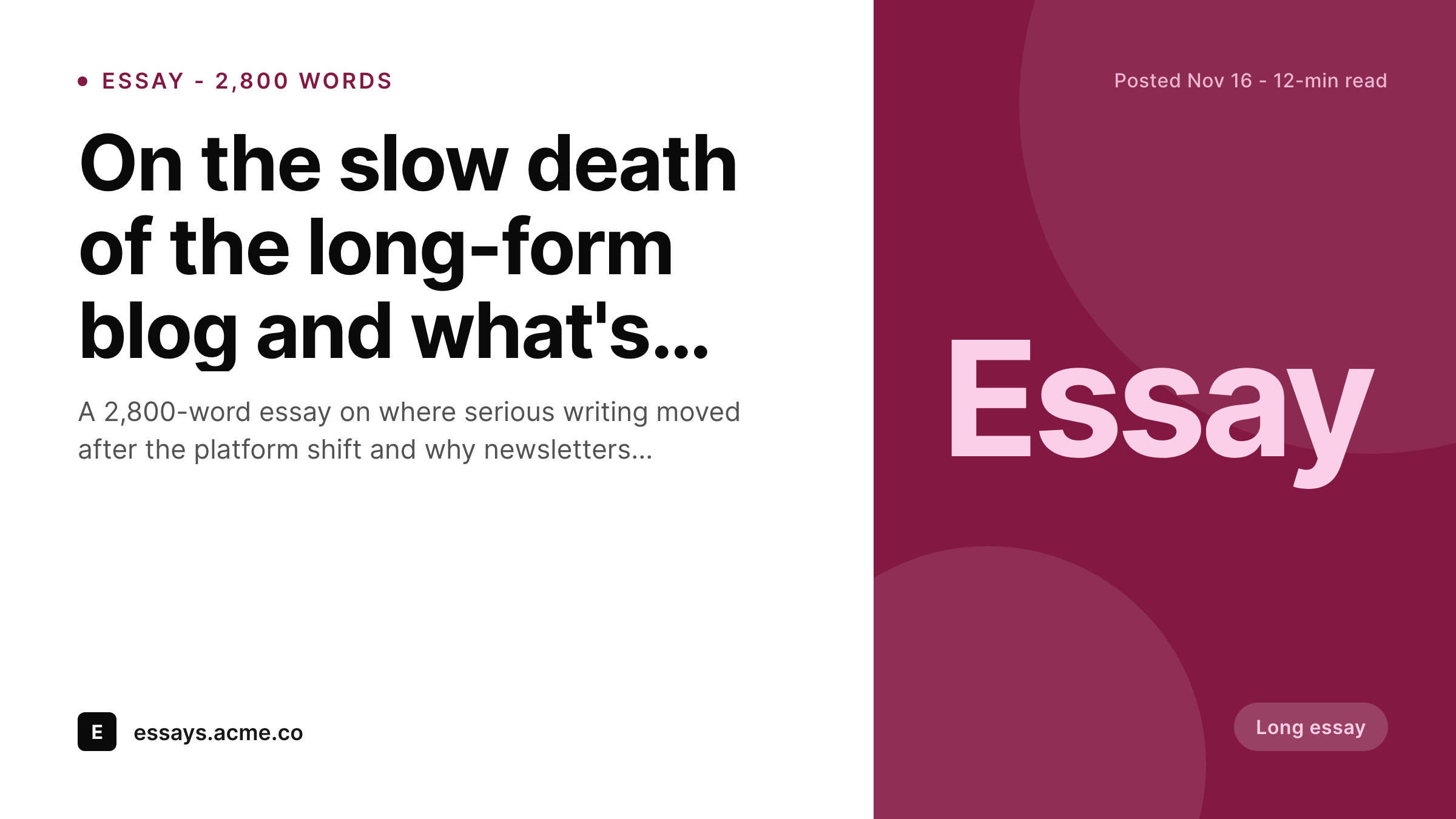
Essay shares that communicate depth on the card
Long-form essays compete for attention against shorter content, and the social share has to communicate depth or it gets scrolled past as just another title-only post. The word count, the read time, and the seriousness of the headline together do that work. Most essay posts ship with a generic featured image that gives the reader none of that information, which means the click-through rate falls below where it should.
SleekPixel renders the essay metadata onto the card. Map essay_headline, word_count, read_time, and essay_topic to the template. The headline takes the title slot in a serif font that signals editorial depth, the word count and read time render on the meta line, and the topic appears on the badge. The composition reads as long-form work, not as a quick news hit.
The Twitter 1200 by 675 size is the default because essay posts find their audience on Twitter where long-form-friendly readers spend time. The same template emits a 1200 by 630 OG image for the blog and a 1200 by 1200 LinkedIn card for professional reposts. The serif typography on the title slot stays consistent across every essay so the series builds a recognizable editorial brand.
Workflow
How SleekPixel handles long-form essays
Map the essay fields
essay_headline, word_count, read_time, and essay_topic as the template inputs. Word count and read time can be computed automatically from the post body via a WordPress filter or set manually for fine-tuned control.
Draft the essay
Publish and render
Share to thoughtful readers
Output
Sample essay share card
A Twitter card promoting a long-form essay on writing platforms. The headline takes the title slot in serif type, the word count and read time render on the meta line, and the topic sits on the badge.
Comparison
Default theme OG image vs SleekPixel for essay card
Default theme OG image
- Default themes show a featured image that does not signal long-form depth to the reader
- Word count and read time live in body text instead of rendered on the share preview
- Headline competes with site branding instead of taking primary visual weight on the card
- Each essay needs a fresh design pass because no template captures editorial typography
- Essay archive reads as a patchwork of one-off designs rather than a coherent series
SleekPixel
-
Reads
essay_headline,word_count, andread_timefrom meta - Renders the headline in a serif font that signals editorial depth and long-form work
- Emits Twitter 1200x675, OG 1200x630, and LinkedIn 1200x1200 from one template
- Updates the card automatically when essay details change on save
- Caches the PNG so feed unfurlers serve the same file across every share
Features
What SleekPixel gives you for essay card
Headline in serif type
Serif typography signals editorial seriousness in a feed dominated by sans-serif marketing copy. The template uses a serif font on the headline so the card visually announces itself as long-form work and earns clicks from readers who specifically seek out essays.
Word count on the meta line
Word count is a useful signal for essay readers. A 2,800-word essay reads differently than a 500-word post, and serious readers self-select based on the count. The meta line renders the count so readers know upfront whether the essay matches their reading commitment for the day.
Read time on the meta line
Read time accompanies word count as a secondary signal. 12-min read communicates the time investment in a more practical unit than word count alone. The template renders both side by side on the meta line so the card carries the full reading-commitment context.
Use cases
Teams that publish long-form essays from WordPress
Founder and exec essays
Founders and execs publish quarterly essays on company strategy, industry trends, and team-building. The template signals editorial weight so the essay competes with content from publications rather than reading as a corporate update with marketing copy.
Editorial essay archives
Companies that run editorial blogs publish a steady cadence of essays. With one template, the archive page renders as a coherent collection of long-form work across months, with the same serif typography and word count format on every entry.
Personal essay sites
Solo writers running personal sites use the template for every essay. The visual brand stays consistent across years of writing, which matters because the readers who follow personal essay writers value the long-running editorial voice across publications.
The bigger picture
Why long-form essays need a different visual brand from other posts
Essays compete in a feed dominated by quick takes, marketing copy, and news. To earn engagement, the share card has to signal depth before the reader has even read the headline. Serif typography does that work better than any other single design choice because it communicates editorial seriousness through associations the reader does not consciously process.
A reader scrolling Twitter sees the serif headline and registers, even subconsciously, that this is a different kind of content than the sans-serif marketing posts surrounding it. The word count and read time on the meta line do the explicit work of communicating commitment. Together, the typography and the metadata create a card that converts well with the self-selecting audience that actually reads essays.
Most blogs underplay this because they use the same template for essays as for short posts, and the visual brand collapses into one generic format. SleekPixel separates the essay template from the rest of the blog so the editorial cards stand out in the feed and the archive reads as a coherent collection of long-form work. Over a year of monthly essays, that produces 12 cards that compound the editorial brand and 12 archive entries that read as a serious body of work rather than scattered marketing posts that happen to be longer than usual.
Questions
Common questions about SleekPixel for essay card
Yes. A small WordPress filter counts the words in the post body on save and writes the count to the meta field. The template reads the meta value rather than recomputing on render, so the word count stays stable even if the post is edited and saved multiple times in a row.
Minutes by default. The template renders 12-min read or 8-min read on the meta line. You can configure the format per page group if you prefer 12 minute read or a different unit. The read time is computed from word count at roughly 250 words per minute as a baseline standard.
Yes. The template uses a serif font for essay headlines specifically. The rest of the blog can use a sans-serif system, and the essay template overrides the typography on the title slot only. That separation makes essays stand out visually from product or marketing posts on the same site.
Use the essay_headline meta field for the social-card headline and let the post title carry the SEO-optimized version. The template reads from the meta field so you can have a tight, punchy social headline and a longer keyword-rich title that improves search visibility.
Yes. Use a part_number meta field for multi-part series. The badge or mark area can render Part 2 of 4 so readers see that the essay is part of a series. The post body links to the other parts, and the archive page can group them under one parent post on the index.
Yes. The badge area renders the essay's primary topic or category. The template handles topic labels like Strategy, Engineering, Hiring, or Industry. Multi-word topics render in a compact format that keeps the badge readable at thumbnail size on the Twitter feed and LinkedIn previews.
Yes. The template does not assume a company brand. Personal sites can configure their own colors, brand mark, and brand line to match a personal voice. Solo writers running long-form essay sites use the same template as company blogs with different brand-level settings.
Yes. The first render after publish stores the PNG and serves it on subsequent requests. Editing the essay meta invalidates the cache and triggers a regeneration so the file always reflects the current word count, read time, headline, and topic as stored on the post.
Pricing
More than 1000+
happy customers
Explore our flexible licensing options tailored to your needs. Upgrade your license anytime to access more features, or opt for a lifetime license for ongoing value, including lifetime updates and lifetime support. Our hassle-free upgrade process ensures that our platform can grow with you, starting from whichever plan you choose.
Lifetime ♾️
Most popular
EUR
once
- Unlimited websites
- Lifetime updates
- Lifetime support
...or get the Bundle Deal
and save €250 🎁
The Bundle (unlimited sites)
Pay once, own it forever
Elevate your WordPress site with our exclusive plugin bundle that includes all of our premium plugins in one package. Enjoy lifetime updates and lifetime support. Save significantly compared to buying plugins individually.
What’s included
-
SleekAI
-
SleekByte
-
SleekMotion
-
SleekPixel
-
SleekRank
-
SleekView
€749
Continue to checkoutBrowse more
- LinkedIn newsletter headers
- eBay listing images
- kbin post images
- Discord server banners
- KDP paperback cover
- Bluesky link cards
- Ghost feature images
- Linktree banner image
- X social cards
- Mastodon profile header
- Rumble thumbnails
- Beacons.ai banner
- Pinterest pins
- Depop listing images
- LinkedIn carousel slides