






SleekPixel for MainWP Dashboard site reports
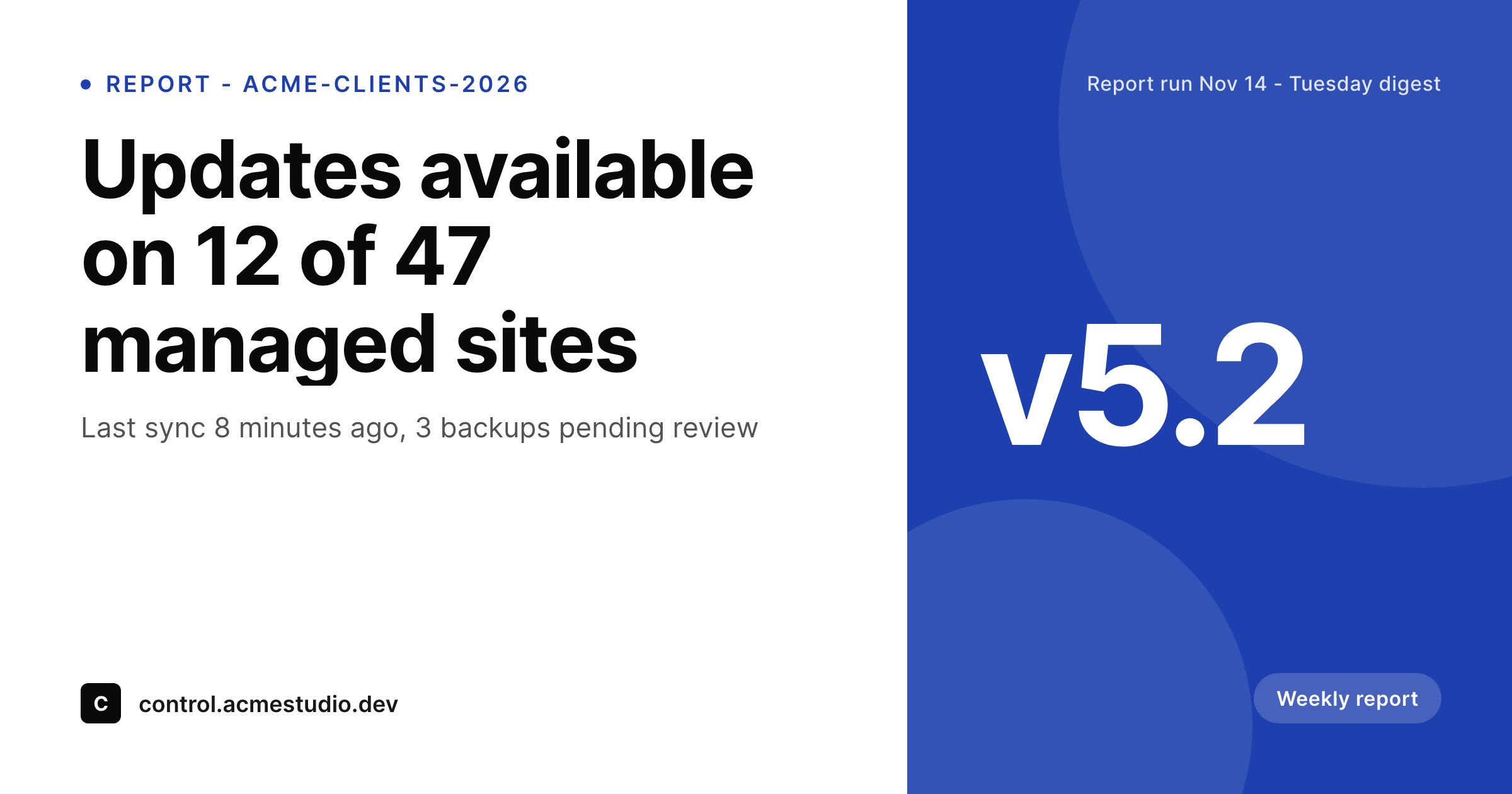
Agencies running MainWP send client reports as URLs, paste site summaries into Slack, and link to the dashboard from internal runbooks. SleekPixel renders an OG card with the site count, update backlog, sync state, and report date pulled straight from the MainWP child-site tables.
♾️ Lifetime License available
Client report URLs that show the numbers up front
MainWP stores its managed-site list in a custom table called mainwp_wp, with one row per child site and columns for the connection URL, last sync time, and update counts. Reports and groupings live in mainwp_wp_group and mainwp_wp_settings. The dashboard surface is a normal WordPress admin page, and the public-facing report pages (for clients who get read-only access) are standard pages with embedded MainWP shortcodes.
The links agencies share most often are these report URLs. Pasted into Slack for a teammate, forwarded to a client over email, or dropped into a runbook. The default preview is the agency site's homepage card, which carries no information about the report itself. A reader has to click through to know whether it covers 5 sites or 50, and whether anything is broken.
SleekPixel queries the mainwp_wp table for the sites in the report group, totals the pending updates, and renders a card with site count, update backlog, last-sync timestamp, and report period. The card refreshes when the daily sync runs, so a Monday report URL forwarded on Friday still previews with current numbers.
Workflow
From mainwp_wp rows to per-report card
Apply template to reports
Query mainwp_wp on render
mainwp_wp filtered by group, a sum of pending updates from the sync column, and the max last-sync timestamp. All run as a single read query.
Hook the MainWP sync cron
mainwp_cronsites_action so the card regenerates whenever the dashboard pulls new data. Updated numbers reach previews without manual intervention from the agency team.
Share URLs across surfaces
Output
Sample MainWP weekly report card
Rendered from a real mainwp_wp table query summing pending updates across the 47 child sites in the agency's main group.
Comparison
Default agency OG vs SleekPixel for MainWP
Same agency homepage image
- Every MainWP report URL previews with the same agency homepage image
- Site counts and update backlog never appear in the share preview
- Stale-sync warnings stay invisible until the recipient opens the dashboard
- Client read-only report links look identical to internal staff URLs
- Tuesday and Friday digests share the same generic preview with no date context
SleekPixel
-
Queries the
mainwp_wptable for site counts and update totals -
Reads
mainwp_wp_settingsfor the report period and group filters - Last-sync timestamps composite onto the card with relative time labels
- Different templates for client-facing vs staff-only report URL patterns
- Card refreshes on the MainWP cron sync, not just on manual save in admin
Features
What SleekPixel gives you for MainWP Dashboard
Site and update counts on the card
The total number of managed child sites and pending plugin, theme, and core updates render as the headline numbers. A teammate scanning Slack can see at a glance whether a report is routine or whether something is overdue and needs attention this week.
Last-sync freshness indicator
Each child site has a last-sync timestamp in mainwp_wp. SleekPixel surfaces the oldest one or counts sites with stale syncs (more than 24h), so the card warns when reports are based on out-of-date data that the team should refresh first.
Client vs staff card variants
Read-only client report URLs render a sanitised card (counts and status, no domain names). Internal staff URLs include child-site hostnames and IPs. Both pull from the same data, with template branching by audience and viewer role.
Use cases
Agencies that benefit from MainWP per-report cards
Weekly client digest senders
When the digest URL lands in a client's inbox or chat, the preview already shows the headline numbers. Fewer questions back about what the report contains and faster sign-off on routine weeks.
Ops teams escalating incidents
Sharing an incident report URL into a war-room channel previews with the affected site count and severity. Responders triage faster because the preview already names the scope.
Portfolio review for internal use
Quarterly portfolio review URLs paste into runbooks with the site total, growth, and update health surfaced on the card. Stakeholders skim the link rather than opening every report.
The bigger picture
Why MainWP cards reduce noise in agency comms
Agencies running MainWP live in their dashboard. Every conversation about a client portfolio starts with a URL. Without per-report previews, those URLs all look the same in chat, which means context lives entirely in the message text around the link.
Anyone joining a thread has to read up. With SleekPixel, the preview itself carries the report period, site count, update backlog, and freshness state. A scan of the channel surfaces the routine reports from the urgent ones without anyone opening a page.
The MainWP data is already there. The mainwp_wp table is the source of truth for child sites. The sync cron updates counts on a schedule.
Pending update totals are queryable. SleekPixel just composes that into an image and writes it to the meta tag, so the same numbers that power the dashboard view also drive the share card. The agency keeps its brand on the surround, the report keeps its identity on the inside.
Questions
Common questions about SleekPixel for MainWP Dashboard
Yes. The core mainwp_wp table is the same in both. Pro extensions like Pro Reports, Boilerplate, and Code Snippets add their own meta tables, which SleekPixel can read if you want extension-specific data on the card.
Yes. The template branches by viewer role. Read-only client URLs render aggregate counts and dates only, never hostnames or IPs. Internal staff URLs include full site details. Both pull from the same source query with different field projections.
SleekPixel listens for the mainwp_cronsites_action hook fired on each sync run. After the sync writes new update counts to mainwp_wp, the card regenerates with current numbers. A manual sync from the dashboard triggers the same hook.
No. Card generation runs asynchronously via Action Scheduler after the sync completes, not inline with the sync itself. A portfolio of 100 sites adds a few seconds of background work after each sync, never blocking the cron.
Yes. The template reads the group ID from mainwp_wp_group and you can map each group to a different layout, accent, or copy. Useful for agencies with both consumer-facing and B2B portfolios under one MainWP install.
Yes. The shortcode embeds report data on a normal WordPress page, and SleekPixel applies the template to that page just like any other public page. The og:image meta lands in the page head and gets picked up by social and chat scrapers.
The query against mainwp_wp stays cheap because it operates on aggregates, not per-row joins. Regeneration runs in background batches, so even portfolios of 500+ sites refresh report cards within minutes of each sync run completing.
No. The integration is read-only on the MainWP side. SleekPixel writes PNG files to the uploads directory and the og:image meta tag in the page head. The mainwp_wp, mainwp_wp_group, and other MainWP tables are never touched.
Pricing
More than 1000+
happy customers
Explore our flexible licensing options tailored to your needs. Upgrade your license anytime to access more features, or opt for a lifetime license for ongoing value, including lifetime updates and lifetime support. Our hassle-free upgrade process ensures that our platform can grow with you, starting from whichever plan you choose.
Lifetime ♾️
Most popular
EUR
once
- Unlimited websites
- Lifetime updates
- Lifetime support
...or get the Bundle Deal
and save €250 🎁
The Bundle (unlimited sites)
Pay once, own it forever
Elevate your WordPress site with our exclusive plugin bundle that includes all of our premium plugins in one package. Enjoy lifetime updates and lifetime support. Save significantly compared to buying plugins individually.
What’s included
-
SleekAI
-
SleekByte
-
SleekMotion
-
SleekPixel
-
SleekRank
-
SleekView
€749
Continue to checkoutBrowse more
- Threads profile banners
- LinkedIn showcase page banners
- Discord stage banner
- Twitter header banners
- Snapchat Discover tiles
- Spotify Canvas
- YouTube channel banners
- Instagram Reels covers
- Lens Protocol posts
- Twitch panel images
- YouTube banner art
- podcast cover art
- Instagram collab post images
- WeChat Moments images
- Facebook Shop product images