






SleekPixel for WPvivid Backup completion reports
Teams running WPvivid send backup-completion URLs to clients, paste backup IDs into Slack for migrations, and link to specific restore points from runbooks. SleekPixel renders an OG card with the backup ID, schedule name, size, destination, and duration from the WPvivid backup list option.
♾️ Lifetime License available
Backup-report URLs that name the backup at preview time
WPvivid stores its backup catalogue as a serialised array in the wp_options table under wpvivid_backup_list. Each backup entry carries a unique ID, the schedule that triggered it, the start and end timestamps, the database and uploads sizes, the remote destination (Google Drive, Dropbox, S3, etc.), and a success flag. Backup runs fire wpvivid_backup_complete and related actions on completion.
When teams share a backup URL or a restore-point link, the default preview is the site's homepage image. There is no visible signal about which backup, when, how big, or where it was stored. Migration teams pasting a backup ID into chat have to add context in text every time, and recipients clicking through just to identify the right backup adds friction to every restore workflow.
SleekPixel reads the wpvivid_backup_list entry for the URL being scraped, then composes a card with the backup ID, schedule name, completion timestamp, database and uploads sizes, and destination. Failed backups get a warning template so a broken backup never previews as a green checkmark.
Workflow
From backup list to backup share card
Apply template to reports
Read the backup entry
wpvivid_backup_list array: ID, schedule, sizes, destination, start and end timestamps. The failure flag drives the template branch between green and amber.
Hook backup completion actions
wpvivid_backup_complete and the failure equivalent so cards regenerate the moment a backup finishes. The next scrape of the URL receives the updated image immediately.
Share backup URLs in handoffs
Output
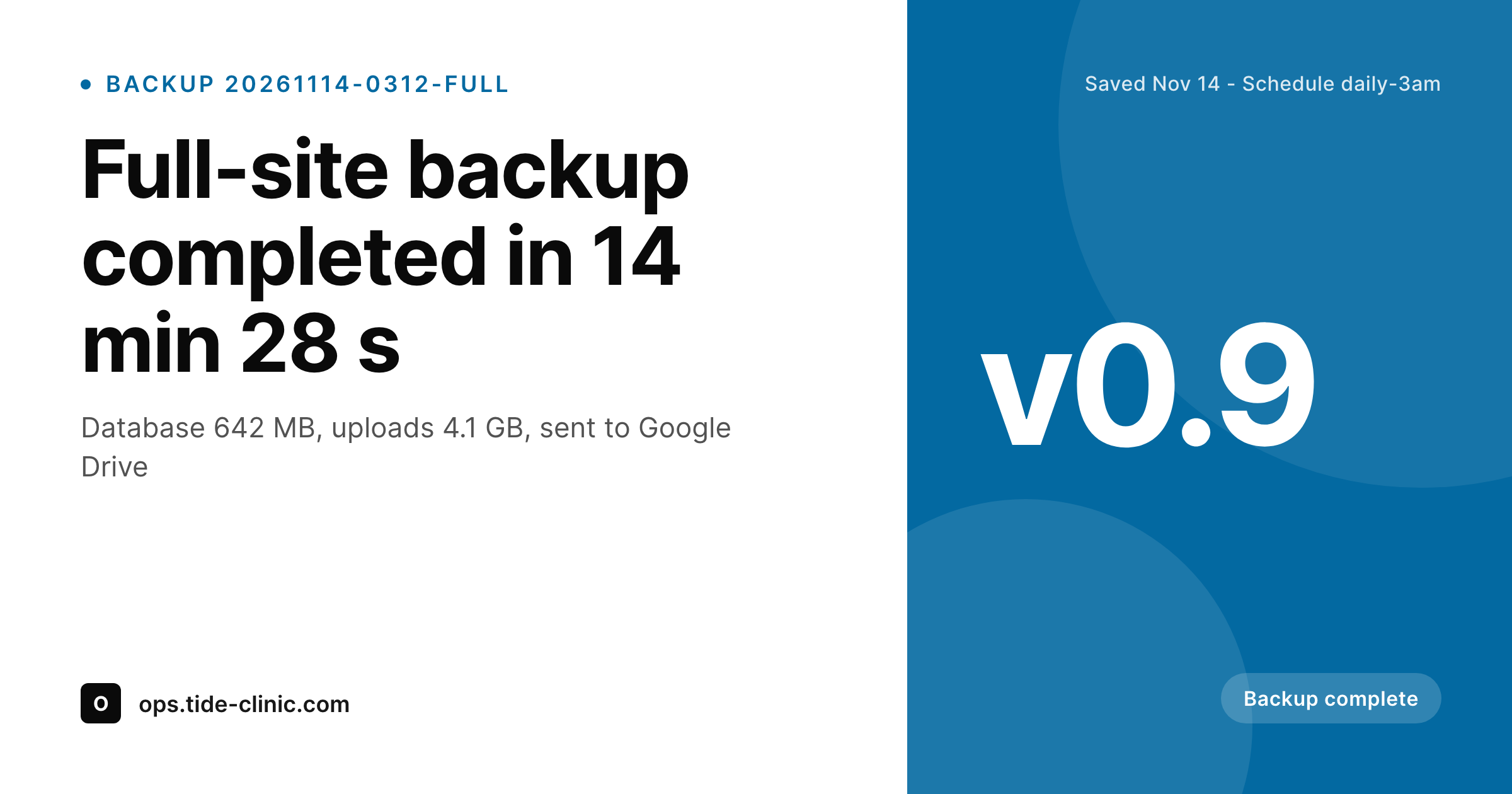
Sample WPvivid backup completion card
Rendered from a real wpvivid_backup_list entry showing backup ID, schedule name, sizes, and remote storage destination from the option payload.
Comparison
Default backup OG vs SleekPixel for WPvivid
Same site image on every URL
- Every backup-report URL previews with the same site homepage image
-
Backup IDs from
wpvivid_backup_listnever reach the share preview - Failed backups look identical to successful ones in shared links
- Sizes and destinations stay invisible until the recipient opens the page
- Migration teams cannot identify the right restore point from chat previews
SleekPixel
-
Reads the
wpvivid_backup_listserialised option for backup metadata - Backup ID, schedule, and completion timestamp on the card headline area
- Database and uploads sizes composited with human-readable byte units
- Destination badge: Google Drive, Dropbox, S3, FTP, or local storage
- Failure state flips the card to amber with the error code clearly visible
Features
What SleekPixel gives you for WPvivid Backup
Backup ID and schedule on the card
The unique backup ID from wpvivid_backup_list renders as a subtitle, and the schedule name (daily-3am, weekly-saturday, manual) becomes the label. Teams reading chat see exactly which backup the URL points at without opening it or running a query.
Remote destination icon
The destination saved in the backup entry (Google Drive, Dropbox, OneDrive, Amazon S3, FTP, SFTP, local) renders as a small icon on the card. Migration handoffs go faster when the recipient already knows where to fetch the archive without asking.
Failure state warning
Backups marked failed in the WPvivid log render with an amber accent and a short error reason. The card surfaces the failure at share time so a broken backup never previews as a healthy completion in a team chat or a client email message.
Use cases
Where WPvivid users benefit most from backup cards
Migration restore handoffs
Migration runbooks paste a backup URL with the card already showing ID, size, and destination. The receiving engineer fetches the right archive on the first try instead of cross-checking the backup list manually.
Client backup confirmations
Daily backup completion emails forwarded to clients arrive with the size and destination on the preview, building confidence that the routine is running and pointing where the data lives.
Failed-run investigations
Failed backup URLs shared in a war-room channel render with the failure state already visible. The team triages from the preview alone, often resolving simple credential issues before the next scheduled run.
The bigger picture
Why backup cards speed up restore work massively
Backups are the most boring piece of infrastructure right up until they are the most important. The moment something needs restoring, every second spent identifying the right backup is friction the team did not need. WPvivid keeps a clean backup list with IDs, sizes, destinations, and timestamps.
The data is queryable, the events are hookable. What is missing is the connection between that data and the URLs the team actually exchanges. A backup-report URL pasted into Slack today previews like the site's homepage.
Same on Tuesday, same on Friday, same for the failed run nobody noticed. SleekPixel fixes that by reading the backup entry and composing a card with the ID, schedule, size, destination, and success state. Migration handoffs go faster because the receiving engineer knows which archive to fetch.
Client confirmations build more trust. Failed runs stop hiding because the card flips to a warning state.
Questions
Common questions about SleekPixel for WPvivid Backup
Yes. Both versions write to the same wpvivid_backup_list option structure. Pro features like staging-site backups and incremental runs add fields that the template can optionally render, but the base integration works on either tier without configuration changes.
Yes. The destination field in each backup entry tells SleekPixel where the archive lives. The card renders the destination icon and the location label. The image itself stays hosted on the WordPress site, only the backup file lives remotely.
If the entry disappears from wpvivid_backup_list, the URL falls back to a generic site card on the next regeneration. Stale share previews continue showing the old card until scrapers re-fetch, at which point they pick up the fallback.
Yes. WPvivid stores split sizes for database, uploads, plugins, themes, and core. The template renders the two largest components (typically DB and uploads) as paired numbers, with a Total prominent above them. Smaller components show on hover or expanded view.
No. Card regeneration runs after wpvivid_backup_complete fires and adds maybe a second of work post-completion. The backup process itself, including the upload to the remote destination, is untouched. Image rendering happens in the background via Action Scheduler.
Yes. Scheduled migrations write entries to the same backup list with a migration flag set. The template can branch on that flag to render a migration-specific card with source and destination site URLs instead of just a backup ID.
Yes. The template accent, logo, and copy are all configurable per site. Agencies running WPvivid Pro under their own branding can drive the card's surround from their agency brand while keeping the backup-specific data in the centre identical.
No. SleekPixel only reads the backup-list option to get metadata, then renders a PNG card. The archive files themselves, whether stored locally or pushed to a remote destination, are never opened, modified, or moved by the integration in any way.
Pricing
More than 1000+
happy customers
Explore our flexible licensing options tailored to your needs. Upgrade your license anytime to access more features, or opt for a lifetime license for ongoing value, including lifetime updates and lifetime support. Our hassle-free upgrade process ensures that our platform can grow with you, starting from whichever plan you choose.
Lifetime ♾️
Most popular
EUR
once
- Unlimited websites
- Lifetime updates
- Lifetime support
...or get the Bundle Deal
and save €250 🎁
The Bundle (unlimited sites)
Pay once, own it forever
Elevate your WordPress site with our exclusive plugin bundle that includes all of our premium plugins in one package. Enjoy lifetime updates and lifetime support. Save significantly compared to buying plugins individually.
What’s included
-
SleekAI
-
SleekByte
-
SleekMotion
-
SleekPixel
-
SleekRank
-
SleekView
€749
Continue to checkoutBrowse more
- explainer video thumbnails
- ESG report card
- swipe file card
- build log cards
- award announcement images
- growth chart cards
- LinkedIn poll card
- indie hacker cards
- founder letter card
- OKR recap card
- code snippet card
- downtime notice cards
- founding customer card
- holiday greeting cards
- behind the build card
- LinkedIn company banners
- Mastodon link previews
- GitHub social preview images
- Substack post thumbnail
- Dailymotion thumbnails
- Twitch stream overlay images
- kbin post images
- YouTube podcast thumbnails
- Pinterest pins
- Etsy listing images
- Vimeo channel banners
- YouTube channel banners
- X ad images
- Twitch panel images
- Tidal cover art