






SleekPixel for Asset CleanUp rollout posts
Asset CleanUp is the Gabe Livan asset gating plugin used across many WordPress sites. The posts that recap a Asset CleanUp rollout get a SleekPixel card with the defer or minify state, the configuration flags, and a clean rules count summary pulled from safe option counters.
♾️ Lifetime License available
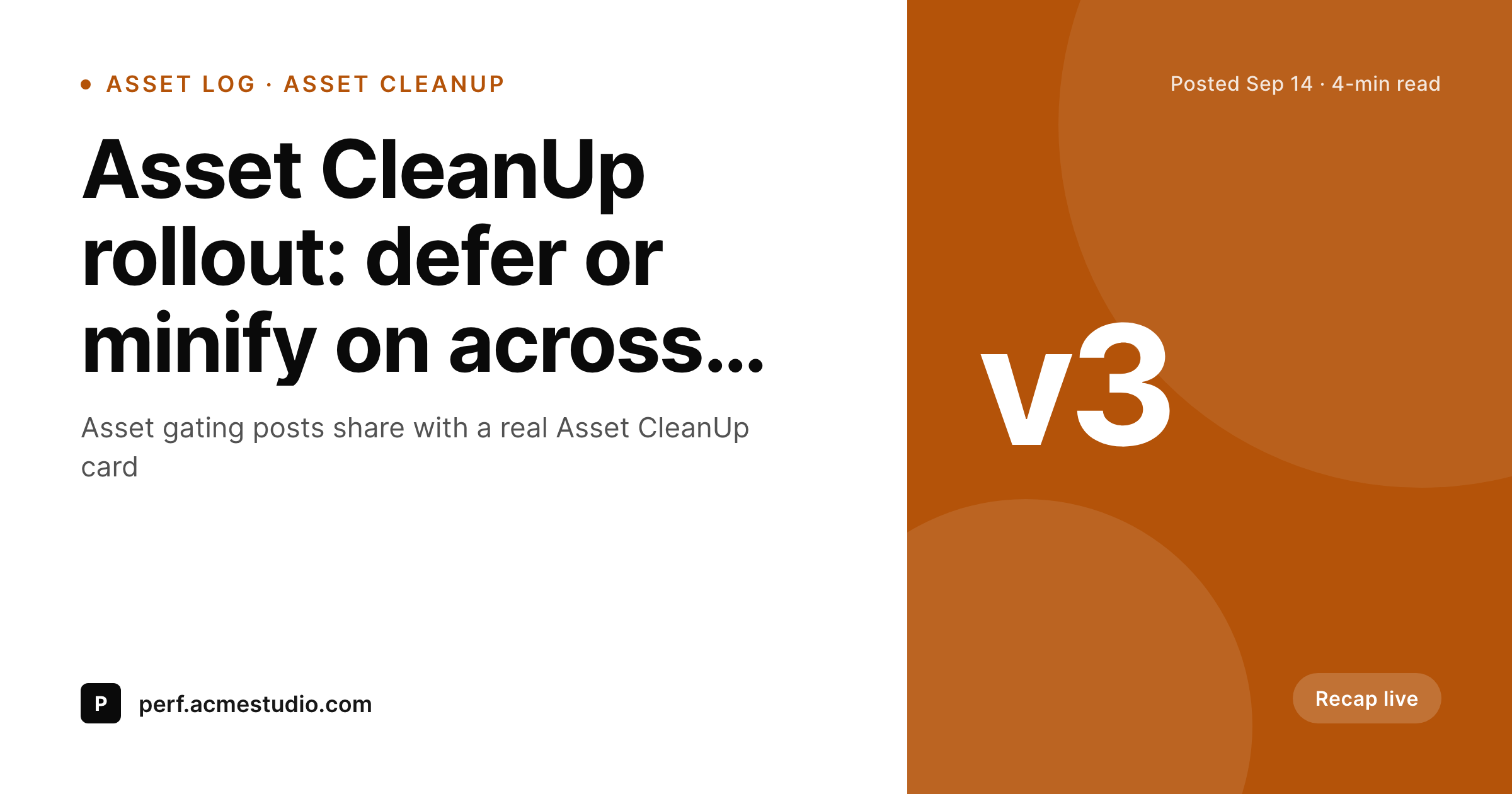
Asset CleanUp recaps deserve a state-shaped preview
Asset CleanUp stores its configuration in the wpacu_settings option family with sub-keys for the defer or minify state, the toggle flags, and the rules count counter. Per-attachment data lives in the _assetcleanup_load_exceptions postmeta on each item the plugin touches, and wpacu summary powers the dashboard summary. The keys are designed for the standard options API.
Sites that run a Asset CleanUp rollout publish a recap post. The post explains what the rollout covered such as initial sweep, defer rollout, critical CSS. The audience is performance-aware readers and clients reviewing the work. A generic homepage banner buries the result in a regular blog update. A state card with the defer or minify flags and the rules count number communicates the rollout in the preview itself.
SleekPixel binds to a recap post type with fields for rollout type, period, and summary. A whitelisted subset of wpacu_settings renders as small posture badges showing defer on, minify on, critical CSS on. The template lays out the badges on the right and the recap summary on the left. The render produces a 1200x630 PNG that surfaces the Asset CleanUp rollout result.
Workflow
From Asset CleanUp settings to state card
Set up the recap post type
Whitelist safe Asset CleanUp fields
wpacu_settings are safe to expose such as the defer or minify flags and the rules count counter. The exact list is configurable per site through a small filter.
Bind template fields
Publish or update the post
Output
Sample Asset CleanUp rollout card
A 1200x630 OG card from a Asset CleanUp rollout post showing the defer or minify state badges, the rules count summary, the brand mark, and a clean recap label.
Comparison
Default theme OG vs SleekPixel for Asset CleanUp
Default theme OG image
- Asset CleanUp rollout recaps share with the same homepage banner as marketing posts
- The defer or minify flag set never appears in the social preview for any recap
- Rules count stays invisible to anyone forwarding the recap link
- Manual graphics for each rollout stop happening within a quarter or two
- Performance reviewers see no operational signal in the share preview at all
SleekPixel
-
Reads safe summary counters from the
wpacu_settingsoption family -
Per-item
_assetcleanup_load_exceptionsdata is never exposed wholesale on the ca.. - The defer or minify flags each render as a clean posture badge on the card
- Rules count renders as a clean number, not a per-row dump
- Per-rollout template variants for initial sweep, defer rollout, critical CSS and related reca..
Features
What SleekPixel gives you for Asset CleanUp
Defer or minify state badges
Whitelisted state from wpacu_settings renders as small posture badges showing the defer or minify flags and the active configuration. The badges reflect the live state on every recap save without any manual entry from the post a..
Rules count summary line
The running rules count value renders as a short summary line below the headline. A clean number is used rather than a per-row dump from the underlying tables. The card stays focused on the result that clients care about.
Rollout-type variants
initial sweep, defer rollout, critical CSS each use a rollout-type variant. The variant selection happens on the rollout-type field, so editors pick the kind of work and the right card design renders on every save without manual..
Use cases
Where Asset CleanUp users benefit from state cards
Performance milestone posts
Posts that announce a Core Web Vitals win get a Asset CleanUp state card pairing the score with the defer or minify flags. The share signals the win came from real asset gating work.
Client recap reports
Agencies that publish quarterly recaps for clients get a Asset CleanUp card with the period summary. The card communicates the rollout work without exposing billing or quota data.
Tutorial-style Asset CleanUp guides
How-to posts on configuring Asset CleanUp get a tutorial template card with the configured state as a sample. The visual signals the technical nature before the click.
The bigger picture
Why Asset CleanUp recaps need state-shaped previews
Asset CleanUp does asset gating work that is invisible by default. The frontend pages changes shape, scores improve, and clients never see the lift in the share preview because the recap looks like every other blog post on the site. Performance and SEO are disciplines that compound across a back catalog.
Asset CleanUp rollouts are the visible evidence that the discipline is alive across the site. The share preview is what audiences see first when the link lands in Slack or email. A generic homepage banner collapses the rollout into a marketing update.
A state card with the defer or minify flags and the rules count number communicates the work directly and gets the right attention from performance reviewers. The compounding effect shows up over a year of recaps. Each rollout, with a consistent state card, becomes a body of operational evidence that the program is real and ongoing across the back catalog of recap posts on the site.
Questions
Common questions about SleekPixel for Asset CleanUp
No. The per-item _assetcleanup_load_exceptions postmeta is not part of the whitelist. The render reads only safe summary counters from the option family, and per-item data stays scoped to the underlying tool where it belongs in normal use.
Yes. Pro adds bulk rules and critical CSS but stores configuration in the same option family. Any flag you whitelist renders the same way as the free flags, through the standard template binding on the card render. There is no separate code path for the paid tier on the binding side.
Generally no. Per-row data is operational detail that most teams prefer to keep off the share image. The whitelist defaults to summary counters and toggle flags. Per-row dumps can be added on internal-only variants but are not in the default binding by design.
Each recap captures the state at publication time through the whitelisted flags. Historical recap posts keep the values current at save, so the audit trail of changes stays intact across the back catalog of recap posts published on the site over time.
Yes for live binding. If the plugin is deactivated the binding falls back to a manual value entered on the recap post and the auto-state badges go quiet by design. Reactivating restores the live binding on the next save without any code change.
Yes. The rollout type drives the variant selection. initial sweep, defer rollout, critical CSS each use a dedicated layout that highlights the relevant badge set as the headline state of the recap and downplays unrelated badges accordingly through the variant configuration.
Yes. The rules count field is opt-in per variant. Some teams prefer to keep the number off the share image and reserve it for the body of the post, which is supported through a simple toggle on the variant configuration without code changes.
Yes. Each tool stores configuration in its own option family. SleekPixel binds to whichever option family is active for the recap post type, and multi-tool variants are supported as a separate template family for joint recap posts that touch both layers.
Pricing
More than 1000+
happy customers
Explore our flexible licensing options tailored to your needs. Upgrade your license anytime to access more features, or opt for a lifetime license for ongoing value, including lifetime updates and lifetime support. Our hassle-free upgrade process ensures that our platform can grow with you, starting from whichever plan you choose.
Lifetime ♾️
Most popular
EUR
once
- Unlimited websites
- Lifetime updates
- Lifetime support
...or get the Bundle Deal
and save €250 🎁
The Bundle (unlimited sites)
Pay once, own it forever
Elevate your WordPress site with our exclusive plugin bundle that includes all of our premium plugins in one package. Enjoy lifetime updates and lifetime support. Save significantly compared to buying plugins individually.
What’s included
-
SleekAI
-
SleekByte
-
SleekMotion
-
SleekPixel
-
SleekRank
-
SleekView
€749
Continue to checkoutBrowse more
- webinar replay card
- did-you-know card
- dashboard screenshot cards
- explainer video thumbnails
- live now card
- state of industry cards
- limited edition cards
- anniversary promo card
- beta launch cards
- LinkedIn thread card
- annual report card
- compliance update cards
- white paper cover
- incident postmortem card
- founder story cards
- YouTube podcast thumbnails
- Pinterest product pin covers
- Shopify product images
- Warpcast frame images
- Behance project covers
- Beacons.ai banner
- Etsy shop banners
- Amazon Storefront banners
- Weibo post images
- Ko-fi banners
- VSCO cover
- Slack channel headers
- Twitter/X header
- Instagram Reels covers
- LinkedIn showcase page banners