






SleekPixel for incident postmortem cards
SleekPixel reads the incident date, duration, root cause, and customer impact from a single postmortem post and renders a Twitter-ready share card. Engineering writes the postmortem once; the card carries the headline facts onto every share without anyone re-cropping a screenshot.
♾️ Lifetime License available
Public postmortems live or die by their share image
Engineering teams that ship public postmortems get rewarded for the practice, but only when those posts actually reach the people who care. A postmortem buried under a generic site logo OG image gets 5% of the audience that the same post with a real share card gets. The difference is not the writing. It is whether the share preview tells the reader 'this is a postmortem about an outage on Nov 8' before they click.
SleekPixel reads the postmortem post's incident_date, duration_minutes, root_cause, and customer_impact fields and renders a Twitter-card-ready 1200x675 image. The card carries the incident date, duration, and a one-line root-cause summary. The full postmortem stays in the post body where engineering wrote it.
Every postmortem inherits the same template. The visual rhythm tells readers, at a glance, that the post is part of a series the company takes seriously. The accent color shifts to a muted red so the card reads as a real engineering artifact, not a marketing piece.
Workflow
How a card renders, end to end
Write the postmortem
postmortem CPT. Fields: incident date, duration, root cause, customer impact, action items.
Bind regions
Save and render
Share or archive
Output
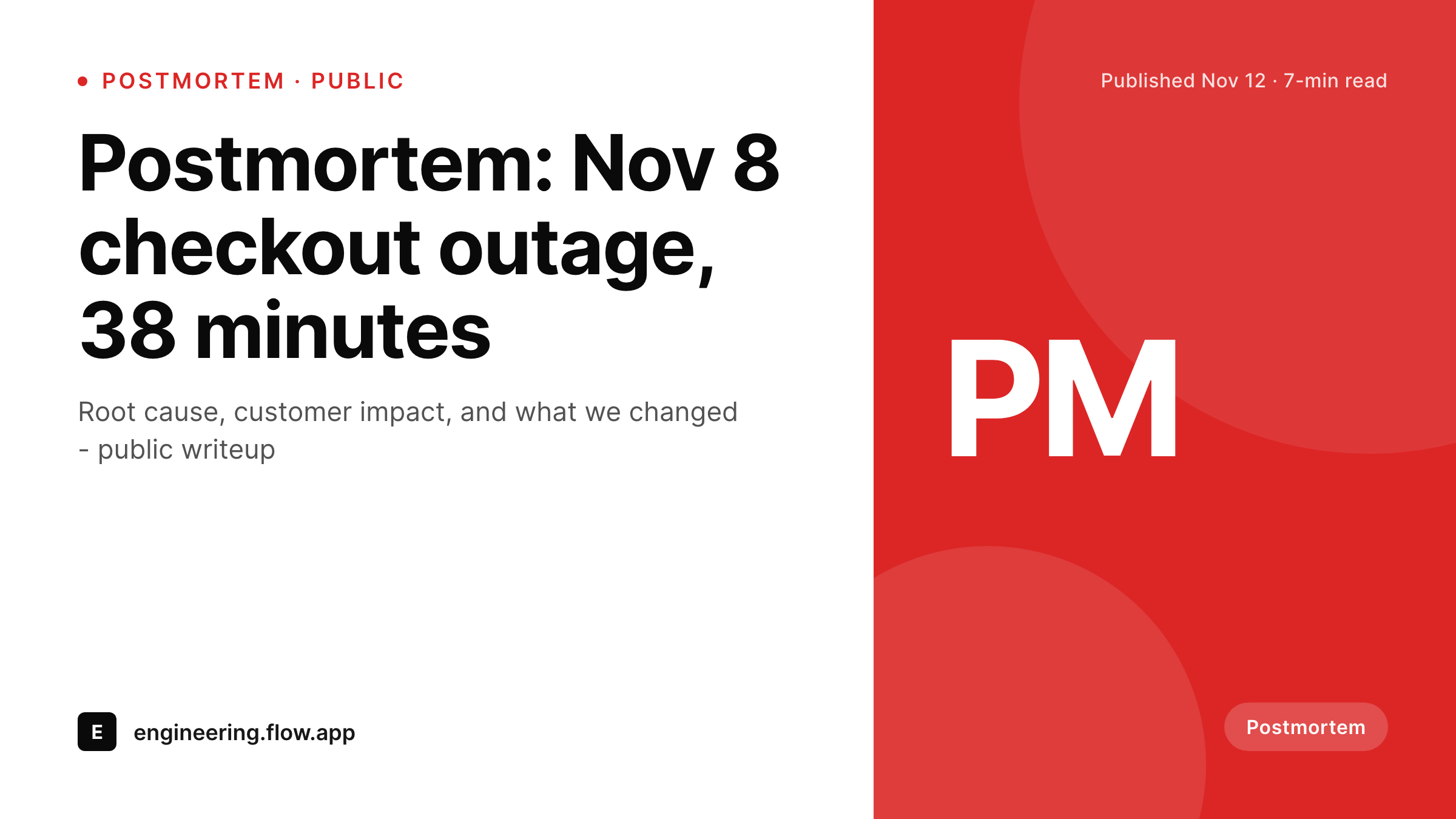
Sample postmortem share card
Rendered from a single postmortem post: incident date, duration, and one-line root cause. The full writeup remains in the post body.
Comparison
Default twitter card vs SleekPixel for incident postmortem cards
Generic engineering blog OG image
- Postmortems publish under the site's default OG image; the topic disappears
- Engineering teams skip the design step entirely and live with bad previews
- Manual share images require dragging the incident date into Figma each time
- Root cause summary in the card and the writeup drift after revisions
- No visual continuity across a multi-year incident archive
SleekPixel
-
Reads
incident_date,duration_minutes,root_causefrom the postmortem post - Customer-impact line surfaces directly on the card, not buried in the writeup
- Twitter-card 1200x675 with an OG 1200x630 variant from the same render
- Muted-red accent treatment signals 'engineering postmortem' visually
- Falls back to date-and-duration-only headline if root cause is still unset
Features
What SleekPixel gives you for incident postmortem card
Incident-aware
The template surfaces the incident date, duration, and root cause as first-class information. Readers know what the post is about before they click, which is the entire job of an OG image.
Single source of truth
Engineering writes the postmortem once in WordPress. The same fields feed both the post body and the rendered card, so revisions to the writeup automatically propagate to the share image.
Series consistency
Every postmortem inherits the same template. A reader who has seen one of your postmortems recognizes the next at a glance. That recognition is hard to buy with paid social.
Use cases
Where this fits engineering blogs
Twitter / X distribution
Engineering teams share postmortems on X primarily. The 1200x675 card surfaces the date and duration so timeline scrollers see the topic without clicking.
Customer comms
Account managers attach the rendered card when emailing affected customers after an outage. The card is a more readable artifact than a status-page screenshot.
Hiring signal
Strong engineering brands attract better candidates. A visible cadence of well-designed postmortems is a real recruiting asset, not just a customer-facing one.
The bigger picture
Why postmortems are a brand-shaping artifact
Public postmortems are one of the few engineering artifacts that double as marketing. Vendors that publish them consistently signal a real engineering culture, and customers reward that signal with retention. The cost of not publishing is not just the absence of the artifact; it is the absence of the visible cadence.
A team that ships two postmortems a year cannot match the brand effect of a team that ships eight, even if those eight cover smaller incidents. Making the publishing process frictionless is what unlocks the cadence. SleekPixel removes the design step from the postmortem workflow.
The engineer writing the postmortem fills in the same fields they would already fill in - incident date, duration, root cause - and the card renders on save. There is no separate Figma file, no separate handoff. Over a year, that removes hours of friction per postmortem and several days across the team, and the share quality improves rather than degrades.
The downstream effect is more postmortems, more visible cadence, more reach per postmortem, and a brand that gets stronger every time something goes wrong. That last sentence sounds counterintuitive until you see it work for a year.
Questions
Common questions about SleekPixel for incident postmortem card
Probably not. Most teams have a severity threshold that determines whether a postmortem is published. SleekPixel can render cards for both internal-only and public postmortems; you decide which posts make it to a public URL.
Only if the post fields contain it. Most teams keep customer_impact generic (e.g. 'checkout requests for ~12% of customers') instead of naming specific accounts.
Yes. A status field with preliminary or final values can route to two SleekPixel templates with different badge labels.
Yes, with a separate template. Most teams use a slightly different visual treatment for security postmortems so readers know the post is a security-class artifact.
Use the X Card Validator after a revision to force a re-scrape. The og:image on the post URL updates immediately when SleekPixel re-renders on save.
The PNG cannot carry links. But the host post page can anchor the action-items section, and most teams add a footer line on the card directing readers to scroll for action items.
One post per incident, one card per post. If two incidents happen on the same day, each gets its own postmortem with its own card. The archive page handles ordering by post date and time.
Optional. A remediation_eta field can be bound to a small region of the card showing the target date for action items. Many teams use this only after the first review cycle.
Pricing
More than 1000+
happy customers
Explore our flexible licensing options tailored to your needs. Upgrade your license anytime to access more features, or opt for a lifetime license for ongoing value, including lifetime updates and lifetime support. Our hassle-free upgrade process ensures that our platform can grow with you, starting from whichever plan you choose.
Lifetime ♾️
Most popular
EUR
once
- Unlimited websites
- Lifetime updates
- Lifetime support
...or get the Bundle Deal
and save €250 🎁
The Bundle (unlimited sites)
Pay once, own it forever
Elevate your WordPress site with our exclusive plugin bundle that includes all of our premium plugins in one package. Enjoy lifetime updates and lifetime support. Save significantly compared to buying plugins individually.
What’s included
-
SleekAI
-
SleekByte
-
SleekMotion
-
SleekPixel
-
SleekRank
-
SleekView
€749
Continue to checkoutBrowse more
- GitHub social preview images
- GitHub README banners
- Passes page banner
- Etsy listing images
- Reddit subreddit banners
- Discord event cover
- KDP paperback cover
- Discord server banners
- Odnoklassniki banners
- YouTube playlist covers
- Facebook cover photos
- Instagram grid tiles
- Tidal cover art
- Mastodon profile header
- Dailymotion thumbnails