






SleekPixel for behind the build cards
Build log posts perform best on Twitter when the card carries the feature name, the team size, and the timeline. SleekPixel reads those fields from your WordPress post meta and renders a Twitter card so engineering can publish build logs without queuing design for every retrospective.
♾️ Lifetime License available
Build logs the engineering team can publish themselves
Build log posts have a predictable shape. There is a feature name, a team that shipped it, a timeline (days or weeks), a deadline if one applied, and a short summary of what worked. Most engineering blogs publish these as text posts with a featured image because the structure varies enough that a fixed template feels limiting. The result is a feed of retrospectives that all look slightly different and a share preview that does not carry the actual feature name.
SleekPixel handles the variation through meta. Map feature_name, team_size, timeline, and summary to the template, and use a category field for the type of post (Retrospective, Sprint recap, Spike, Refactor). The template branches the badge per type but keeps the same layout, so retros and sprint recaps share visual continuity while still reading distinctly.
The Twitter 1200 by 675 size is the default because build logs land on developer Twitter where the audience is technical and time-constrained. The template also emits a 1200 by 630 OG image for the engineering blog itself and a 1200 by 1200 LinkedIn card for engineering-recruiting reposts. Three sizes, one render, one WordPress post.
Workflow
How SleekPixel handles build logs
Map the build fields
feature_name, team_size, timeline, summary, and build_type as the template inputs. Engineering maintains these through a build-log post type or an ACF group attached to the regular posts.
Draft when the feature ships
Publish to the engineering blog
Share to engineering channels
Output
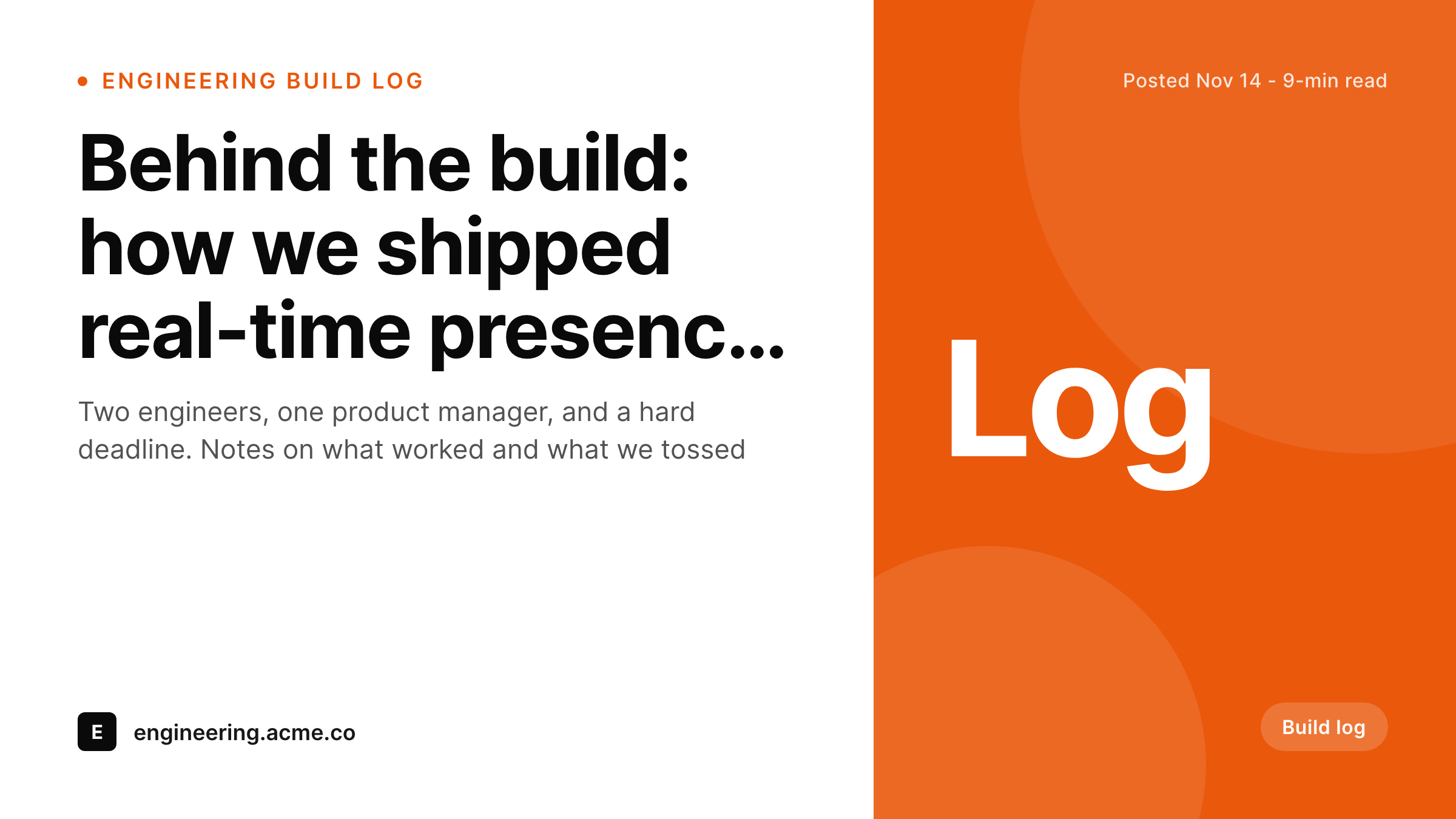
Sample build log retrospective card
A Twitter card recapping a feature shipped in two weeks. The feature name sits on the title slot, the team size on the meta line, and the timeline on the mark area.
Comparison
Default theme OG image vs SleekPixel for build log
Default theme OG image
- Default themes show a generic featured image with no feature name on the card
- Team size and timeline live in body text instead of rendered on the share preview
- Each build log needs a custom design pass because no template captures the structure
- Retro, sprint recap, and refactor posts look identical because there is no badge variation
- Engineering blog reads as a patchwork of post types instead of one coherent series
SleekPixel
-
Reads
feature_name,team_size, andtimelinefrom meta - Branches the badge between Retrospective, Sprint recap, Spike, and Refactor
- Renders Twitter 1200x675, OG 1200x630, and LinkedIn 1200x1200 from one template
- Engineering publishes build logs without filing a design request per post
- Caches the PNG so feed unfurlers serve the same file across every share
Features
What SleekPixel gives you for behind the build card
Feature name on the title slot
The feature is the headline of the build log, and the template reserves the title slot for it. Long names wrap to two lines automatically, and short names use a larger font so the card reads cleanly whether the post is about real-time presence or about an unused refactor.
Team size on the meta line
Build logs are more interesting when readers know the team size. The template renders the team size on the meta line so an engineer scrolling Twitter sees that the feature shipped with two engineers and a PM, not a thirty-person org. That context changes how the post reads.
Timeline on the mark
The timeline is the punchline of a build log. The template renders the timeline on the mark area as 2w, 6d, Q3, or whatever short string the post stores. Readers scanning the feed see the punchline before clicking through, which improves click-through rate.
Use cases
Teams that publish build logs from WordPress
Engineering blogs
Engineering blogs publish build logs as one of their most engaging post types. The template makes it self-serve for engineers, who can draft a retrospective without filing a design request and publish the same day the feature ships.
Engineering recruiting
Recruiting reposts build logs to show developers how the team works. The LinkedIn-sized version from the same template gives recruiting a feed-ready asset without a separate design pass for the recruiting-specific channel.
Sprint-recap archives
Engineering blogs that publish recurring sprint recaps build a long archive. With one template, the archive reads as a clean record of engineering progress over time rather than a patchwork of different design eras and inconsistent layouts.
The bigger picture
Why build logs are usually undershared and how a template helps
Build logs are one of the best-performing engineering content types on social, but most engineering blogs publish far fewer of them than they could. The reason is rarely lack of material. Engineers ship features every week, and almost every shipped feature has a story worth telling.
The reason is the friction between writing the post and getting a share asset. The post is easy to draft. The share image requires a design pass.
So the team writes the retrospective internally, posts a Slack thread, and never publishes externally. With SleekPixel, the share image is no longer a blocker. The engineer drafts a post with the feature name, team size, timeline, and a one-paragraph summary, hits publish, and the share asset is rendered before the page reloads.
The Twitter card lands on developer Twitter the same hour, the LinkedIn version goes to recruiting, and the OG image unfurls cleanly in Slack when teammates link the post internally. Over a quarter, that shifts the engineering blog from publishing two build logs to publishing eight, because the marginal cost of each post drops to writing the post itself. The cumulative effect on developer brand and recruiting is significant, and the engineering team gets a public archive of how they actually work.
Questions
Common questions about SleekPixel for behind the build card
Yes. Use a build_type field with values like Retrospective, Sprint recap, Spike, Refactor, and Postmortem. The badge branches per type while the composition stays the same, so a refactor post and a sprint recap read as part of the same series with appropriate labeling.
Store the team size as the count of people who worked on the feature over its lifespan. The template renders it as 2 engineers, 3 engineers, or a mixed count with a PM and a designer if you store those roles. Readers value the rough scale, not exact daily attendance.
Yes. The mark area accepts any short string stored in the timeline meta, so 2w, 6d, Q3, or a custom string like Friday-to-Monday all render. The template scales the font size to fit longer timelines while keeping shorter ones large and prominent on the card.
Yes. The title slot renders the feature name exactly as stored, including version numbers like Real-time presence v2 or Search indexer v3. Long names wrap to two lines automatically, and the layout stays readable even when version numbers extend the headline.
Yes. Store the authors as a repeating meta field or use WordPress's native co-author support. The template renders the byline as a list of names with a +N indicator for longer lists. The post body can include detailed credits for each contributor on the team.
Yes. The card regenerates during the WordPress save hook so any edit to the meta refreshes the rendered image immediately. Social platform caches can be refreshed through their respective debuggers when needed to pick up the corrected version.
Yes. WordPress supports private posts and staff-only access. SleekPixel still renders the card for staff URLs so internal retros can use the same template even when the post is not public. External build logs and internal retros share visual consistency.
Yes. The first render after publish stores the PNG and serves it on subsequent requests. Editing the post invalidates the cache and triggers a regeneration so the file always reflects the current meta and post content for every share.
Pricing
More than 1000+
happy customers
Explore our flexible licensing options tailored to your needs. Upgrade your license anytime to access more features, or opt for a lifetime license for ongoing value, including lifetime updates and lifetime support. Our hassle-free upgrade process ensures that our platform can grow with you, starting from whichever plan you choose.
Lifetime ♾️
Most popular
EUR
once
- Unlimited websites
- Lifetime updates
- Lifetime support
...or get the Bundle Deal
and save €250 🎁
The Bundle (unlimited sites)
Pay once, own it forever
Elevate your WordPress site with our exclusive plugin bundle that includes all of our premium plugins in one package. Enjoy lifetime updates and lifetime support. Save significantly compared to buying plugins individually.
What’s included
-
SleekAI
-
SleekByte
-
SleekMotion
-
SleekPixel
-
SleekRank
-
SleekView
€749
Continue to checkoutBrowse more
- beta launch cards
- listicle thumbnail
- tool of the day cards
- Product Hunt launch card
- growth experiment card
- code snippet card
- ISO certification card
- fact-of-the-day card
- new arrival cards
- LinkedIn poll card
- KPI cards
- press kit card
- before-after comparison images
- explainer video thumbnails
- longform article card
- TikTok Now image
- KDP paperback cover
- Audible audiobook cover
- Flickr cover photo
- Substack podcast cover
- Tidal cover art
- Weibo post images
- Discord stage banner
- Substack post thumbnail
- Mastodon profile banners
- Telegram channel banner
- Kick channel banners
- Facebook Shop product images
- Facebook cover photos
- Twitch schedule banners