






SleekPixel for code snippet cards
Code snippet posts get the most engagement when the share image actually shows the code. SleekPixel reads the snippet, language, and line count from your WordPress post meta and renders a Twitter card with the snippet typeset cleanly so readers can scan the logic before they click through to the blog post.
♾️ Lifetime License available
Snippet cards that show the code on the social preview
Code snippet posts perform well on developer Twitter because the audience can scan the code, decide if it is interesting, and click through if it is. Most posts hide the code in the body, which means the social preview shows a featured image with no actual content. The result is a click-through rate that depends entirely on the title rather than the substance.
SleekPixel renders the snippet onto the card itself. Store the code in a snippet_code meta field with a matching snippet_language, and the template typesets the snippet in a monospace font with appropriate spacing. The mark area carries the language abbreviation like TS, PY, GO, or RS, and the meta line carries the line count. Readers see the actual code on the Twitter unfurl.
The Twitter 1200 by 675 size is the default because snippets thrive on developer Twitter. The same template emits a 1200 by 630 OG image so the linked blog post unfurls the same way in Slack and email. Both renders use the snippet content from the same meta field, so corrections to the code update both images automatically on save.
Workflow
How SleekPixel handles snippet posts
Map the snippet fields
snippet_code, snippet_language, and line_count as the template inputs. The code is stored as a multi-line string field, and the language is a short string. ACF handles both cleanly with a code editor field type.
Draft the snippet post
Publish and render
Share to developer feeds
Output
Sample code snippet share card
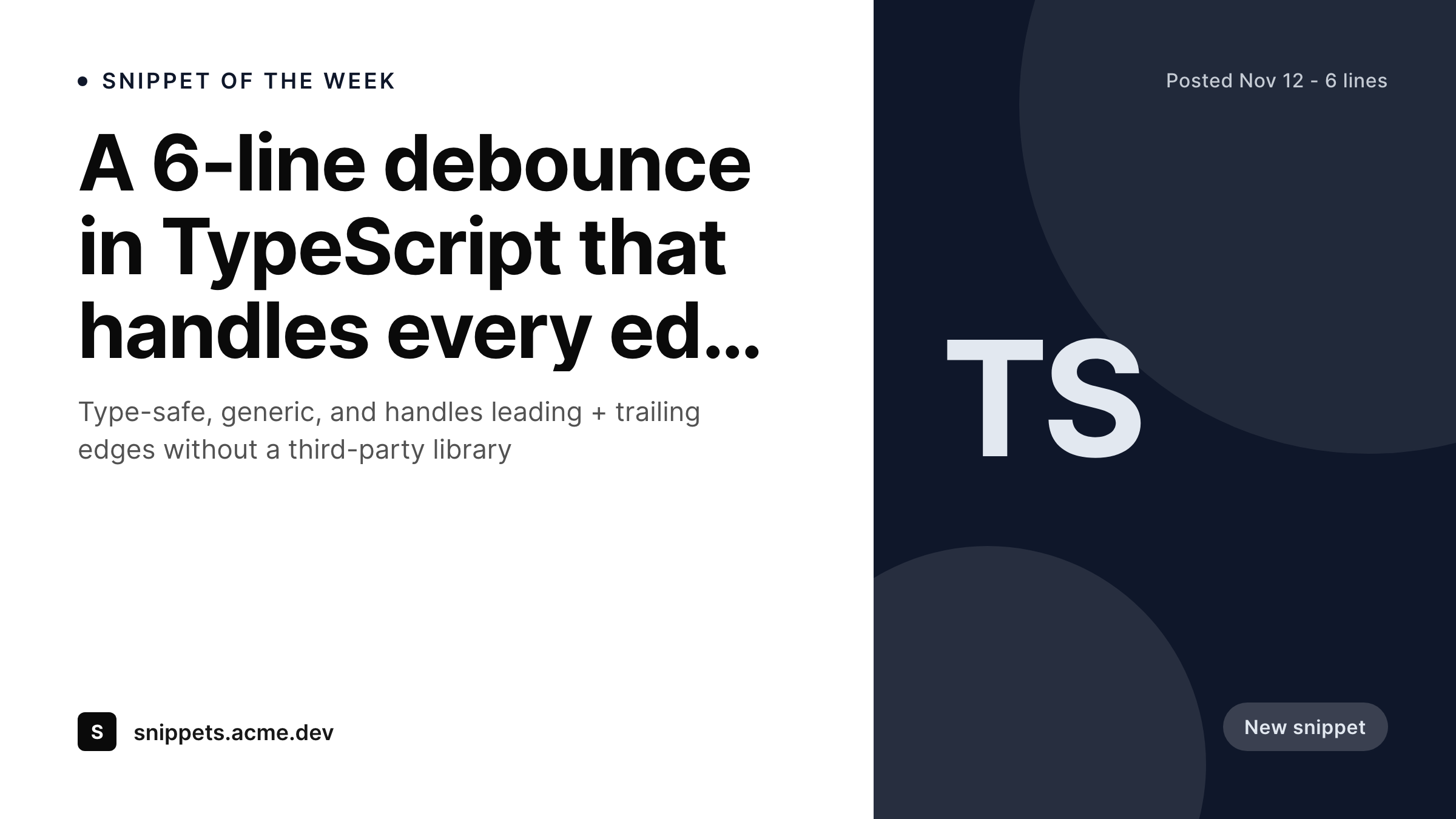
A Twitter card with a typeset TypeScript debounce function. The language abbreviation sits on the mark, the line count on the meta line, and the snippet renders in monospace in the preview area.
Comparison
Default theme OG image vs SleekPixel for code snippet
Default theme OG image
- Default themes show a featured image with no actual code visible on the share preview
- Language and line count live in body text instead of rendered as visible context
- Snippet posts get title-only click-through because readers cannot scan the code first
- Each snippet needs a manual screenshot for socials because no template renders the code
- Screenshots end up at different fonts and sizes because they are exported ad hoc
SleekPixel
-
Reads
snippet_code,snippet_language, andline_countfrom meta - Typesets the snippet in a monospace font with consistent line spacing across posts
- Renders Twitter 1200x675 and OG 1200x630 from one template definition
- Regenerates the card on save so corrections to the code update both images at once
- Caches the PNG so feed unfurlers serve the same file across every share
Features
What SleekPixel gives you for code snippet card
Code typeset on the card
The snippet is rendered in a monospace font with appropriate line height in the preview area of the card. Readers can scan up to twelve lines on Twitter and click through for the full explanation. Longer snippets fade with a more-on-blog indicator at the bottom.
Language on the mark
The language abbreviation goes on the mark area as TS, PY, GO, RS, JS, or any other short code. Readers identify the language at a glance, which matters because developers filter their feeds by language preference and skip past snippets in stacks they do not use.
Line count on the meta line
Shorter snippets earn more engagement because they fit the scan-then-click cycle. The meta line renders the line count so a six-line snippet looks distinct from a sixty-line one, which helps the reader decide whether to click through or just save the image.
Use cases
Teams that share code snippets from WordPress
Engineering blogs
Engineering blogs publish short snippet posts as part of their distribution strategy. The template renders the snippet on the social card so the post earns clicks from the code itself, not just from the title written for the blog index.
Developer education sites
Tutorial sites and learning platforms share daily snippet cards. With one template, every snippet uses the same typography and the same card layout so the social feed reads as a consistent series of bite-sized lessons.
Snippet collection pages
Collection pages list every snippet across languages and topics. With one template, the page renders as a clean grid of consistent cards rather than a patchwork of screenshots at different fonts, sizes, and formats from one post to the next.
The bigger picture
Why code snippets need the code on the share image
Code snippet posts are some of the highest-performing engineering content on social media because they offer immediate utility. A reader who scans the snippet can decide whether it solves a problem they have right now, and clicks through to read the explanation if it does. The trouble is that most snippet posts publish with a generic featured image, which means the social preview gives the reader nothing to scan.
They have to trust the title and click through blindly, which most readers do not. SleekPixel changes the math by rendering the snippet onto the card. The Twitter unfurl shows the actual code, the reader scans it in two seconds, and either saves the image, clicks through, or keeps scrolling with high confidence about which choice is right.
That selection effect lifts click-through rate on posts that survive the scan, because the readers who click are the ones for whom the snippet actually matters. Over a quarter of snippet posts that adds up. A blog that publishes weekly snippet cards produces 13 consistent cards a quarter, each one carrying the actual code, each one cached and served quickly by social platforms.
The cumulative effect on developer brand is meaningful, and the snippet archive page on the site reads as a clean grid of cards across languages, topics, and authors.
Questions
Common questions about SleekPixel for code snippet card
Up to twelve lines fit cleanly in the default Twitter card layout. Longer snippets fade at the bottom with a more-on-blog indicator. The post body always carries the full snippet, so readers who want the complete version click through and find it immediately on the blog post.
Yes. The template typesets the snippet using a monospace font and applies a subtle color scheme to keywords, strings, and comments based on the language meta. The highlighting is intentionally restrained so the card remains readable on small mobile screens and in feed previews.
Yes. The mark area accepts any short string stored in the language meta. Standard codes like TS, PY, GO, RS, JS, and SH render with appropriate brand colors. Custom values render as plain text on the mark area in the brand accent.
Store the snippet as a normal string in the meta field. The template handles tabs, newlines, and Unicode characters correctly when typesetting. Escaped characters in your stored value render as the underlying character on the card, so a literal newline becomes a line break.
Yes. If you leave the line count meta empty, the template counts the lines in the snippet at render time and renders the count on the meta line. You can also override the count manually if you want to display a different number, such as effective lines without comments.
Yes. The default accent color is dark slate to match developer color schemes, but you can configure light, dark, or solarized variants per page group. The accent and accentFg fields control the card background and foreground colors independently for each variant.
Yes. Store one file as the primary snippet for the card and link the other files in the post body. For multi-file content, use the longform-article-cards template instead, which is designed for longer content with code blocks embedded in narrative paragraphs.
Yes. The first render after publish stores the PNG and serves it on subsequent requests. Editing the snippet meta invalidates the cache and regenerates the card so the file always reflects the latest version of the code as stored on the post.
Pricing
More than 1000+
happy customers
Explore our flexible licensing options tailored to your needs. Upgrade your license anytime to access more features, or opt for a lifetime license for ongoing value, including lifetime updates and lifetime support. Our hassle-free upgrade process ensures that our platform can grow with you, starting from whichever plan you choose.
Lifetime ♾️
Most popular
EUR
once
- Unlimited websites
- Lifetime updates
- Lifetime support
...or get the Bundle Deal
and save €250 🎁
The Bundle (unlimited sites)
Pay once, own it forever
Elevate your WordPress site with our exclusive plugin bundle that includes all of our premium plugins in one package. Enjoy lifetime updates and lifetime support. Save significantly compared to buying plugins individually.
What’s included
-
SleekAI
-
SleekByte
-
SleekMotion
-
SleekPixel
-
SleekRank
-
SleekView
€749
Continue to checkoutBrowse more
- privacy update cards
- product launch cards
- preorder cards
- checklist download card
- compliance update cards
- case study banner
- expert quote card
- benchmark report cards
- podcast clip cards
- feature launch images
- office opening card
- Series A cards
- prediction cards
- infographic card snippets
- customer story card
- Bluesky profile banner
- Twitch offline banners
- Discord event cover
- Slack channel headers
- Snapchat ad images
- Substack post headers
- KakaoTalk channel banners
- Spotify Canvas
- Amazon Storefront banners
- Nostr note images
- TikTok profile banners
- Kick channel banners
- Substack post thumbnail
- Tidal cover art
- Instagram Reels covers