






SleekPixel for regex cards
Regex posts thrive on developer Twitter when the card carries the actual pattern. SleekPixel reads the pattern, the regex flavor (PCRE, JS, POSIX), and the character count from your WordPress meta and renders a Twitter card so readers can copy the pattern straight from the unfurl or click through for the explanation.
♾️ Lifetime License available
Regex share cards that show the pattern itself
Regex posts perform well on developer Twitter because the pattern is the value. A reader who sees the pattern can decide whether it fits their problem in three seconds. Most regex posts publish with a generic featured image, which hides the pattern in the post body and converts the share into a title-only impression. That loses the entire selection mechanism that makes regex posts work.
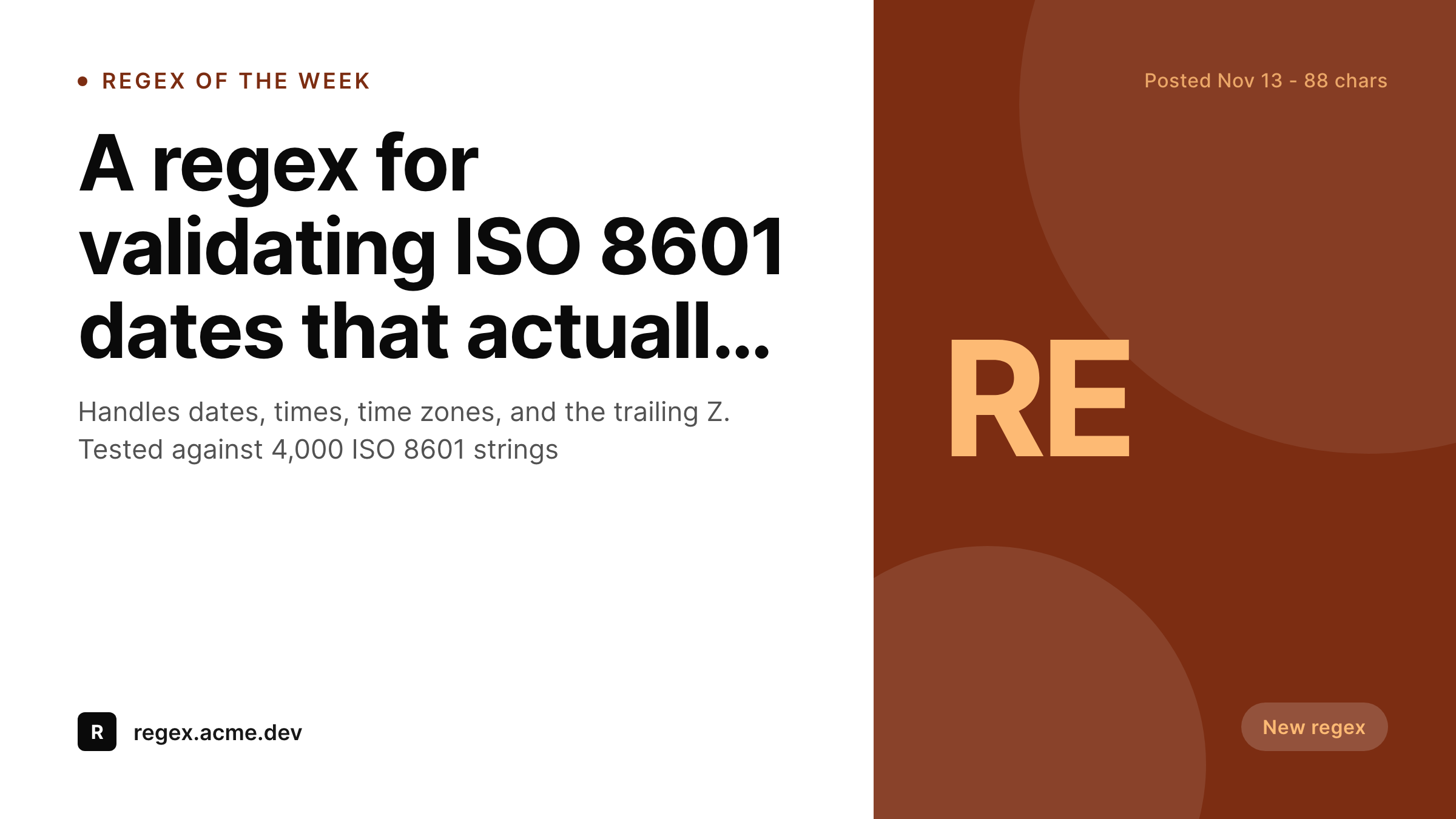
SleekPixel renders the pattern onto the card. Store the pattern in a regex_pattern meta field, the flavor in regex_flavor, and the template typesets the pattern in a monospace font with appropriate spacing for the slashes and brackets. The mark area carries an RE abbreviation, the meta line carries the character count, and the flavor renders on the brand mark so PCRE patterns read distinctly from JavaScript or POSIX flavors.
The Twitter 1200 by 675 size is the default because regex posts land on developer Twitter where readers are already in pattern-debugging mode. The same template emits a 1200 by 630 OG image for the blog post that explains the pattern in depth. Both renders pull from the same meta field, so a correction to the pattern updates both images automatically on save.
Workflow
How SleekPixel handles regex posts
Map the pattern fields
regex_pattern, regex_flavor, and char_count as the template inputs. The pattern is stored as a string in the meta field, and the flavor is a short string like PCRE, JS, POSIX, or PY.
Draft the regex post
Publish and render
Share to developer feeds
Output
Sample regex share card
A Twitter card with an ISO 8601 regex pattern typeset in monospace. The flavor sits on the brand mark, the character count on the meta line, and the pattern fills the preview area.
Comparison
Default theme OG image vs SleekPixel for regex card
Default theme OG image
- Default themes show a featured image with no actual pattern visible on the share preview
- Flavor and character count live in body text instead of rendered as visible context
- Regex posts get title-only click-through because readers cannot scan the pattern first
- Each pattern needs a manual screenshot because no template renders the regex directly
- Screenshots end up at different fonts and sizes because they are exported ad hoc per post
SleekPixel
-
Reads
regex_pattern,regex_flavor, andchar_countfrom meta - Typesets the pattern in monospace with appropriate spacing for slashes and brackets
- Renders Twitter 1200x675 and OG 1200x630 from one template definition
- Regenerates the card on save so corrections to the pattern update both images at once
- Caches the PNG so feed unfurlers serve the same file across every share
Features
What SleekPixel gives you for regex card
Pattern on the card
The pattern is the entire value of a regex post, so the template renders it on the preview area of the card in a monospace font. Readers scan the pattern in three seconds, copy it if it solves their problem, or click through for the full explanation if they want to understand why.
Flavor on the brand mark
PCRE, JavaScript, POSIX, and Python regex flavors all behave differently. The template renders the flavor on the brand mark so readers see which engine the pattern targets at a glance. That matters because a pattern that works in JS may not work in POSIX.
Character count on the meta line
Short patterns are easier to remember and to type. The meta line renders the character count so a reader can tell at a glance whether the pattern is a one-line snippet or a multi-line beast. That context helps them decide whether to copy it or skip to a simpler alternative.
Use cases
Teams that share regex patterns from WordPress
Developer education sites
Tutorial sites publish regex posts as part of their distribution. The template renders the pattern on the social card so the post earns clicks from the regex itself, not just from a generic featured image attached to every entry on the blog.
Regex collection pages
Collection pages list every regex across flavors and use cases. With one template, the page renders as a clean grid of consistent cards rather than a patchwork of screenshots at different fonts and sizes from a long history of one-off posts.
Engineering documentation
Internal documentation sites use the same template for regex references shared in Slack. The OG image carries the pattern into the link preview so engineers searching for a known regex pattern can identify it from the unfurl without opening the doc.
The bigger picture
Why regex shares need the pattern on the image
Regex content is uniquely scannable. A pattern is short enough to fit on a card and dense enough that experienced developers can read it in two seconds and know whether it fits their problem. That is why regex posts perform well on Twitter when they are shared with the pattern visible, and why they underperform when the pattern is hidden in the post body.
Most blogs default to the underperforming version because there is no automated way to render the pattern onto a share card. The screenshots that some authors take by hand vary in font, size, and color from post to post, which means the regex archive on the blog looks like a patchwork rather than a series. SleekPixel solves both problems with a template that reads the pattern from meta and typesets it consistently on every card.
Over a year of weekly regex posts, that produces 52 consistent cards across PCRE, JavaScript, POSIX, and Python flavors. The archive page on the blog renders as a clean grid of patterns. Each card carries the flavor on the brand mark and the character count on the meta line, so readers can filter by flavor visually and prioritize shorter patterns when space matters.
The cumulative effect is a regex archive that reads as a coherent reference rather than scattered one-off shares.
Questions
Common questions about SleekPixel for regex card
Up to about 200 characters fit cleanly in the default Twitter card layout in a single line, with wrapping for longer patterns up to about 600 characters across three lines. Very long patterns fade at the bottom and link to the full post body for the complete version.
Yes. If you store the pattern with leading and trailing slashes, the template renders them. If you store the pattern without slashes, the template can add them based on the flavor meta. JS flavor renders with slashes, PCRE renders without, and POSIX renders with bracketed syntax.
Yes. The brand mark accepts a small logo file in addition to or instead of the flavor text. You can store JS, Python, or PCRE logos in the media library and reference them from the flavor meta so the card carries both the flavor name and its visual mark.
Store the pattern as a normal string in the meta field. The template handles escaped characters, backslashes, and Unicode correctly during typesetting. Brackets, parentheses, and quantifiers all render as the literal characters on the card without further escaping.
Yes. If you leave the count meta empty, the template counts the characters in the pattern at render time and renders the count on the meta line. You can also override the count manually if you want to display a different number, such as the count without flags.
Yes. Store the flags in a separate meta field like regex_flags with values like i, g, m. The template renders the flags after the closing slash for JS-style patterns or as a footnote on the meta line for flavors that handle flags inline.
Yes. The template handles multi-line patterns by wrapping at each newline in the stored value. PCRE x flag patterns with whitespace and comments render with the comments visible on the card so the structure of the pattern stays readable on small previews.
Yes. The first render after publish stores the PNG and serves it on subsequent requests. Editing the pattern meta invalidates the cache and regenerates the card so the file always reflects the current version of the pattern stored on the post.
Pricing
More than 1000+
happy customers
Explore our flexible licensing options tailored to your needs. Upgrade your license anytime to access more features, or opt for a lifetime license for ongoing value, including lifetime updates and lifetime support. Our hassle-free upgrade process ensures that our platform can grow with you, starting from whichever plan you choose.
Lifetime ♾️
Most popular
EUR
once
- Unlimited websites
- Lifetime updates
- Lifetime support
...or get the Bundle Deal
and save €250 🎁
The Bundle (unlimited sites)
Pay once, own it forever
Elevate your WordPress site with our exclusive plugin bundle that includes all of our premium plugins in one package. Enjoy lifetime updates and lifetime support. Save significantly compared to buying plugins individually.
What’s included
-
SleekAI
-
SleekByte
-
SleekMotion
-
SleekPixel
-
SleekRank
-
SleekView
€749
Continue to checkoutBrowse more
- SoundCloud track art
- Pinterest Idea Pins
- Rumble thumbnails
- Vimeo channel banners
- Twitter card images
- Facebook group banners
- YouTube banner art
- Pinterest product pin covers
- Mastodon profile header
- TikTok cover images
- TikTok Now image
- Rednote (Xiaohongshu) post
- Lemmy post images
- Mastodon link previews
- Discord stage banner