






SleekPixel for Chinese restaurants
Cantonese dim sum, Sichuan numbing oil, Shanghainese xiao long bao, all live in WordPress already. SleekPixel renders them into squares and OG images with the regional tag and bilingual title intact.
♾️ Lifetime License available
Chinese cooking is a continent of regions, the art should respect it
An independent Chinese restaurant in most Western cities is fighting two opposite assumptions at once, the strip-mall takeout assumption and the white-tablecloth Mandarin assumption. The actual kitchen could be Cantonese dim sum, Sichuan mapo and dan dan, Shanghainese soup dumplings, Hunanese smoked work, Northeastern hand-pulled noodles, or a dozen others. The website's menu page may explain the regional sourcing, but the customer scrolling on a Saturday morning does not read menu pages. They see a generic kung pao photo and reach for the same takeout conclusion they have been reaching for since 1998.
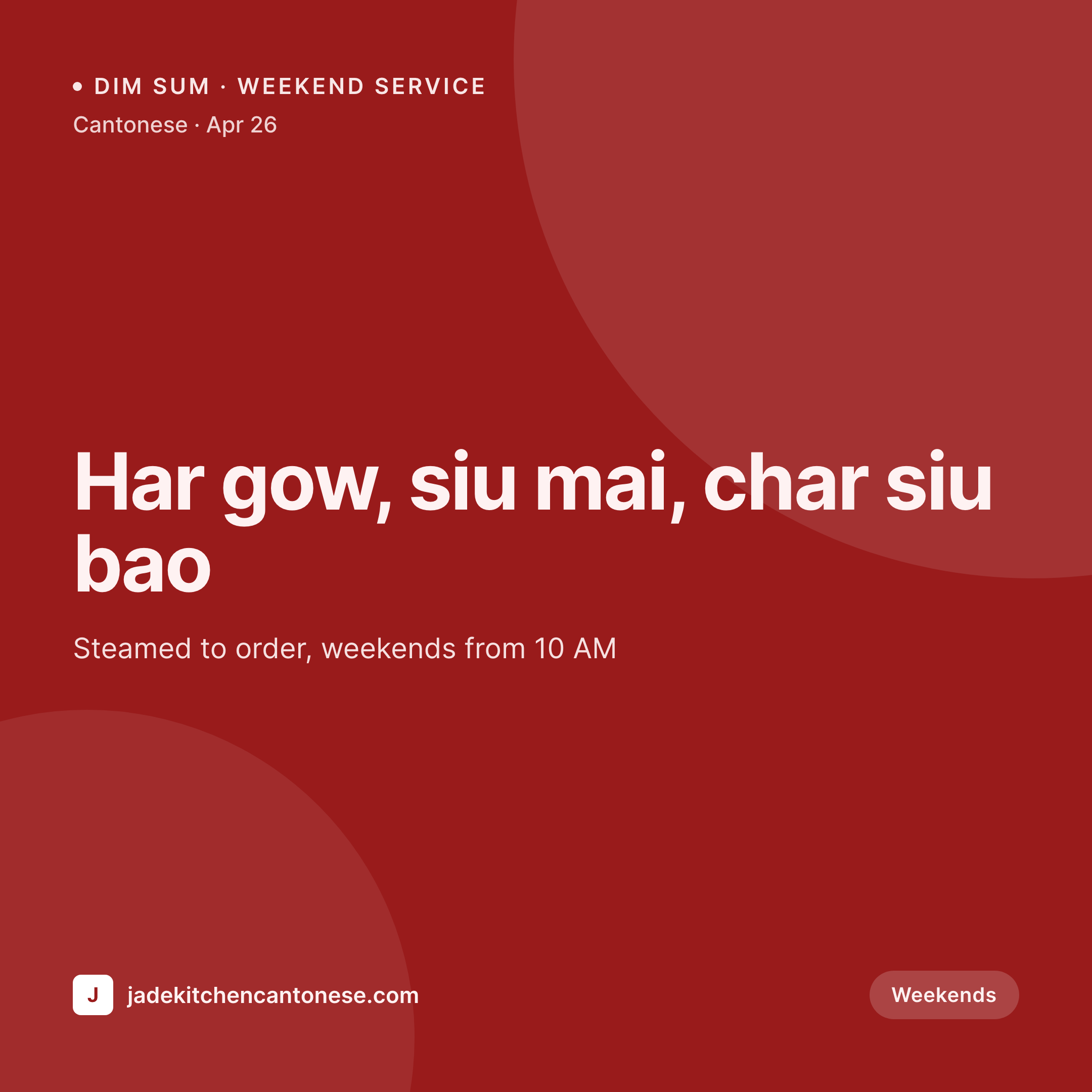
SleekPixel reads from the menu and dim-sum-service posts in WordPress. The dish name in English, the Chinese characters, the regional tag, the dietary badges, the spice scale, and the price all live as fields. One template renders the Instagram square and the OG image with the bilingual title set in matching weights, the regional tag as a small city line, and the dim sum service window as a fixed strip when the post type is dim-sum-service.
The customer who is actually looking for Cantonese dim sum on a Saturday morning finds it, because the art they see when scrolling reads as Cantonese, not as generic Chinese.
Workflow
From a dim-sum post to a service-window square
Build the dish template
Map the menu post type
Save the service post
Post and share
Output
What renders for dim sum service
A 1080 square Instagram post built from the dim-sum-service post: dish list, regional tag, service window, price-per-basket range, and a hero shot.
Comparison
Default Chinese restaurant image vs SleekPixel
Default Chinese restaurant image
- Generic kung pao photo recycled for every special, regional cooking flattened
- Chinese characters dropped entirely because Canva fonts do not cover them
- Regional tag (Cantonese, Sichuan, Hunan) buried in caption text
- Dim sum service window mentioned in description but never on the image
- Spice scale missing, so Sichuan dishes get ordered as if they were Cantonese
SleekPixel
- Bilingual titles render with simplified or traditional characters from a field
- Regional tag renders as a small city line under the dish title
- Dim sum service window renders as a fixed strip on dim-sum posts
- Spice scale renders as pepper icons readable at thumbnail size
- Dietary badges pull from taxonomy and render in a fixed row
Features
What SleekPixel gives you for Chinese restaurants
Simplified and traditional
Template supports both simplified and traditional characters via Noto Sans CJK SC and TC. The kitchen picks the field, the template renders the script.
Regional tag
Cantonese, Sichuan, Shanghainese, Hunanese, Northeastern renders as a small city line under the dish, signaling tradition without burying it.
Service window
Dim sum on weekends 10 AM to 2 PM renders as a fixed strip, so customers know when to walk in without calling first.
Use cases
Who uses SleekPixel for Chinese restaurants
Dim sum service
Weekend dim sum service renders its own square with the basket list and the service window baked in.
Sichuan and Hunan specials
Spicy-regional specials render with the spice scale and the regional tag in a fixed position, so the heat level reads at thumbnail.
Festival menus
Lunar New Year, Mid-Autumn Festival, and Dragon Boat specials render from a festival-night post type with festival name and dates baked in.
The bigger picture
Why regional Chinese art rewrites who walks in the door
The Chinese restaurant market in most cities is split into two flat categories, takeout and banquet, neither of which describes what an actual independent regional kitchen is doing. The customer who wants Cantonese dim sum on Saturday morning, or Sichuan mapo on a Tuesday night, or Shanghainese soup dumplings as a weekend ritual, is searching for those specific things. The kitchen that does them is invisible in the search results because the marketing reads as generic Chinese, the same as the takeout joint down the block.
Auto-rendered art that surfaces the regional tag, the bilingual title in the right characters, the spice scale, and the service window changes who finds the kitchen. The dim sum customer finds dim sum, the Sichuan customer finds Sichuan, and the kitchen stops sharing search results with takeout boxes. The food still does the cooking, the art makes the cooking findable to the customers who were already looking for it.
Questions
Common questions about SleekPixel for Chinese restaurants
Yes. The renderer is headless Chromium, so Noto Sans CJK SC for simplified and TC for traditional both load correctly. The kitchen picks the field, the template renders the script that field contains.
Yes. A dim sum service post can list baskets as repeating items with name, characters, and price each. The template renders them in a grid below the headline.
Any menu plugin storing items as custom posts with custom fields exposes those fields to the template. WP Cafe, Five Star Restaurant Menu, or a hand-rolled CPT all map the same way.
The character field is a single text field, so the kitchen picks which variant to use. Cantonese restaurants typically use traditional characters, mainland-leaning kitchens use simplified, and the template renders whatever is in the field.
Yes. The spice field can be a composite, with one number for ma (numbing) and another for la (spicy). The template renders two small icon rows side by side, so Sichuan customers see the full picture instead of one flattened spice score.
A festival post type with parent festival and child dishes renders one cover image per festival and one card per dish. The festival name and dates bake into a fixed corner across the rollout.
Not directly. SleekPixel renders images. If the kitchen uses WooCommerce or a third-party ordering plugin, the order URL bakes into the corner of the image as text, the same way the menu URL works for sit-down service.
Yes. Edit the template once, run bulk re-render from the SleekPixel admin, every menu post re-renders with the new design. Regional tags, characters, and service windows all stay correct because they live on the post, not in the template.
Pricing
More than 1000+
happy customers
Explore our flexible licensing options tailored to your needs. Upgrade your license anytime to access more features, or opt for a lifetime license for ongoing value, including lifetime updates and lifetime support. Our hassle-free upgrade process ensures that our platform can grow with you, starting from whichever plan you choose.
Lifetime ♾️
Most popular
EUR
once
- Unlimited websites
- Lifetime updates
- Lifetime support
...or get the Bundle Deal
and save €250 🎁
💎 Want everything forever? The All Access Pass is going away on 01.08.2026.
The Bundle (unlimited sites)
Pay once, own it forever
Elevate your WordPress site with our exclusive plugin bundle that includes all of our premium plugins in one package. Enjoy lifetime updates and lifetime support. Save significantly compared to buying plugins individually.
What’s included
-
SleekAI
-
SleekByte
-
SleekMotion
-
SleekPixel
-
SleekRank
-
SleekView
€749
Continue to checkoutBrowse more
- team hire card
- command of the day card
- course module cards
- review snippet cards
- recap card
- speaker cards
- infographic headers
- before-after comparison images
- workshop replay card
- doors closing card
- tool of the day cards
- book recommendation cards
- workshop cards
- incorporation card
- feature comparison cards
- Twitch overlay
- X Space banners
- Rednote (Xiaohongshu) post
- WhatsApp status images
- YouTube playlist covers
- LINE official account banners
- Twitch camera frame
- Snapchat Discover tiles
- Twitch profile banner
- Facebook group banners
- Snapchat ad images
- Telegram channel cover images
- KakaoTalk channel banners
- Spotify podcast covers
- podcast cover art