






SleekPixel for domain launch cards: new site reveals
When the team moves to a new domain, the share image is what tells the audience the move is real. SleekPixel reads the new domain, the launch date, and the redirect status from custom fields and composes a Twitter card that puts the URL front and center in the new brand system.
♾️ Lifetime License available
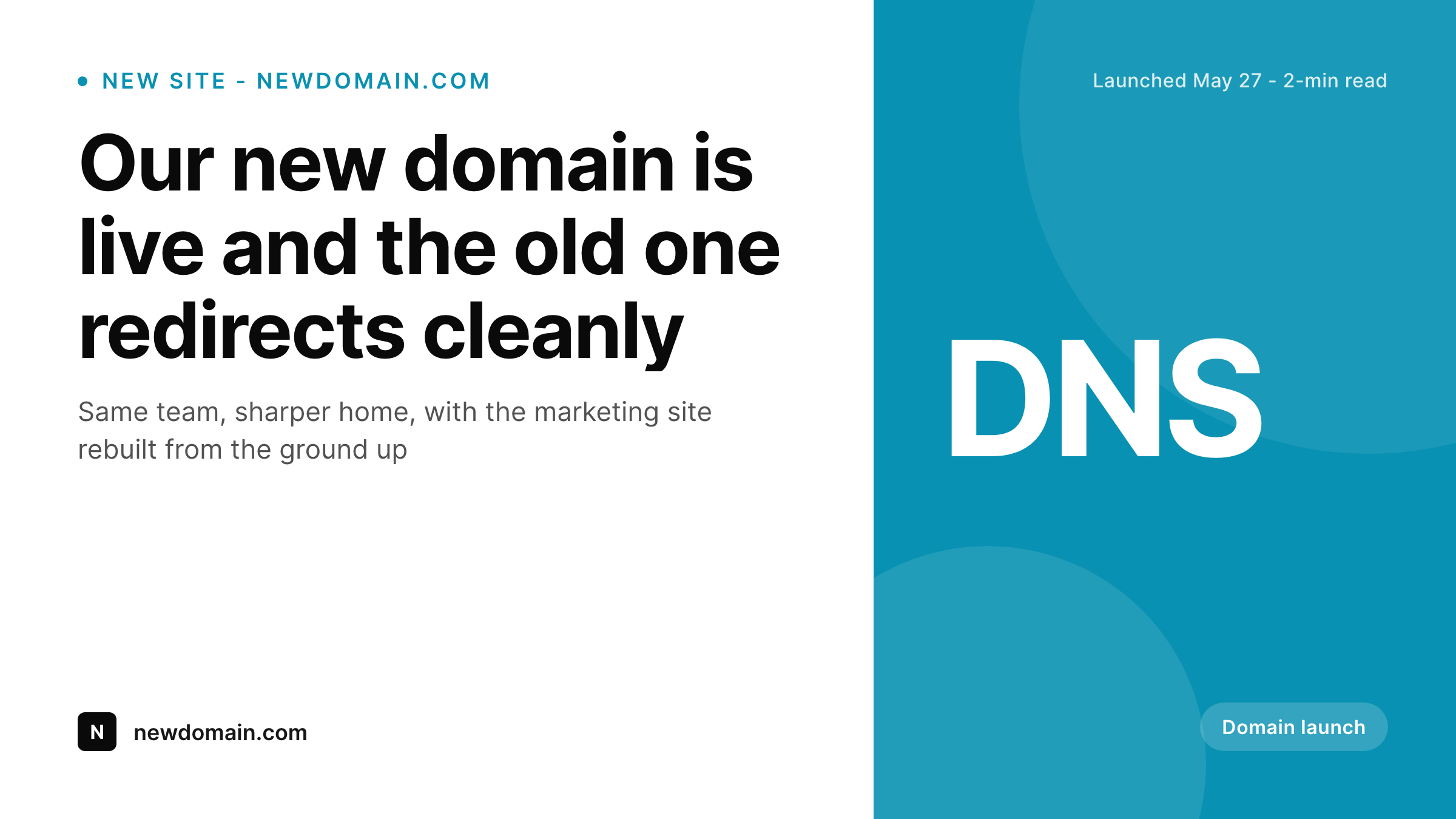
A new domain is news that has to be shareable
Domain launches happen for a few reasons. A startup outgrows its initial name, a company consolidates onto a primary domain, or a brand refresh comes with a new TLD. The post that announces the move usually explains the reasoning. The share image usually does not, because most theme defaults reuse the existing site banner for every URL on the new domain. SleekPixel handles the case with a preset that surfaces the new URL itself as part of the card.
The setup uses two custom fields: new_domain for the URL shown in the brand slot and launch_date for the footer line. The corner mark is a short DNS token by default, or whatever short code the team picks for the launch series. The accent color is a single restrained cyan or blue that signals technical news without leaning toward marketing. The card composition is square or landscape depending on the platform target.
The post body explains the move in detail: which old domains redirect, when DNS propagation completes, whether there are any legacy URLs that need updating. The card surfaces the headline data so the unfurl in Slack, LinkedIn, and Twitter does not need to be supplemented with a separate explanation. The new domain is right there in the brand slot, which is what the audience reads first.
Workflow
From migration post to launch card
1. Add domain custom fields
new_domain and launch_date as custom fields on the migration post. The fields are short strings that the template reads directly into the brand slot and footer.
2. Pick the domain launch template
new_domain into the brand slot, launch_date into the footer, and uses a calm cyan accent appropriate for technical news.
3. Publish the migration post
4. Share across channels
Output
Sample domain launch card
A Twitter card with the launch headline, a subhead naming the redirect handling, the DNS corner mark, and the new domain anchored in the brand slot.
Comparison
Default theme OG image vs SleekPixel for domain launch cards
Default theme OG image
- Reuses the homepage banner so the new domain looks like a routine product post
- Cannot show the new URL prominently, which is the entire point of the announcement
- Misses the launch date in the footer, so the audience cannot tell when the move happened
- Forces a designer to assemble a one-off graphic at the worst moment of a migration
- Risks the OG tags still pointing at the old domain's assets after the cutover
SleekPixel
-
Maps
new_domaincustom field into the brand slot on every card variant -
Renders the launch date from
launch_dateon the footer line - Uses a single accent across every launch-related card for visual continuity
- Updates the OG and Twitter tags to point at the new domain's asset path
- Composes deterministically on save with no headless browser involved
Features
What SleekPixel gives you for domain launch card
New domain in the brand slot
The brand slot is where the audience reads the URL. The domain launch preset pulls new_domain directly into that slot, so the card surfaces the new address before anyone reads the headline. That single change makes the move feel substantive rather than incidental.
Launch date in the footer
The footer renders the launch date from launch_date so readers know when DNS cutover happened. The date is structured data, not narrative, which keeps the card precise and gives the post body room to explain the migration in detail.
Redirect status in the subhead
The subhead pulls from the post excerpt, where most teams note whether the old domain redirects, which paths are preserved, and whether legacy bookmarks still work. That one line answers the most common follow-up question without requiring a click-through.
Use cases
Where domain launch cards travel
Launch-day tweets
The launch tweet pinned at the top of the team's profile surfaces the card with the new URL in the brand slot, so anyone scrolling sees the move before they read the thread.
Press release unfurls
Reporters and partners paste the announcement URL into Slack and email. The unfurl carries the SleekPixel card with the new domain visible, which makes the move read as official rather than provisional.
Team reshares
Existing teammates resharing the launch post all surface the same card. The new domain shows up consistently across multiple accounts on the same day, which reinforces the move without requiring coordination.
The bigger picture
A new domain is judged by how visible the URL becomes
Domain migrations are operational events disguised as marketing events. The team has done the work of standing up the new domain, configuring DNS, building redirects, and migrating the content. What remains is making the new URL visible to the audience, which is mostly a share-image problem.
If the OG tag still references the old domain or the share card reuses a banner that does not mention the new URL, the move becomes invisible to the audience that scrolls past without clicking through. SleekPixel makes the URL the structural feature of the card. The new domain occupies the brand slot, which is the part of the card the eye reads first after the headline.
The launch date occupies the footer, which closes the announcement with a specific moment. The post body underneath carries the migration details, the redirect map, and any caveats about legacy URLs. The three layers reinforce each other instead of duplicating effort.
Six months after the launch, when a partner looks up the company and lands on a recent post, the brand slot in the card still shows the current domain because the post field is the source of truth. There is no orphan banner that needs to be retired, no asset that lags the actual DNS state, and no design ticket that has to be filed every time the team mentions the move. That alignment between the announcement and the daily share infrastructure is what makes the launch stick, which is why SleekPixel makes it the default rather than a custom build.
Questions
Common questions about SleekPixel for domain launch card
Two fields cover the standard case: new_domain for the URL in the brand slot and launch_date for the footer line. Both are short strings, and together they answer the two most common questions about a domain move: where is the new home and when did the cutover happen.
The card prioritises the new domain to avoid keeping the old name visible after migration. If you want to acknowledge the previous domain, the post body is the right place. Some teams include a short subhead like 'moved from olddomain.com' which renders from the post excerpt.
Yes. The featured image attached by SleekPixel sits on the new domain's media library, so the OG and Twitter tags reference URLs under the new domain. Older shares may still point at the old domain's asset until you replace the URL in the post or run a migration command.
Use the subhead to communicate the redirect status, such as 'all routes redirect; bookmark refresh recommended.' The card stays accurate even during a phased migration, and the post body underneath carries the detailed redirect map for technical readers who need it.
Yes. Override the corner mark with a custom field if you prefer a short code like v2, NEW, or a year mark like '26. The field accepts any short string up to a few characters, and the layout reflows to fit the value you supply.
Yes. Each regional domain gets its own announcement post and its own card, with the new domain custom field set per locale. The German domain renders with the .de URL, the French domain with the .fr URL, and so on. The series stays visually consistent across languages.
Indefinitely. The card lives on the post, so as long as the post is published, the share image carries the new domain. Future references to the migration post pull the same card, which keeps the move recognisable to readers who arrive months or years later.
In the WordPress media library, attached to the post as the featured image. The same file powers the OG image, the Twitter image, and the RSS thumbnail, so every consumer of the post URL sees the same card without duplicate uploads in the library.
Pricing
More than 1000+
happy customers
Explore our flexible licensing options tailored to your needs. Upgrade your license anytime to access more features, or opt for a lifetime license for ongoing value, including lifetime updates and lifetime support. Our hassle-free upgrade process ensures that our platform can grow with you, starting from whichever plan you choose.
Lifetime ♾️
Most popular
EUR
once
- Unlimited websites
- Lifetime updates
- Lifetime support
...or get the Bundle Deal
and save €250 🎁
The Bundle (unlimited sites)
Pay once, own it forever
Elevate your WordPress site with our exclusive plugin bundle that includes all of our premium plugins in one package. Enjoy lifetime updates and lifetime support. Save significantly compared to buying plugins individually.
What’s included
-
SleekAI
-
SleekByte
-
SleekMotion
-
SleekPixel
-
SleekRank
-
SleekView
€749
Continue to checkoutBrowse more
- Xiaohongshu cover images
- YouTube ad thumbnails
- Threads social images
- Bandcamp release cover
- GitHub README banners
- Beacons.ai banner
- Substack post headers
- Twitch camera frame
- Fanvue page banner
- Discord server banners
- Odnoklassniki banners
- Reddit subreddit banners
- Passes page banner
- Spotify Canvas
- Ko-fi banners