






SleekPixel for rebrand cards: identity reveal shares
A rebrand is the moment when the new system has to read clearly on the very first share. SleekPixel reads the brand version, the reveal date, and the accent color from custom fields and composes a Twitter card that demonstrates the new typography and palette in the layout itself, before anyone clicks through.
♾️ Lifetime License available
A rebrand card has to be the rebrand
A rebrand reveal is the rare day when the share image is itself the announcement. The card should not show the old brand on a banner, and it should not show the new logo on the old banner. It needs to be composed in the new system, which most teams accomplish by handing a designer a brief at the worst possible moment, the morning of the reveal. SleekPixel handles the case differently. Update the SleekPixel template once with the new typography, the new accent, and the new corner-mark style, and every card across the site immediately renders in the new system. The rebrand post becomes the first card people see in the new visual language.
The reveal post uses two custom fields beyond the standard post fields: brand_version for the corner mark (v2, v3) and an optional brand_anchor for a footer URL to the brand book. The headline and subhead come from the post itself. Because the card composes from the same template that every other post will use going forward, the reveal post serves a second purpose: it documents what every future card will look like.
The rendering pipeline is the same as for every other SleekPixel card. Save the post, the PNG is composed on the server, the featured image is replaced, and the OG and Twitter tags update. The rebrand reveal carries no special infrastructure, which is why the new system can ship the same day the post does.
Workflow
From new system to reveal card in one save
1. Update the SleekPixel template
2. Add brand custom fields
brand_version and optionally brand_anchor as custom fields on the rebrand post. The version becomes the corner mark, the anchor becomes the footer URL pointing at the brand book.
3. Publish the reveal post
4. Optionally regenerate the backlog
Output
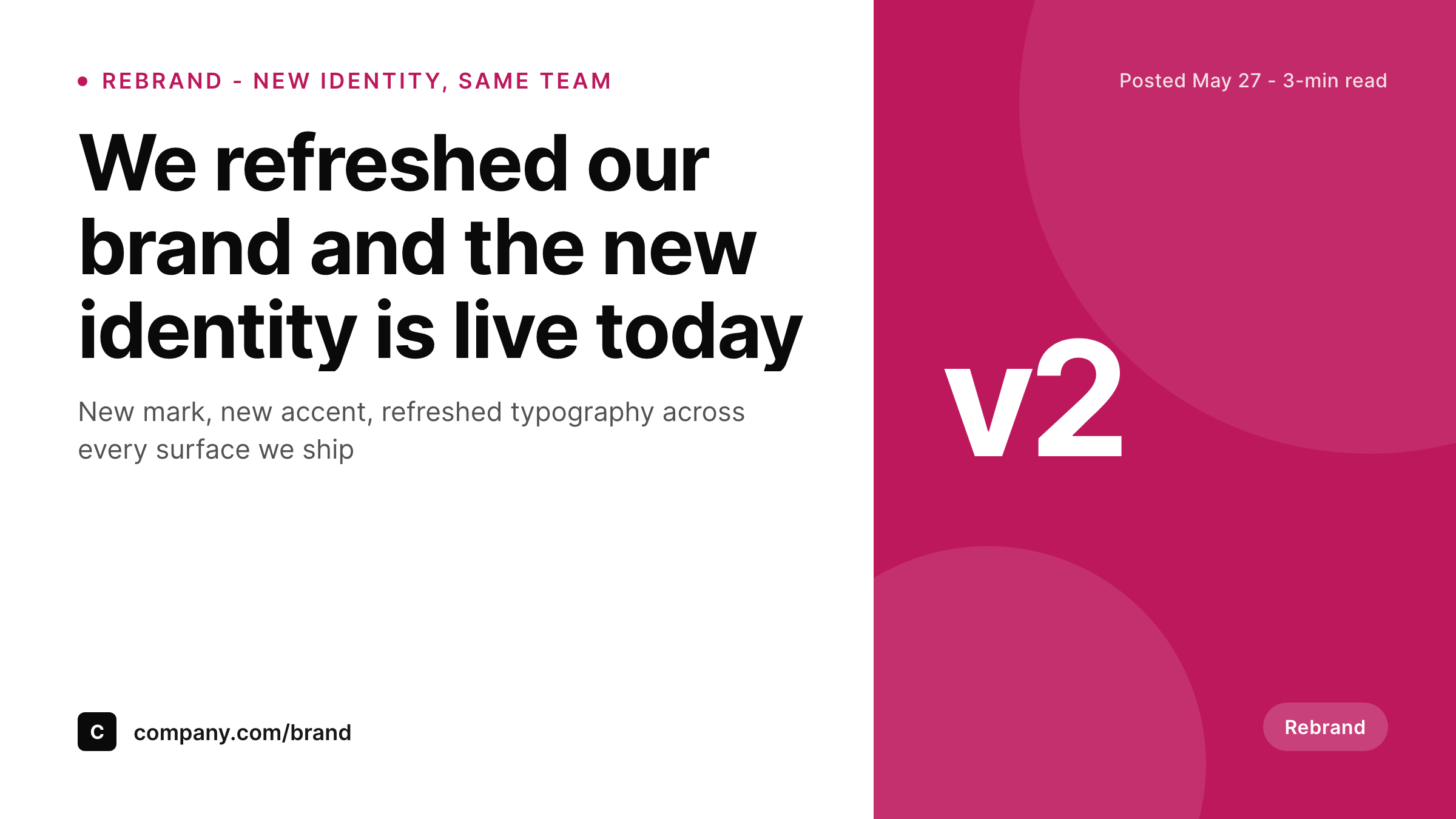
Sample rebrand reveal card
A Twitter card composed entirely in the new brand system: new headline typography, new accent, new corner mark, with the reveal date anchored in the footer line.
Comparison
Default theme OG image vs SleekPixel for rebrand cards
Default theme OG image
- Forces a one-off banner that does not match the rest of the site after the reveal
- Cannot demonstrate the new typography because text is baked into a static image
- Misses the brand version mark, so v1 and v2 reveals look interchangeable on the feed
- Requires a designer at the busiest moment of the rebrand cycle, the reveal morning
- Risks the new banner shipping while old OG images linger on cached unfurls
SleekPixel
- Composes the reveal card in the new brand system as soon as the template is updated
-
Maps
brand_versioncustom field to the corner mark asv2orv3 -
Renders an optional
brand_anchorfooter URL to the brand book or guidelines - Updates every other card across the site at the same time as the reveal post
- Stores the rendered PNG as the featured image so unfurls match the reveal exactly
Features
What SleekPixel gives you for rebrand card
Composed in the new system
The reveal card uses the new typography, the new accent, and the new corner-mark style directly, because the SleekPixel template is the source of truth for every card on the site. Updating the template once propagates the new identity across every existing post and the reveal itself.
Brand version mark in the corner
A small mark like v2 or v3 in the corner anchors the reveal in the brand's history. Future cards keep the same mark, and the next rebrand will swap to v3 at the same moment the typography and accent change.
Brand book anchor in the footer
The optional footer anchor links to a public brand book or guidelines page, so press and partners can pick up the new system the same day. The card carries the URL inline, which makes the reveal a discoverable event rather than just a tweet.
Use cases
Where rebrand cards earn the most attention
Launch-day tweet threads
The reveal tweet pinned at the top of the team's profiles surfaces the card as the first surface of the new identity, with the new accent and typography on display before anyone reads the thread.
Design press write-ups
Design publications cover rebrands when the system is interesting. The card embedded in their write-up shows the new layout in context, which makes the coverage land more accurately than a logo-only screenshot.
Team-wide reveal posts
Every team member sharing the reveal post on their own profile surfaces the same card. The new brand shows up consistently across dozens of accounts at once, which is rarely the case without a system in place.
The bigger picture
A rebrand reveal is the first user test of the new system
Rebrands fail in the first 48 hours when the new identity does not show up consistently across the surfaces people share. The website might update overnight. The social profiles get new avatars.
The press release goes out with the new mark. But the share image on the rebrand post itself is often a one-off banner that nobody updates again, which means a week later the new identity is everywhere except on the post that announced it. SleekPixel solves this by making the share image a property of the new system.
When the template updates, every card across the site renders in the new typography and accent, including the reveal post itself. There is no separate banner to maintain, no orphan asset that lingers in the OG tags after the rebrand is complete. The reveal post becomes the canonical first card in the new system, and every post published after it inherits the same layout.
Six months later, when a journalist writes a retrospective on the rebrand, the linked post still carries a card that is current with the brand because the template is still the source of truth. That is a small architectural decision with a long-running benefit: it removes the asset-management problem that derails most rebrands in their second quarter. The team can focus on the words of the reveal post, the substance of the brand book, and the systems behind the new identity, instead of chasing down banner files that need to be retired across dozens of pages.
Questions
Common questions about SleekPixel for rebrand card
Yes, as long as you update the SleekPixel template with the new typography, accent, and corner-mark style before publishing. The card is composed from the template, so the reveal post and every future post both render in the new system from the moment of the update.
It drives the corner mark on the card. Set it to v2 for the second iteration of the brand, v3 for the third, and so on. The mark anchors the card in the brand's history and gives future rebrands a clear way to differentiate their cards from the previous identity's cards.
Yes. SleekPixel ships a WP-CLI command that walks every post in your site and regenerates the featured image using the current template. After the rebrand, run the command once to bring the backlog into the new system at the same time as the reveal post.
Each platform caches OG images for a known window. After a rebrand, share the URL fresh and most platforms will refetch within hours. For pinned posts, force-refresh the platform cache via their developer tools so the new card replaces the old one immediately.
Yes. Some teams publish a teaser post a week before the full reveal. SleekPixel supports a different template per post via the sidebar toggle, so the teaser can carry the v1 system with a hint, and the reveal carries the full v2 layout. Both posts coexist cleanly.
Update the font configuration in the SleekPixel template and the cards will use the new typeface across every render. The template loads the font once on the server and caches it for every subsequent card, so performance does not degrade after the change.
Yes. The optional brand_anchor custom field renders a URL on the footer line of the card, pointing readers to the public brand book or guidelines page. The URL is rendered as plain text on the card and as a real link on the post itself.
No. The same template handles smaller refreshes like an accent shift or a typography swap, with the corner mark bumped to v1.1 or similar. The reveal pattern scales from minor evolutions to full identity overhauls without changing the underlying mechanism.
Pricing
More than 1000+
happy customers
Explore our flexible licensing options tailored to your needs. Upgrade your license anytime to access more features, or opt for a lifetime license for ongoing value, including lifetime updates and lifetime support. Our hassle-free upgrade process ensures that our platform can grow with you, starting from whichever plan you choose.
Lifetime ♾️
Most popular
EUR
once
- Unlimited websites
- Lifetime updates
- Lifetime support
...or get the Bundle Deal
and save €250 🎁
The Bundle (unlimited sites)
Pay once, own it forever
Elevate your WordPress site with our exclusive plugin bundle that includes all of our premium plugins in one package. Enjoy lifetime updates and lifetime support. Save significantly compared to buying plugins individually.
What’s included
-
SleekAI
-
SleekByte
-
SleekMotion
-
SleekPixel
-
SleekRank
-
SleekView
€749
Continue to checkout