






SleekPixel for remote first cards: distributed company posts
Declaring a remote-first policy means committing to a specific way of working. SleekPixel reads the country count, the timezone span, and the handbook anchor from custom fields and composes a LinkedIn card that signals the commitment rather than the slogan, so candidates know exactly what to expect.
♾️ Lifetime License available
Remote-first is a structure, not a marketing line
Most remote-first announcements get shared with a generic banner that says 'remote-first' in a slab serif font. That tells a candidate nothing about how the policy is implemented, where the team is, or what they should expect on day one. SleekPixel handles the case with a preset that reads the actual structure from the WordPress post: how many countries the team is in, how many timezones the working day spans, and where the public handbook lives. The card surfaces those facts, which is what candidates evaluating remote roles actually want to see.
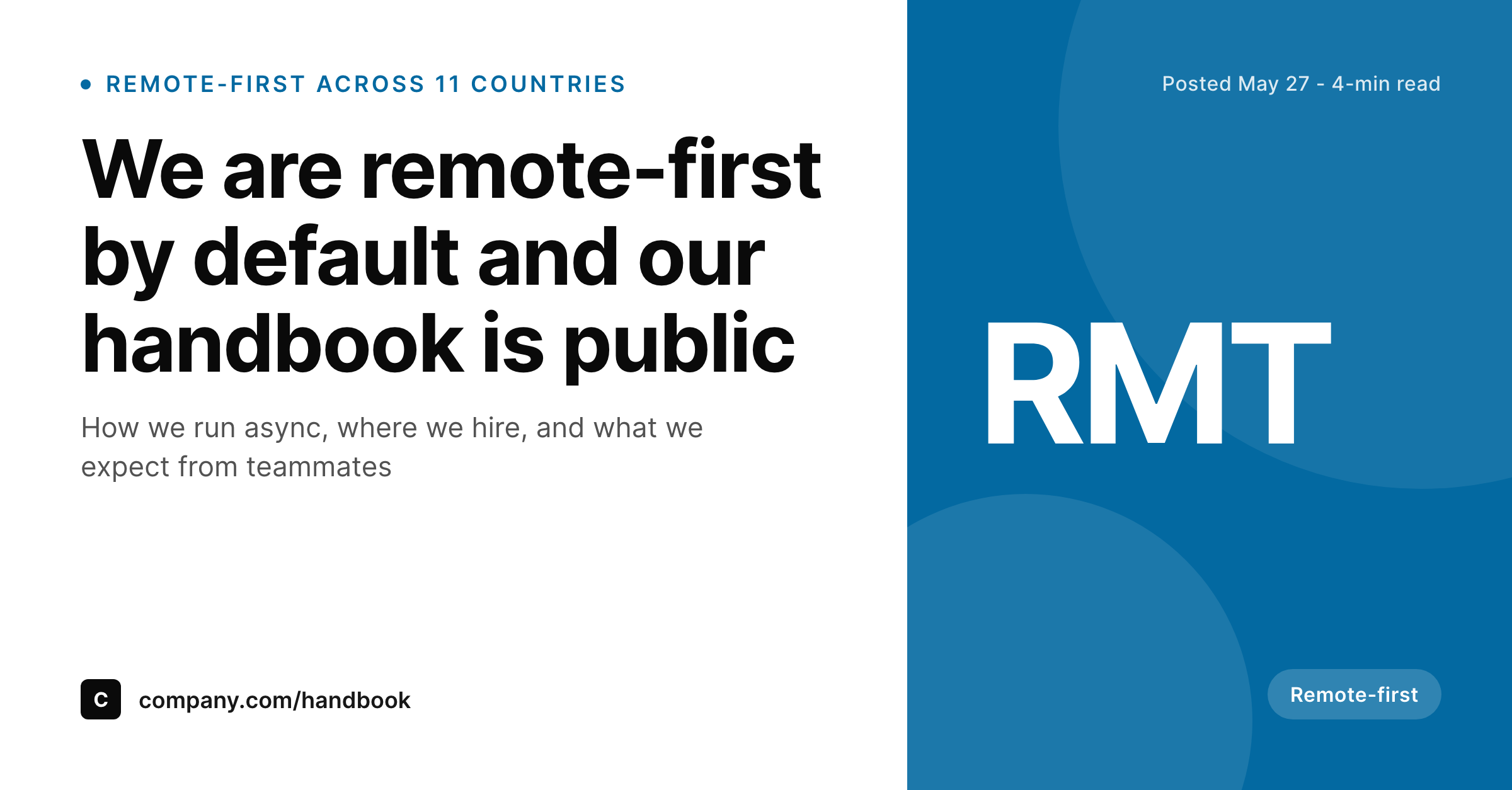
The setup uses three custom fields: countries_count, timezones_count, and handbook_url. The first two render in the subhead as a fact line. The third is a footer anchor that hints the policy is documented rather than aspirational. The accent color is restrained, the typography is calm, and the corner mark uses RMT to signal the post category at a glance.
The card is square at 1200 by 1200 so it fits LinkedIn, Instagram, and Slack equally well. Because the source fields live in the post, updating the country count when a new region opens regenerates the card automatically. There is no risk of an outdated number sitting on a recruiter's pinned post six months after the team grew past it.
Workflow
From handbook post to remote-first card
1. Add remote custom fields
countries_count, timezones_count, and handbook_url as custom fields on the policy post. The first two are short integers, the third is a relative or absolute URL that the template renders as an anchor on the footer.
2. Pick the remote-first template
RMT, and uses a calm accent color appropriate for an HR-style announcement.
3. Publish the announcement
4. Keep the fields current
Output
Sample remote-first announcement card
A LinkedIn card with the remote-first headline, a subhead showing country and timezone counts, the RMT corner mark, and a handbook anchor on the footer line.
Comparison
Default theme OG image vs SleekPixel for remote first cards
Default theme OG image
- Uses a 'remote-first' slogan banner that signals nothing about how the policy works
- Cannot show country or timezone counts, which is what candidates actually evaluate
- Misses the handbook link, so candidates cannot verify the policy from the share image
- Forces a designer to redraw the banner when the country count grows
- Treats the policy as a one-off announcement rather than an ongoing system
SleekPixel
-
Maps
countries_countandtimezones_countinto the subhead fact line -
Shows the
RMTcorner mark so the post category reads at a glance - Renders a handbook anchor on the footer to signal the policy is documented
- Regenerates automatically when the country count is updated in the post
- Composes deterministically on save with no headless browser involved
Features
What SleekPixel gives you for remote first card
Country and timezone counts
The subhead is the part of the card candidates read first when evaluating a remote role. The fact line pulls countries_count and timezones_count directly, so a card that says '11 countries, 7 timezones' is the literal current state, not a marketing claim.
Handbook anchor in the footer
Remote-first policies are credible when they are documented. The footer renders an anchor to the public handbook or remote policy page, so the card signals 'this is written down somewhere' without forcing the headline to do the work.
Auto-update on growth
When a new country opens up or a new timezone is added, edit the custom fields on the post and SleekPixel rerenders the card. The next share of the URL picks up the new numbers, so the card stays current without anyone manually rebuilding the banner.
Use cases
Where remote-first cards earn their place
Recruiter pinned posts
Recruiters pin the remote-first announcement on their LinkedIn profile. The card stays current because the post fields are updated as the team grows, instead of going stale a quarter after the original announcement.
Remote-work news roundups
Sites that aggregate remote-first companies link back to the announcement post. The unfurl carries the SleekPixel card with the country count, which makes the listing more credible than a generic logo lockup.
Outbound candidate emails
Recruiters reach out to candidates with a link to the policy post. The Slack and email unfurls show the card with the current country count, which answers the candidate's first three questions before they click.
The bigger picture
Remote-first is a credibility test for distributed talent
Candidates evaluating remote roles read announcements with a specific filter. They look for signals that the company has actually built for distributed work, not just labelled itself remote-first. A slogan banner does not carry those signals.
A card that shows the country count, the timezone span, and a link to a public handbook does, because all three facts are checkable and they tell the candidate exactly what to expect on the inside. SleekPixel makes those facts the structure of the card rather than copy points buried in the post body. The team fills in the custom fields once, the template renders them in the subhead and footer, and the card stays current as the numbers change.
That last part matters more than it sounds. A remote-first announcement that says '5 countries' six months after the team is in 11 actively undermines the credibility the post is supposed to build. A card that updates automatically when the field is edited keeps the pinned post honest.
The same template can be applied to follow-up posts that announce a new region or a new timezone block, so the series of remote posts reads as a continuous policy rather than a one-time launch. Over time the card becomes the canonical visual for the policy, and the post body becomes the place where the implementation details live. That is the right split.
Cards summarise, posts explain, and SleekPixel handles the summary automatically so the team can keep writing the explanation as it grows.
Questions
Common questions about SleekPixel for remote first card
Three fields cover the standard case: countries_count for the country total, timezones_count for the working-day span, and handbook_url for the documentation anchor. Together they answer the three questions most candidates ask when they see a remote-first card in the feed.
Yes. The subhead can render free-form text from a custom field if the country list is short, like 'NL, DE, FR, US.' For longer lists, the numeric count keeps the card readable. The template supports both modes by switching which field powers the subhead slot.
Edit the post and update the countries_count field, then save. SleekPixel rerenders the card with the new number and replaces the featured image. The next share of the URL carries the updated card after the normal platform cache window.
The card renders whatever URL you put in the field, including private pages, but the value of the anchor comes from being a public, browsable handbook. Most remote-first companies link to a Notion site or a documentation page candidates can read before applying.
Yes. Adjust the corner mark to HYB or any other short code, and reword the headline to describe the actual policy. The custom fields stay the same: country count, timezone span, and handbook anchor still apply to hybrid teams, and the card composes the same way.
The card is the featured image of the post, so it appears in the WordPress media library, the OG image tags, the Twitter image tags, and any RSS feed enclosure. Any share of the post URL surfaces the same card without manual upload anywhere along the way.
Yes. The URL is rendered as an anchor with the literal string you supply, so a German handbook at /handbuch or a French one at /manuel renders without issue. Multilingual sites with translated posts can use separate URLs per translation.
Treat the country count and timezone fields as live data. Update them whenever the team grows. Because the card is rerendered on every save, the share image is never older than the last edit to those fields, which keeps the pinned post honest indefinitely.
Pricing
More than 1000+
happy customers
Explore our flexible licensing options tailored to your needs. Upgrade your license anytime to access more features, or opt for a lifetime license for ongoing value, including lifetime updates and lifetime support. Our hassle-free upgrade process ensures that our platform can grow with you, starting from whichever plan you choose.
Lifetime ♾️
Most popular
EUR
once
- Unlimited websites
- Lifetime updates
- Lifetime support
...or get the Bundle Deal
and save €250 🎁
The Bundle (unlimited sites)
Pay once, own it forever
Elevate your WordPress site with our exclusive plugin bundle that includes all of our premium plugins in one package. Enjoy lifetime updates and lifetime support. Save significantly compared to buying plugins individually.
What’s included
-
SleekAI
-
SleekByte
-
SleekMotion
-
SleekPixel
-
SleekRank
-
SleekView
€749
Continue to checkoutBrowse more
- library of the week card
- transparency report card
- ISO certification card
- song of the day cards
- HIPAA compliance card
- longform article card
- release day cards
- sustainability report card
- quarterly update cards
- good vs bad cards
- delivery cards
- feature launch images
- weekly ship cards
- movie review cards
- do vs don't cards
- LinkedIn company banners
- kbin post images
- Klaviyo email headers
- Twitch schedule banners
- SoundCloud banner
- Pinterest shop banners
- Spotify playlist cover
- Fanvue page banner
- TikTok profile banners
- Instagram grid tiles
- Etsy listing images
- Telegram channel cover images
- TikTok Now image
- Instagram Shop product images
- Shopify product images