






SleekPixel for return to office cards: hybrid policy posts
RTO announcements are sensitive and the card has to be precise. SleekPixel reads the days per week, the effective date, and the core hours from custom fields and composes a calm LinkedIn card that signals the policy directly, so candidates and teammates do not have to guess at what is changing.
♾️ Lifetime License available
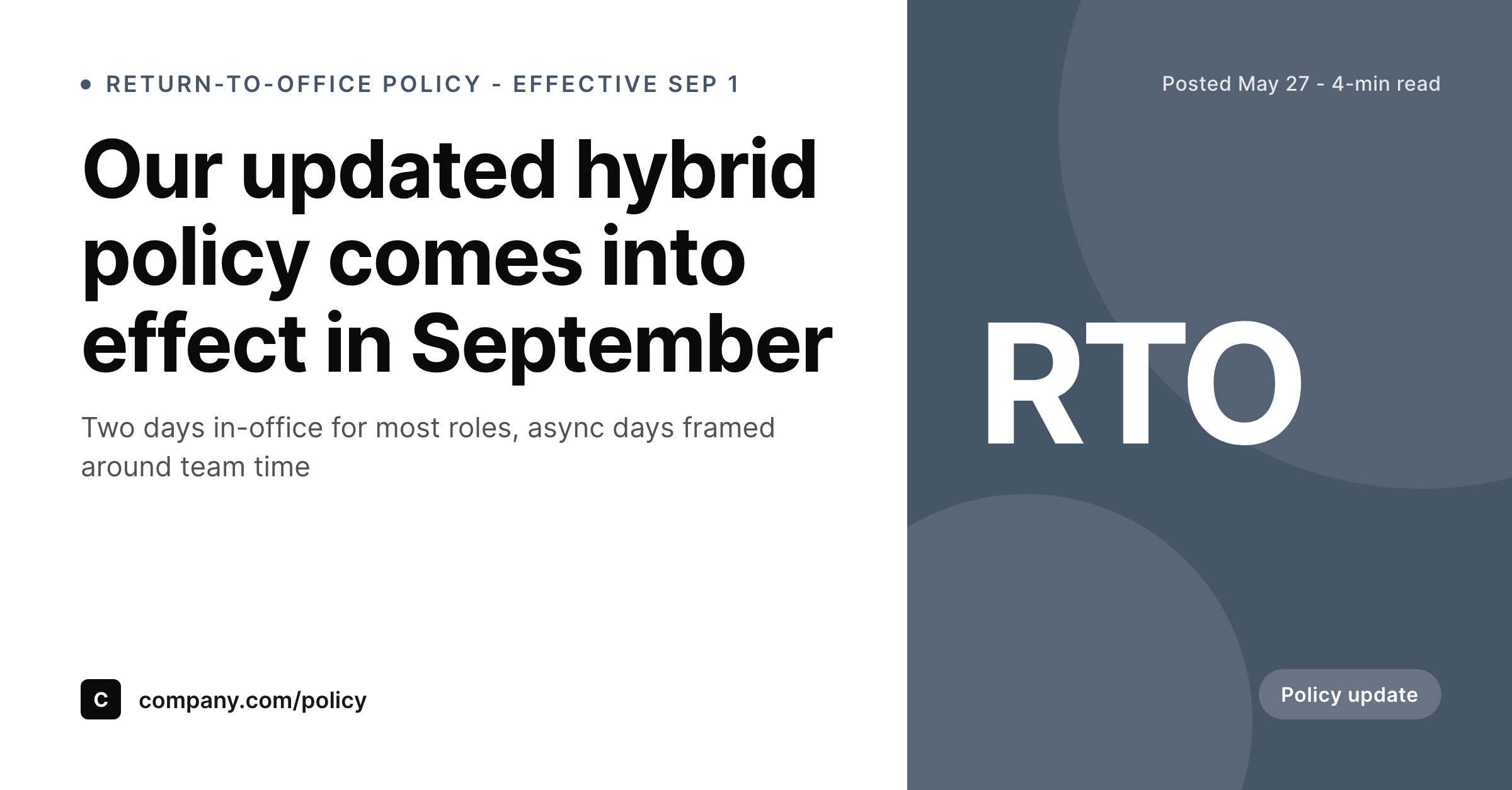
An RTO policy needs typography, not exclamation marks
Return-to-office posts are read carefully. Teammates evaluate whether the new policy is workable. Candidates evaluate whether the role is still remote-friendly. Press picks up the post if the change is significant. None of those audiences wants enthusiasm in the share image. They want the facts: how many days, when it starts, what the expectations are. SleekPixel handles the case with a preset that puts those facts in the layout instead of in the headline.
The setup uses three custom fields: days_in_office, effective_date, and core_hours. The first appears in the subhead, the second in the footer, and the third optionally on a second footer line. The corner mark is RTO so the post category is recognisable at a glance. The accent color is restrained, usually a slate or navy, to match the tone of an HR-led announcement rather than a marketing push.
Because the card lives on the policy post, updates to the policy regenerate the card. If the effective date slips by a month, edit the field and the card updates. If the days-per-week count changes from two to three, the subhead reflects the new number. The teammates and candidates who reread the post a quarter later see the current policy, not the original one.
Workflow
From policy post to RTO card
1. Add policy custom fields
days_in_office, effective_date, and optionally core_hours as custom fields on the policy post. The fields capture the core data points that drive the card and become the source of truth for the layout.
2. Pick the RTO template
RTO, and uses a calm slate or navy accent appropriate for HR-led announcements.
3. Publish the policy post
4. Keep the policy current
Output
Sample return-to-office policy card
A LinkedIn card with the policy headline, a subhead naming the days-per-week count, the RTO corner mark, and the effective date on the footer line.
Comparison
Default theme OG image vs SleekPixel for return to office cards
Default theme OG image
- Uses an enthusiastic stock photo that misreads the tone of a sensitive policy change
- Cannot show the days-per-week count, which is the entire substance of the policy
- Misses the effective date, leaving teammates unsure when the change actually starts
- Requires a designer at exactly the moment the team needs the post out quickly
- Risks reusing an old hybrid banner that no longer matches the current policy text
SleekPixel
-
Maps
days_in_officecustom field to the subhead as a clear fact line -
Shows the
RTOcorner mark so the post category reads at a glance -
Renders the effective date from
effective_dateon the footer line - Updates automatically when policy fields are edited on the post
- Uses a restrained accent appropriate for sensitive HR announcements
Features
What SleekPixel gives you for return to office card
Effective date on the footer
The footer line shows the policy effective date drawn from effective_date. Teammates and candidates can see when the change starts without reading the post body, which is the right separation for an HR announcement: the date is structured data, not narrative.
Days per week in the subhead
The subhead pulls the days-per-week count from a custom field, so the card communicates the policy core in one short fact line. Adjust the field as the policy evolves and the card stays in sync without anyone touching a graphic.
Auto-update on policy edits
When the policy is revised, edit the custom fields on the post. SleekPixel rerenders the card with the new numbers and dates so the share image never falls out of sync with the policy body, which avoids the classic case of an outdated banner sitting on a pinned post.
Use cases
Where return-to-office cards travel
Internal Slack announcements
Posting the policy URL in the company-wide Slack channel surfaces the card with the days-per-week count and the effective date, so the policy is legible before anyone clicks through to the full post body.
Candidate Q&A threads
Recruiters share the policy URL with candidates who ask about remote vs hybrid expectations. The unfurl carries the card with the structured details so the candidate answer is consistent across every recruiter.
Press coverage of policy shifts
Reporters writing about hybrid work pickup policy posts and embed them in articles. The card carries the structured fact line, which makes the policy easier to compare against other companies in the same piece.
The bigger picture
Policy posts are read for the facts, not the framing
Return-to-office is a category of post where the share image matters more than the team usually realises. Teammates skim the unfurl in Slack before reading the body. Candidates evaluate it for tone before clicking through to the careers page.
Press uses it to decide whether the policy is newsworthy. In all three cases, the audience wants the same information: how many days a week, starting when, with what flexibility. SleekPixel makes those facts the visible structure of the card.
The days-per-week count is the subhead. The effective date is the footer. The corner mark identifies the category.
There is no marketing language in the layout because there is no marketing budget in the post; this is HR communication, not a campaign. The benefit of this approach compounds when the policy evolves. Companies often soften or sharpen their RTO policy in the months after the initial announcement.
With SleekPixel, those updates are field edits, not new posts and not new banners. The original URL keeps its place on internal pages and pinned recruiter profiles, and the card on that URL stays current as the policy text below it gets revised. That is the closest thing to a single source of truth that a policy can have in a system where the share image is usually disconnected from the post body.
The card and the post stay in sync because the card is composed from the post fields, which is exactly the architecture this kind of sensitive communication needs.
Questions
Common questions about SleekPixel for return to office card
Three core fields cover most cases: days_in_office for the days-per-week count, effective_date for the policy start date, and an optional core_hours for a secondary footer line. The corner mark uses a fixed RTO string drawn from the template configuration.
Use a phase indicator in the subhead like 'phase 1 of 2' alongside the days-per-week count, or override the corner mark with a phase code like P1 for the first phase. The template accepts either approach, and a follow-up post can carry the next-phase card.
Add a scope field like policy_scope and surface it in the subhead. The card might read 'engineering and design only, two days per week,' which is clearer than a blanket statement that does not apply to support or sales. The scope field is rendered alongside the day count.
Yes. Edit the policy post, change the custom fields, and save. SleekPixel rerenders the card with the new values, and the next share of the URL picks up the updated image after the platform cache window. The pinned policy share stays current automatically.
A restrained slate or navy accent reads as an HR communication rather than a marketing push. A bright accent on a policy card can come across as enthusiasm in a context where teammates want neutrality. The SleekPixel template defaults to a calm accent, which most teams retain.
Each post has its own card because the fields differ. If you have separate posts for the European policy and the US policy, both use the same template but render different cards with different days, dates, and scope. The series stays consistent because the template is shared.
Treat the custom fields as the source of truth. Write the policy body to match the field values, not the other way around. The card carries the fields verbatim, so anything that contradicts the body will be obvious to the reader, which keeps both surfaces honest.
It lives in the media library as the featured image of the policy post. The OG and Twitter tags reference the same file, so a single attachment powers every share surface. There is no duplicate upload to manage, and no risk of the wrong image lingering in a CDN.
Pricing
More than 1000+
happy customers
Explore our flexible licensing options tailored to your needs. Upgrade your license anytime to access more features, or opt for a lifetime license for ongoing value, including lifetime updates and lifetime support. Our hassle-free upgrade process ensures that our platform can grow with you, starting from whichever plan you choose.
Lifetime ♾️
Most popular
EUR
once
- Unlimited websites
- Lifetime updates
- Lifetime support
...or get the Bundle Deal
and save €250 🎁
The Bundle (unlimited sites)
Pay once, own it forever
Elevate your WordPress site with our exclusive plugin bundle that includes all of our premium plugins in one package. Enjoy lifetime updates and lifetime support. Save significantly compared to buying plugins individually.
What’s included
-
SleekAI
-
SleekByte
-
SleekMotion
-
SleekPixel
-
SleekRank
-
SleekView
€749
Continue to checkoutBrowse more
- Instagram feed posts
- Douyin cover
- Flickr cover photo
- WeChat Moments images
- LinkedIn newsletter headers
- Instagram highlight covers
- Threads profile banners
- YouTube end screens
- KakaoTalk channel banners
- LinkedIn ad images
- Poshmark listing images
- LinkedIn showcase page banners
- Pinterest shop banners
- Twitter header banners
- LinkedIn document post covers