






SleekPixel for tech stack cards
Stack disclosure posts are one of the highest-trafficking engineering content types because every developer is curious about what other teams use in production. SleekPixel reads the stack list, the version year, and the changelog summary from your WordPress meta and renders a Twitter card that stays accurate every time the stack evolves.
♾️ Lifetime License available
Stack disclosures that stay accurate over time
Engineering stack posts are evergreen content with a short half-life. The stack evolves every quarter, but the post on the company blog tends to stay frozen because updating the share image is a design task and nobody opens Figma to swap one tool name. So the post lives on, the tweets keep flowing, and the rendered card slowly drifts from reality as the team adopts new tools.
SleekPixel ties the share image to the post content directly. Map stack_items, stack_year, changelog_summary, and updated_date to the template. When engineering edits the post to add Temporal or drop Redis, the card regenerates on save with the updated stack list rendered on the preview area and the latest update date on the meta line.
The template is sized for Twitter at 1200 by 675 because stack posts thrive on developer Twitter where the audience is most active. The same render pass also produces a 1200 by 630 OG image for the blog post itself and a 1200 by 1200 LinkedIn card for engineering-recruiting reposts. The stack list reads as a tidy logo grid in the preview area, and the brand mark carries the version year.
Workflow
How SleekPixel handles stack posts
Map the stack fields
stack_items as a repeating meta with tool name and logo, plus stack_year, changelog_summary, and updated_date. Engineering maintains this through ACF or a custom post type.
Draft when the stack settles
Publish and render
Update as the stack evolves
Output
Sample engineering stack card
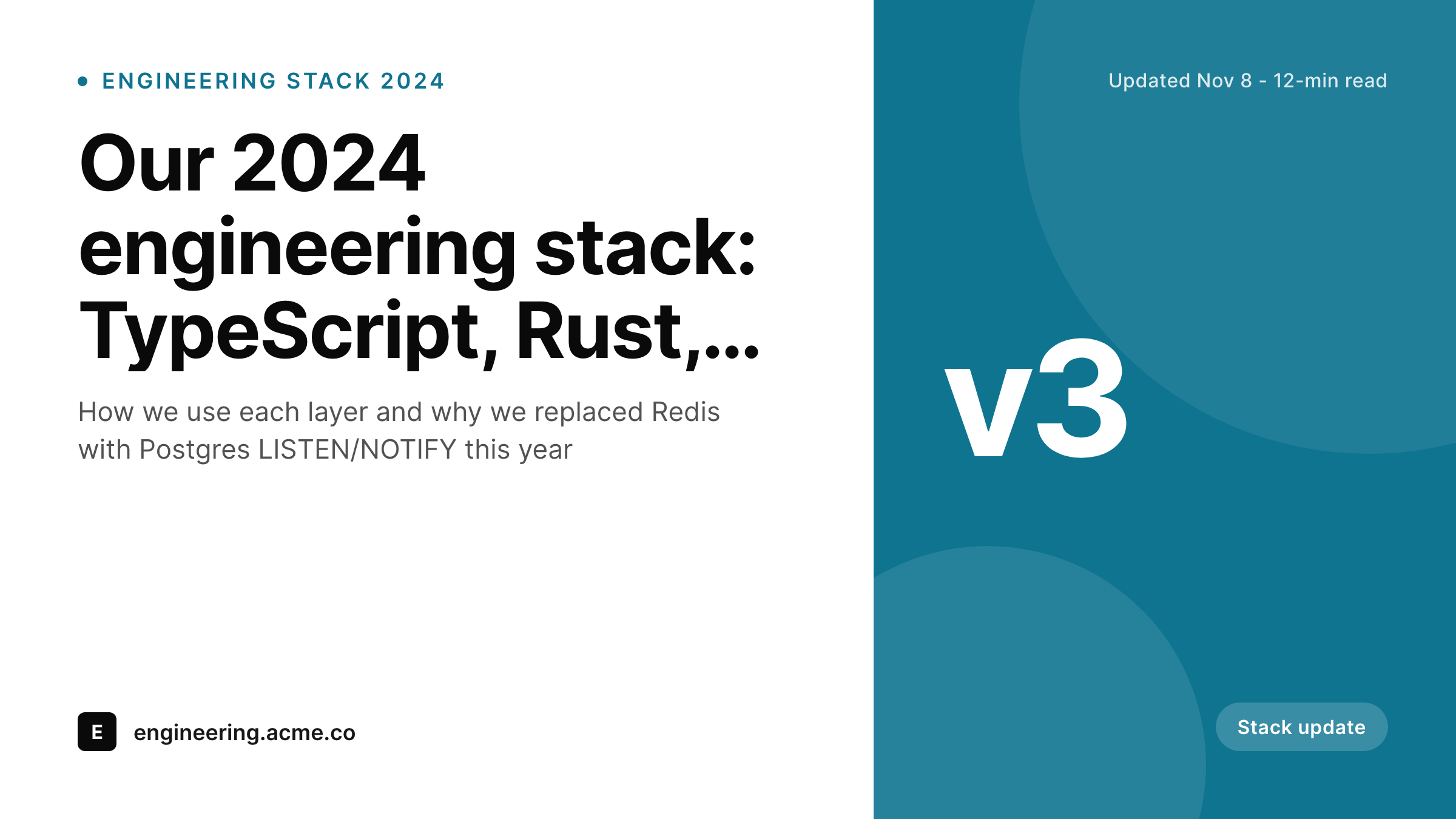
A Twitter card showing the engineering stack as a logo grid in the preview area, with the stack year on the mark and the changelog summary on the meta line.
Comparison
Default theme OG image vs SleekPixel for tech stack card
Default theme OG image
- Default themes show a featured image with no actual stack list rendered on the card
- Stack list lives in body text and never reaches the social share preview
- Version year is missing so old stack posts and new ones look identical at a glance
- Logo grid in the body uses inconsistent sizes because images are uploaded ad hoc
- Each stack update needs a fresh design export instead of regenerating from meta
SleekPixel
-
Reads
stack_items,stack_year, andchangelog_summaryfrom meta - Renders the stack as a tidy logo grid in the preview area with consistent sizing
- Emits Twitter 1200x675, OG 1200x630, and LinkedIn 1200x1200 from one definition
- Regenerates the card on save so the share image always matches the current post
- Caches the PNG so feed unfurlers serve the same file across every share
Features
What SleekPixel gives you for tech stack card
Stack list in the preview area
The point of a stack disclosure is the stack list, and the template renders it as a logo grid on the preview area. Up to eight tools fit in the default grid, with overflow handled by a +N indicator. Engineers reading the card see the tools at a glance.
Year on the mark
Stack posts repeat annually and the year is the difference between 2022 advice and 2024 advice. The template renders the year on the mark area in a compact format like v3 or '24 so the archive reads as a clean timeline of evolutions.
Regenerates when the stack changes
When engineering swaps Redis for Postgres LISTEN/NOTIFY or adopts Temporal, edit the post and update the stack meta. The card regenerates on save so the social image always reflects the current stack, not the version from when the post was first written.
Use cases
Teams that share engineering stacks from WordPress
Engineering blogs
Engineering blogs publish stack disclosures as one of their most-read post types. The template makes it easy to update the post and the share image together so the blog stays accurate without the social card drifting from reality.
Engineering recruiting
Recruiting reposts the stack card to attract developers who use those tools. With LinkedIn-sized output from the same template, recruiting gets a feed-ready asset without filing a design request for a separate version.
Annual stack-evolution archives
Engineering blogs that publish stack posts annually build an archive across years. With one template, the archive reads as a coherent visual timeline of how the stack evolved rather than disconnected posts from different design eras.
The bigger picture
Why stack disclosures drift and how a template prevents it
Stack disclosure posts are some of the longest-lived engineering content on the web because developers love comparing notes on production tooling. But the posts drift fast. Engineering swaps a tool, deprecates a service, or adopts a new orchestrator, and the blog post stays frozen because updating the share image is a design task nobody prioritizes.
The post still gets traffic, the tweets still link to it, and the rendered card slowly diverges from what the team actually uses. SleekPixel solves the drift by tying the card to the meta. The stack list lives in WordPress post meta as a repeating field of tool name and logo.
When engineering edits the post to reflect a change, the card regenerates on save. The next tweet linking the post unfurls with the current stack, not the version from when the post was first written. Over a year, that adds up.
A company that updates the stack post quarterly produces four consistent cards across the year, four consistent OG renders for any links to the post, and a press history page that shows the stack evolution as one visual story. The template also extends to retrospective posts. A 2024 stack post and a 2025 retro reading on what changed both use the same definition with different year marks.
Questions
Common questions about SleekPixel for tech stack card
Yes. Store each stack item as a repeating meta with tool name and logo file. The template renders the logos in a grid in the preview area with consistent sizing. If a logo is missing, the template falls back to a typeset tool name on the same grid slot.
Up to eight tools fit in the default 4x2 grid. For more than eight, the template shows the first eight and adds a +N indicator. The complete stack list stays in the post body, which most readers expand anyway when they click through from social.
Yes. The card regenerates during the WordPress save hook, so editing the stack meta refreshes the rendered image immediately. Cached versions on social platforms can be refreshed through their respective debuggers if the card was already shared.
Yes. Define stack categories like Frontend, Backend, Data, and Infra as separate page groups or use a category meta field. Each category renders its own card from the same template so the engineering blog can publish a series with consistent design.
Yes. Store the short changelog as changelog_summary and the template renders it on the meta line. The post body carries the full changelog with longer commentary on each change. The card itself shows the headline change for the period.
Yes. The mark area can render 2024, '24, v3, Q4, or any short string you store in the year meta. Some teams version their stack posts by quarter, others by year, and the template handles both formats with the same definition.
Yes. If your stack varies per product or per repo, use separate page groups for each one. Each repo or product has its own stack post with its own card, and the engineering blog can roll them up onto an index page that lists every stack across the company.
Yes. The first render after publish stores the PNG and serves it for subsequent requests. Editing the stack meta invalidates the cache and triggers a regeneration so the file always reflects the current state of the stack on the post.
Pricing
More than 1000+
happy customers
Explore our flexible licensing options tailored to your needs. Upgrade your license anytime to access more features, or opt for a lifetime license for ongoing value, including lifetime updates and lifetime support. Our hassle-free upgrade process ensures that our platform can grow with you, starting from whichever plan you choose.
Lifetime ♾️
Most popular
EUR
once
- Unlimited websites
- Lifetime updates
- Lifetime support
...or get the Bundle Deal
and save €250 🎁
The Bundle (unlimited sites)
Pay once, own it forever
Elevate your WordPress site with our exclusive plugin bundle that includes all of our premium plugins in one package. Enjoy lifetime updates and lifetime support. Save significantly compared to buying plugins individually.
What’s included
-
SleekAI
-
SleekByte
-
SleekMotion
-
SleekPixel
-
SleekRank
-
SleekView
€749
Continue to checkoutBrowse more
- YouTube community images
- LinkedIn event banners
- Facebook Marketplace images
- Spotify podcast covers
- TikTok profile banners
- Shopify product images
- Substack post headers
- Telegram bot avatar
- Patreon tier images
- YouTube ad thumbnails
- eBay listing images
- Snapchat Discover tiles
- Flickr cover photo
- podcast cover art
- Fansly banner